

What Is the Connection Between Learning Styles and Student Concentration?
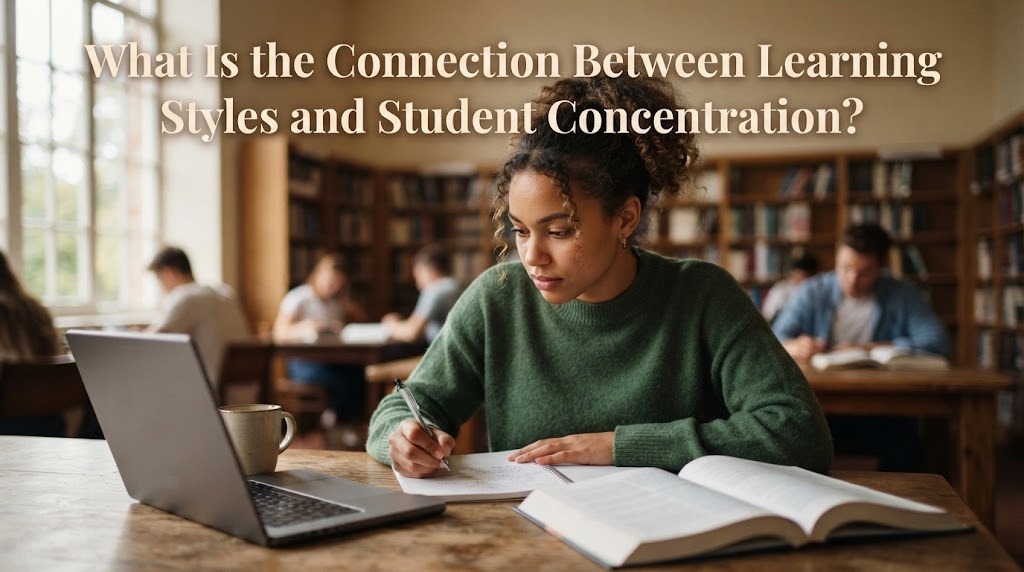
Every student has a different way of processing information during learning. Some students may feel more engaged when they use visual materials, while others may prefer discussion, reading, writing, or practical activities. Understanding these preferences can help students choose study strategies that make learning more comfortable and active.
Student concentration is also influenced by many factors, such as sleep, stress, motivation, study environment, and the difficulty of the material. Therefore, learning style is not the only factor that determines concentration. However, using suitable learning strategies may help students stay engaged with the learning process.
HOW LEARNING STYLES CAN AFFECT CONCENTRATION
A suitable learning approach can make students feel more involved in the learning process. When the learning activity matches the task and the student's preferences, it may become easier to maintain attention. For example, a student who enjoys visual information may find diagrams, charts, and illustrations useful when studying complex concepts.
However, this does not mean that students can concentrate only through one specific learning style. Concentration depends on several factors, and students can develop their ability to focus through different learning activities. The important point is to find strategies that encourage active participation and reduce unnecessary distractions.
VISUAL LEARNING AND STUDENT FOCUS
Visual materials can help some students organize information in a clear and structured way. Mind maps, diagrams, charts, images, and highlighted notes can make relationships between ideas easier to understand. These tools may also help students maintain attention when the material contains many concepts or details.
Students who benefit from visual materials can combine them with active study techniques. For example, they can create a mind map after reading a chapter and then explain the main points without looking at their notes. This combination can make the learning process more active instead of simply looking at information.
AUDITORY LEARNING AND CONCENTRATION
Some students find spoken explanations useful when learning new information. Listening to a lecturer, joining a discussion, explaining a concept aloud, or using educational audio materials can make studying more interactive. These activities may help students maintain attention because they involve active listening and processing.
Students can also use self-explanation to strengthen concentration. After reading a topic, they can explain the main idea aloud using their own words. This method encourages them to process the information instead of simply reading it repeatedly.
READING AND WRITING FOR BETTER ATTENTION
Reading and writing activities can help students who prefer working with written information. Taking short notes, summarizing important points, and writing questions can keep the mind engaged with the material. Writing also encourages students to identify the main ideas instead of copying every sentence.
To improve concentration, students should avoid making notes that are unnecessarily long. Short summaries, keywords, and important concepts are often easier to review. After writing the summary, students can test their understanding by answering questions without checking their notes.
PRACTICAL LEARNING AND ACTIVE CONCENTRATION
Practical activities can be useful when students need to understand how a concept works in real situations. Experiments, simulations, projects, demonstrations, and practice exercises can make learning more active. This type of activity may help students maintain attention because they are directly involved in the task.
Practical learning can also connect theory with real experience. For example, students may understand a business concept more clearly after applying it to a simple case study. The more actively students participate, the more opportunities they have to process and apply what they have learned.
COMBINING DIFFERENT LEARNING METHODS
Students do not have to rely on only one learning method. Combining several strategies can make learning more flexible and suitable for different types of material. A student can read a chapter, create a visual summary, discuss the topic, and then complete practice questions.
This approach can also prevent learning sessions from becoming repetitive. Changing activities can provide different ways to process the same information. The best combination depends on the subject, learning goal, available time, and individual needs.
OTHER FACTORS THAT AFFECT CONCENTRATION
Learning style is only one part of the learning process. Poor sleep, stress, hunger, excessive screen use, noise, and an uncomfortable study environment can make concentration more difficult. Students should consider these factors before assuming that their learning method is the main problem.
A regular study schedule can also support concentration. Students should take appropriate breaks, maintain healthy sleep habits, organize their study space, and reduce unnecessary distractions. These habits can work together with effective learning strategies to create a better learning experience.
HOW TO FIND THE BEST STRATEGY FOR YOU
Students can identify useful learning strategies by trying different methods and observing the results. After each study session, consider whether you understood the material, stayed focused, and remembered the main points afterward. This simple reflection can help identify strategies that are genuinely useful.
It is also important to adjust the method according to the subject. Reading may be useful for understanding theory, while practice may be more suitable for developing technical skills. Instead of searching for one permanent learning style, students can build a flexible set of strategies for different learning situations.
CONCLUSION
The connection between learning styles and student concentration is related to how students engage with information and choose suitable study strategies. Visual materials, discussion, reading, writing, and practical activities can support concentration when they are used appropriately. However, learning style is not the only factor that affects attention.
Sleep, stress, motivation, environment, and study habits also play important roles. Students can improve their concentration by combining different learning strategies, reducing distractions, taking regular breaks, and adapting their approach to each subject. A flexible learning strategy can help students stay engaged and understand academic material more effectively.
Recent Posts

Bagaimana Sistem SKS pada Program Kuliah... 22.11.2026/21 View

How Does Technology Make Daily Evaluation... 21.11.2026/63 View

Apa Strategi Menghadapi Kesenjangan antara Kompetensi... 21.11.2026/65 View

Mengapa Inventaris Aset Penting bagi Kelancaran... 21.11.2026/62 View

When Should Musicians Join a Record... 21.11.2026/59 View
