

What Is the Difference Between a Memo and an Official Letter?
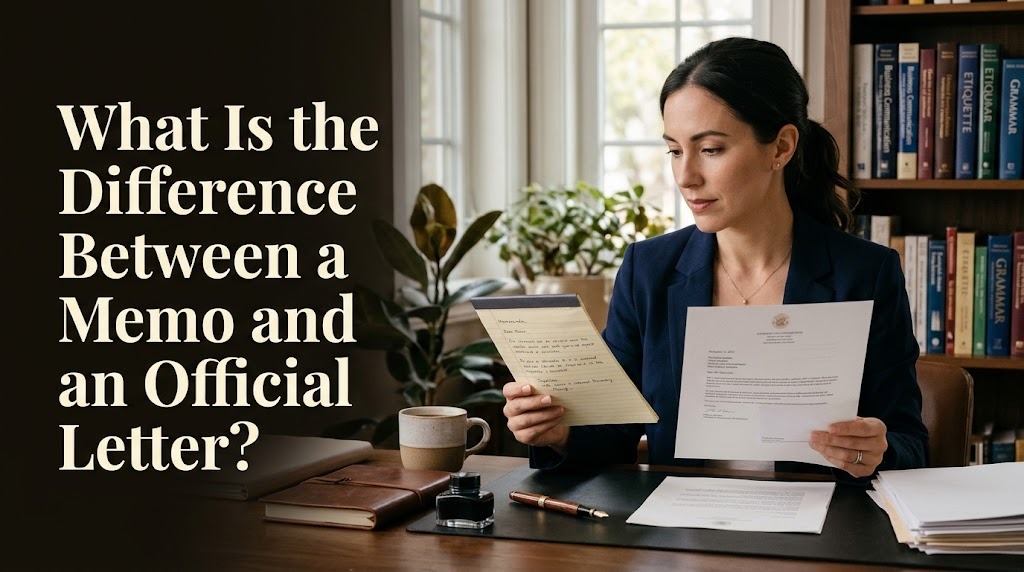
In the corporate, academic, and governmental sectors, selecting the appropriate communication instrument is vital for maintaining administrative efficiency, legal compliance, and organizational hierarchy. Professionals continuously handle various written documents to convey decisions, announce policy shifts, and execute operational requests. Two of the most foundational formal written instruments used in daily business routines are memos and official business letters. Although both documents serve to convey essential messages in a structured manner, they cater to distinctly different audiences, follow different layout protocols, and carry different legal weights.
Failing to distinguish when to deploy a memo versus an official letter can lead to administrative confusion, breaches of protocol, and a loss of professional authority. A memo is specifically designed for internal communication within an organization, whereas an official letter is built for external correspondence with third parties. Recognizing these fundamental distinctions enables professionals to maintain institutional standards, preserve public brand integrity, and streamline internal workflow efficiency across all organizational levels.
TARGET AUDIENCE AND DIRECTION OF COMMUNICATION FLOW
The primary distinction between a memo and an official letter lies in the intended audience and the direction of the communication flow. A memo, short for memorandum, is strictly an internal document created for colleagues, managers, subordinate staff, or other departments within the same parent organization. Because all parties share a common institutional context, memos focus on operational speed, team alignment, and internal collaboration.
An official letter, on the other hand, is designed for external stakeholders, such as clients, vendors, regulators, government bodies, legal partners, or job applicants. Because external recipients do not share internal institutional context or internal office acronyms, an official letter requires a comprehensive, formal tone that represents the organization's public brand. The document acts as an official diplomatic bridge between two separate legal entities.
STRUCTURAL LAYOUT AND VISUAL PRESENTATION
The visual layout and structural components of memos and official letters differ significantly due to their distinct operational roles and delivery mechanisms. A memo uses a streamlined header block at the top of the page that contains standard fields such as recipient, sender, date, and subject. It omits formal salutations, polite opening pleasantries, and complimentary closes, allowing the reader to access the core message immediately.
In contrast, an official letter follows a traditional corporate layout that includes a formal letterhead, recipient inside address block, formal salutation, comprehensive body paragraphs, and a formal sign-off phrase like sincerely or respectfully yours. Official letters almost always require a physical signature or certified digital seal to authenticate origin, whereas memos are authenticated through sender initials in the header block or internal routing numbers.
PURPOSE, LENGTH, AND CONTENT COMPREHENSION
Memos and official letters also fulfill different functions regarding information depth, documentation retention, and detail density. A memo typically addresses a single, highly focused internal topic—such as a policy update, meeting announcement, equipment upgrade, or project status report—and is kept brief, direct, and actionable. It serves as an immediate operational tool that creates an internal paper trail for management tracking.
Conversely, official letters often deal with broader topics, contractual agreements, formal inquiries, dispute resolutions, sales proposals, or legally binding external notices. They require detailed context, formal background evidence, and complete narrative explanations to protect the issuing party's legal standing. Consequently, official letters are archived as primary legal records between distinct organizations.
TONAL DIFFERENCES AND FORMALITY LEVELS
The tone adopted in a memo reflects internal efficiency and shared organizational goals. While remaining professional and respectful, a memo is direct and to the point. It uses active voice and clear directives without needing to establish external rapport or soft introductory remarks, saving time for busy internal teams.
An official letter maintains a higher level of formal etiquette, diplomatic courtesy, and brand-aligned voice. Every sentence in an official letter is crafted to project authority, reliability, and goodwill to external entities. The language avoids internal office jargon and focuses on establishing clear, legally sound, and professional relationships.
LEGAL WEIGHT AND ARCHIVAL PROCEDURES
From a legal and administrative perspective, official letters carry direct legal weight as formal correspondence between independent legal entities. They can be introduced in court proceedings, contract audits, or regulatory reviews as primary evidence of notice, agreement, or demand. Consequently, official letters undergo rigorous review procedures before release.
Memos, while legally discoverable during corporate audits, primarily function as internal operational logs. They record internal decision-making processes, management directives, and staff notifications. Both documents are archived systematically, but official letters are categorized under external legal records, whereas memos are managed under internal operational files.
CONCLUSION
Understanding the difference between a memo and an official letter is essential for effective organizational communication. Using memos for internal team updates and official letters for external stakeholder engagement preserves administrative hierarchy, maintains brand professionalism, and prevents operational misunderstandings. Mastering both instruments ensures that your messaging achieves its intended impact clearly, authoritatively, and efficiently across all professional settings.
Recent Posts

Bagaimana Sistem SKS pada Program Kuliah... 22.11.2026/53 View

How Does Technology Make Daily Evaluation... 21.11.2026/82 View

Apa Strategi Menghadapi Kesenjangan antara Kompetensi... 21.11.2026/81 View

Mengapa Inventaris Aset Penting bagi Kelancaran... 21.11.2026/77 View

When Should Musicians Join a Record... 21.11.2026/82 View
