

What Is the Difference Between a Professional Accountant and a Bookkeeper?
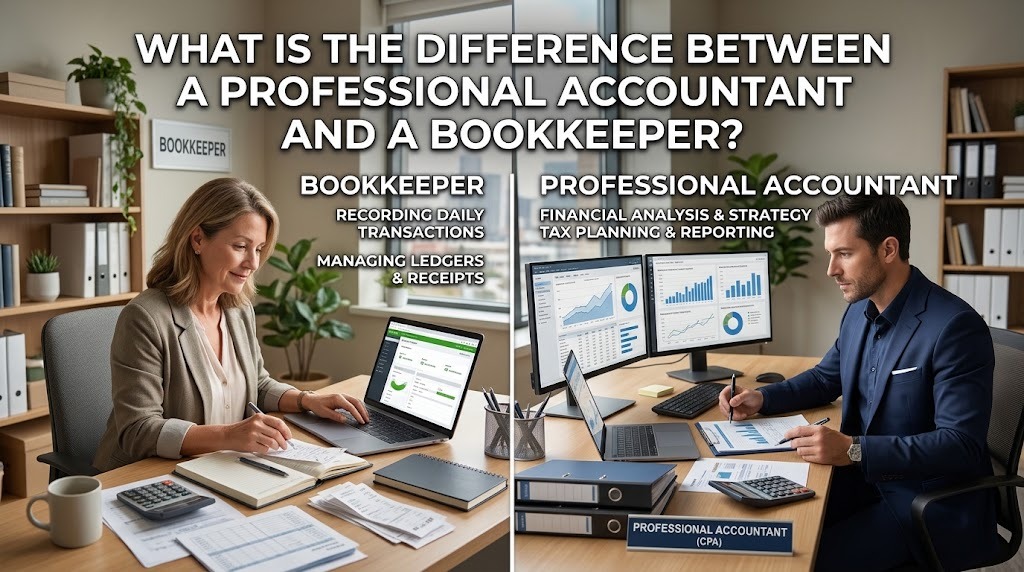
Understanding the distinct roles of a professional accountant and a bookkeeper is essential for optimizing corporate financial management and administrative workflows. While both professions work closely with financial records, their scope of work, educational requirements, and strategic value differ significantly. Bookkeeping is primarily administrative and transactional, focusing on systematic data entry, logging daily receipts, and organizing source documents. Conversely, professional accounting is analytical and advisory, extracting actionable strategic intelligence from aggregated financial records. Recognizing where bookkeeping ends and accounting begins enables business owners to assign financial responsibilities effectively across their organizations.
Deploying both roles appropriately ensures that a business maintains meticulous daily transaction tracking while gaining high-level strategic financial direction. A bookkeeper maintains the structural ledger framework that captures every incoming and outgoing dollar accurately. The accountant then utilizes this organized dataset to evaluate corporate profitability, manage enterprise risks, and ensure full regulatory compliance. Neither role can operate effectively in a vacuum; they complement each other to form a complete financial management ecosystem. Investing in both disciplined bookkeeping and expert accounting safeguards an enterprise's long-term commercial health and operational stability.
WHAT ARE THE CORE RESPONSIBILITIES OF A BOOKKEEPER?
The primary focus of a bookkeeper revolves around maintaining consistent, accurate, and organized day-to-day transactional data within the general ledger. Their routine duties include issuing customer invoices, logging vendor bills, tracking accounts receivable, and processing routine employee payroll disbursements. They perform regular bank reconciliation to verify that recorded ledger balances align precisely with official commercial bank statements. Bookkeepers ensure that every physical receipt, invoice, and payment voucher is categorized systematically according to the company’s chart of accounts. Their detailed work prevents transactional backlogs and protects against unrecorded business expenses.
Additionally, bookkeepers manage daily cash logs and maintain preliminary single-entry or double-entry record-keeping systems. They ensure that source documentation is filed securely for future internal reviews and external statutory audits. While modern cloud software automates much of this routine data entry, human oversight remains necessary to categorize complex transactions correctly. Bookkeepers provide the clean, verified raw data that accountants rely upon to execute higher-level financial analysis. Without consistent, high-quality bookkeeping, accurate financial reporting and strategic planning become nearly impossible. Disciplined daily record-keeping serves as the administrative engine of every commercial enterprise.
WHAT ARE THE STRATEGIC DUTIES OF A PROFESSIONAL ACCOUNTANT?
A certified accounting practitioner operates at a higher analytical tier, transforming basic transactional data into strategic insights that guide executive management decisions. Their core responsibilities include analyzing corporate performance, designing internal control systems, and preparing comprehensive financial statements, such as balance sheets and cash flow reports. They evaluate operating profit margins, perform variance analysis against corporate budgets, and model predictive financial scenarios. Furthermore, accountants ensure full statutory tax compliance, designing strategies to optimize tax liabilities legally while avoiding government penalties. Their focus extends beyond recording past numbers to shaping future corporate direction.
In addition, professional accountants conduct internal audits, evaluate corporate capital allocation structures, and oversee risk management frameworks. They advise executive leadership on capital investments, mergers, acquisitions, and cost-reduction initiatives across operational departments. When commercial regulations change, accountants update internal corporate policies to guarantee continuous alignment with statutory frameworks and international reporting standards. Their technical expertise provides commercial lenders, investors, and regulatory bodies with full confidence in a company's published financial reports. Strategic accounting transforms raw numerical data into a competitive commercial advantage.
HOW DO EDUCATIONAL AND CERTIFICATION REQUIREMENTS DIFFER?
The educational pathways and professional credentials required for these two career fields represent another fundamental difference between them. Becoming a qualified bookkeeper typically requires a high school diploma, specialized vocational training, or short certification courses in basic bookkeeping software. Bookkeepers generally do not require formal university degrees or state licenses to handle routine corporate record-keeping tasks. Their expertise is built primarily through hands-on administrative experience, attention to detail, and practical software mastery. This lower barrier to entry allows individuals to enter the administrative workforce quickly.
In sharp contrast, becoming a professional accountant requires completing a rigorous four-year bachelor’s degree in accounting or corporate finance. To achieve elite status, accountants must pass comprehensive professional board examinations to earn credentials like the certified public accountant (CPA) or Chartered Accountant (CA) designation. Earning these prestigious credentials mandates hundreds of hours of advanced study, verified professional work experience, and strict adherence to ethics codes. Certified accountants possess the exclusive legal authority to conduct statutory external audits, sign official financial filings, and represent clients during government tax audits. Higher educational standards guarantee advanced technical competence.
HOW DO BOOKKEEPING AND ACCOUNTING IMPACT BUSINESS DECISION-MAKING?
The operational impact of bookkeeping is tactical and immediate, ensuring that daily cash flows, bill payments, and client collections move smoothly without disruption. Accurate bookkeeping prevents cash flow bottlenecks by flagging past-due customer invoices and ensuring supplier bills are paid on schedule. It provides managers with real-time visibility into immediate liquid cash balances and daily operational expenditures. By keeping transactional data organized and current, bookkeeping ensures that daily business activities remain orderly and administrative errors are caught early. Tactical record-keeping keeps the daily engine of commerce running efficiently.
On the other hand, the impact of professional accounting is strategic and long-term, driving high-level resource allocation, investment decisions, and corporate expansion strategies. Accountants interpret multi-year financial trends to evaluate whether expanding product lines, entering new geographic markets, or hiring additional staff is commercially viable. They model alternative financial scenarios to help executive boards navigate economic downturns and volatile market conditions safely. Through rigorous financial accounting, accountants provide the objective analysis needed to secure commercial bank loans, attract equity investors, and maximize shareholder value. Strategic accounting turns historical ledger data into future enterprise growth.
WHEN SHOULD A GROWING BUSINESS HIRE AN ACCOUNTANT VERSUS A BOOKKEEPER?
For early-stage startups and small businesses with low transaction volumes, hiring a skilled bookkeeper is often sufficient to establish basic transaction tracking and invoicing. In the initial phase, the primary goal is ensuring that expenses are categorized properly and receipts are filed for annual tax preparation. As transaction volume increases, outsourcing daily record-keeping to a dedicated bookkeeper keeps operational overhead manageable. However, relying solely on a bookkeeper becomes risky as business operations expand in scale, structural complexity, and regulatory exposure. Knowing when to transition from basic tracking to expert analysis is crucial for sustainable scaling.
A growing company must onboard a professional accountant when it faces complex tax regulations, requires audited financial reports for lenders, or seeks external investment capital. Companies reaching higher revenue thresholds require an accountant to establish robust internal controls, optimize working capital, and design tax minimization strategies. Many expanding businesses adopt a hybrid approach, using a bookkeeper for daily transaction management while consulting an accountant monthly or quarterly for strategic oversight. Combining both functions ensures that administrative tasks are handled cost-effectively while high-level strategic direction is fully preserved. Strategic staffing supports long-term enterprise scalability.
CONCLUSION
While a bookkeeper focuses on daily transactional entry and routine bank reconciliation, a professional accountant provides strategic analysis, prepares accurate financial statements, maintains strict tax compliance, and holds certified public accountant credentials to drive long-term business growth.
Recent Posts

Bagaimana Sistem SKS pada Program Kuliah... 22.11.2026/53 View

How Does Technology Make Daily Evaluation... 21.11.2026/82 View

Apa Strategi Menghadapi Kesenjangan antara Kompetensi... 21.11.2026/81 View

Mengapa Inventaris Aset Penting bagi Kelancaran... 21.11.2026/77 View

When Should Musicians Join a Record... 21.11.2026/82 View
