

What Is the Difference Between a Radio Announcer and a Television Presenter?
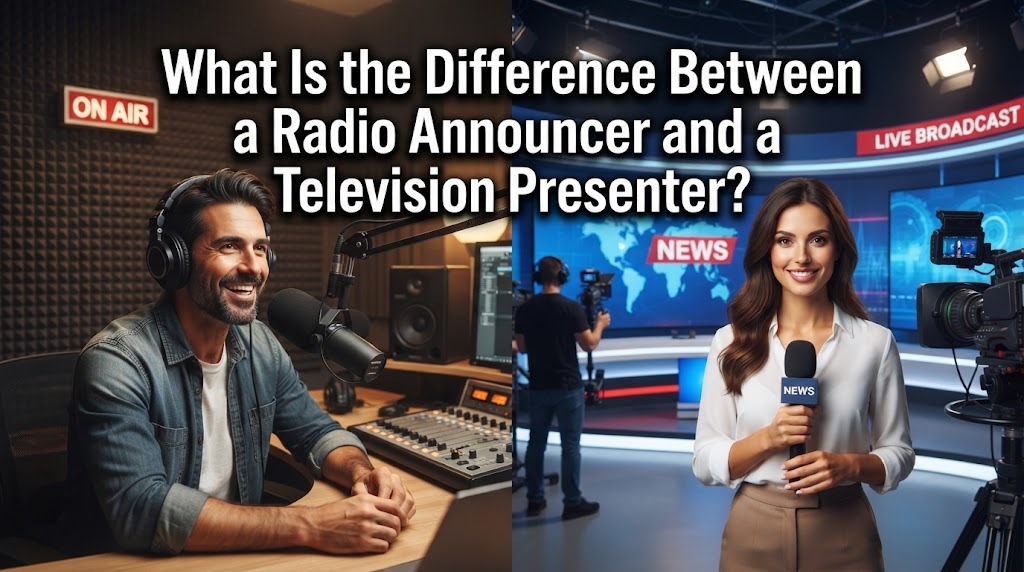
Radio announcers and television presenters are both important figures in broadcasting, but they work in different environments and use different communication techniques. A radio announcer communicates mainly through sound, while a television presenter combines speech with facial expressions, body language, appearance, and visual elements. These differences influence the skills, preparation, and responsibilities required for each profession.
Understanding the difference between a radio announcer and a television presenter can help people who are interested in broadcasting choose a career path that matches their abilities and interests. Although both professions require confidence and strong communication skills, their daily work can be quite different.
MAIN DIFFERENCE BETWEEN RADIO AND TELEVISION
The main difference is the way information reaches the audience. A radio announcer depends almost entirely on voice and sound to communicate ideas, emotions, news, entertainment, and other information. Because listeners cannot see the announcer, the voice must be clear, expressive, and easy to understand. A television presenter, on the other hand, communicates through both spoken words and visual presentation.
Television presenters can use facial expressions, gestures, posture, clothing, graphics, demonstrations, and other visual elements to support their message. Radio announcers need to create a mental picture through words and vocal expression. This makes both professions communication-based, but the techniques used to communicate effectively are not exactly the same.
ROLE OF A RADIO ANNOUNCER
A radio announcer is responsible for presenting audio content to listeners. Their duties can include introducing songs, delivering information, hosting discussions, conducting interviews, reading advertisements, and interacting with listeners. Depending on the program, an announcer may also provide news updates, entertainment, educational content, or public information.
Because radio is primarily an audio medium, announcers need strong voice control and pronunciation. They must make their delivery sound natural while maintaining an appropriate pace and tone. They also need to keep the audience interested without relying on visual elements. This requires creativity, storytelling ability, and effective use of the voice.
ROLE OF A TELEVISION PRESENTER
A television presenter introduces and explains content in front of a camera. Their work can involve news programs, talk shows, entertainment programs, competitions, educational broadcasts, lifestyle programs, and other television formats. Presenters may communicate directly with viewers or interact with guests and other presenters in a studio or outside location.
Television presenters need to manage both their speech and their visual appearance. Facial expressions, eye contact with the camera, gestures, posture, and movement can influence how viewers understand the presentation. They must also be comfortable working with cameras, studio equipment, directors, producers, and production crews.
IMPORTANCE OF VOICE AND VISUAL PRESENTATION
Voice is particularly important for radio announcers because it is their primary communication tool. They need to control pronunciation, volume, pitch, rhythm, and pauses to make their delivery understandable and engaging. A strong radio voice does not necessarily mean having a naturally deep or distinctive voice. More importantly, the announcer should be able to control their voice and communicate effectively.
Television presenters also need good vocal skills, but their visual presentation adds another layer to communication. A presenter can use facial expressions or gestures to reinforce emotions and meaning. For example, a serious topic may require a calm expression and professional posture. Therefore, television presenters need to coordinate their spoken communication with their visual behavior.
TECHNICAL SKILLS REQUIRED
Radio announcers generally need to understand basic audio and studio equipment. They may work with microphones, headphones, audio mixers, playback systems, recording software, and digital broadcasting platforms. Understanding these tools helps them respond to technical situations and maintain smooth broadcasts. Some radio announcers may also participate in podcasting and online streaming.
Television presenters need a broader understanding of camera-based production. They may need to follow camera directions, teleprompter instructions, studio cues, lighting arrangements, and movement directions. They do not necessarily operate the technical equipment themselves, but understanding how television production works helps them perform effectively as part of a production team.
PREPARATION BEFORE BROADCASTING
Both professionals need preparation, but the process can differ depending on the program. Radio announcers may prepare scripts, talking points, music schedules, interview questions, advertisements, and audience interaction topics. They often need to be ready to speak naturally rather than simply reading every word from a script.
Television presenters may have to prepare scripts while also considering camera positions, visual materials, demonstrations, guest interactions, and studio movement. They may participate in rehearsals before a program is broadcast. Preparation is important because television production usually involves several people and technical elements working together at the same time.
AUDIENCE INTERACTION
Radio announcers often have direct interaction with listeners through phone calls, text messages, social media, and online platforms. This interaction can make radio programs feel personal and conversational. Announcers may respond to questions, read listener messages, conduct contests, or discuss topics suggested by the audience.
Television presenters can also interact with audiences, particularly through live programs and social media. However, traditional television interaction is often more dependent on the program format and production structure. Presenters may communicate with viewers while also managing interactions with guests, co-hosts, and production staff.
SKILLS THAT BOTH PROFESSIONS NEED
Despite their differences, radio announcers and television presenters share many important skills. Both need strong communication abilities, confidence, preparation, professionalism, and the ability to think quickly. They must understand their audience and adjust their communication style to suit the program. Good listening skills are also important, especially when conducting interviews or working with other people.
Both professions also benefit from creativity and adaptability. Broadcasting can involve unexpected technical issues, changes in schedules, or unplanned situations. Professionals who can remain calm and respond appropriately can maintain the quality of a program. Continuous learning is also valuable as broadcasting increasingly connects with digital platforms and social media.
CAREER OPPORTUNITIES IN BROADCASTING
Experience as a radio announcer or television presenter can lead to various career opportunities in the media industry. Radio professionals may develop careers in podcasting, voice-over work, audio production, digital content, or broadcast management. Their communication skills can also be useful in areas such as event hosting and public speaking.
Television presenters can develop careers in news, entertainment, digital video, hosting, content creation, and other media-related fields. Some professionals work across several platforms instead of focusing on traditional television or radio alone. As media consumption becomes increasingly digital, broadcasting skills can be applied to streaming platforms, podcasts, social media videos, and online programs.
CONCLUSION
The difference between a radio announcer and a television presenter mainly comes from how they communicate with their audiences. Radio announcers rely heavily on voice, sound, storytelling, and vocal expression, while television presenters combine spoken communication with facial expressions, body language, appearance, cameras, and visual elements.
Both careers require confidence, communication skills, professionalism, creativity, and adaptability. People interested in broadcasting should consider which environment suits their strengths while also developing skills that can be used across different media platforms.
Recent Posts

Bagaimana Sistem SKS pada Program Kuliah... 22.11.2026/35 View

How Does Technology Make Daily Evaluation... 21.11.2026/69 View

Apa Strategi Menghadapi Kesenjangan antara Kompetensi... 21.11.2026/69 View

Mengapa Inventaris Aset Penting bagi Kelancaran... 21.11.2026/67 View

When Should Musicians Join a Record... 21.11.2026/68 View
