

What Is the Difference Between a Village Tourism Awareness Group and a Professional Tourism Management Team?
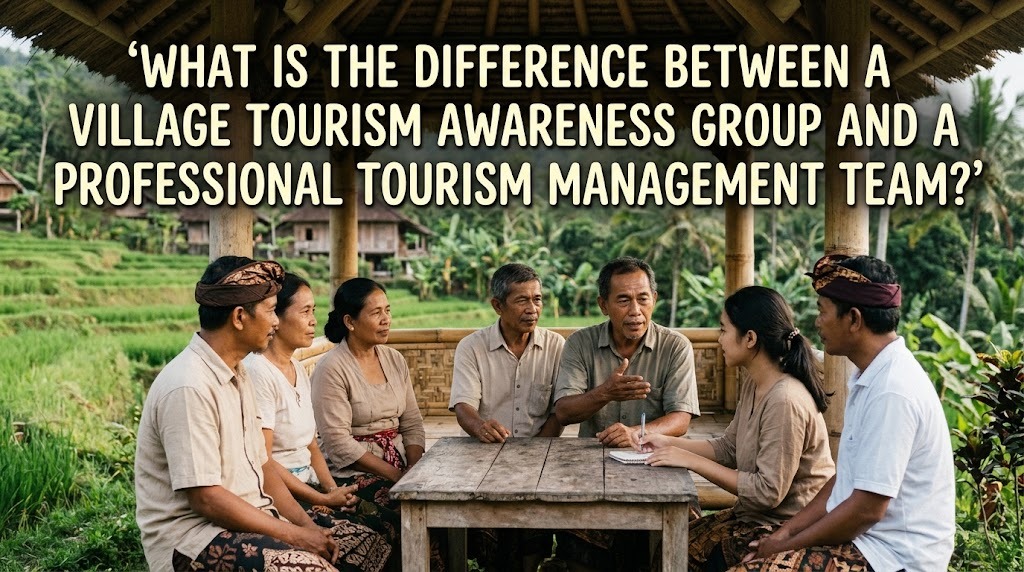
Tourism development requires good organization, effective management, and cooperation among different stakeholders. In village tourism destinations, two groups that may contribute to these activities are Village Tourism Awareness Groups and professional tourism management teams. Although both are involved in developing and managing tourism destinations, they have different responsibilities, working approaches, and organizational structures. Village Tourism Awareness Groups generally focus on community participation and tourism awareness, while professional management teams emphasize operational performance and service quality. Understanding these differences helps communities determine how both groups can work together to create successful and sustainable tourism destinations.
UNDERSTANDING VILLAGE TOURISM AWARENESS GROUPS
A Village Tourism Awareness Group, commonly known as Pokdarwis in Indonesia, is a community-based organization established to encourage local residents to participate in tourism development. Its members usually consist of people who live in the village and have an interest in promoting local attractions. They work together to identify tourism potential, maintain environmental cleanliness, introduce cultural heritage, and encourage positive attitudes toward visitors. Their activities are closely connected to community empowerment and local development.
The group also serves as a bridge between residents, village governments, and other tourism stakeholders. It can organize tourism awareness campaigns, community activities, promotional programs, and training sessions. Unlike organizations that focus mainly on commercial operations, its primary objective is to build community involvement and improve the local tourism environment. Therefore, community participation becomes one of its most important foundations.
UNDERSTANDING PROFESSIONAL TOURISM MANAGEMENT TEAMS
A professional tourism management team is an organization or group of individuals responsible for operating a tourism destination using structured management practices and specialized skills. Its members may include destination managers, marketing specialists, financial administrators, customer service staff, operational supervisors, and tourism professionals. Each person generally has specific duties based on their expertise and organizational responsibilities. This structure helps ensure that tourism activities operate efficiently and consistently.
Professional teams usually focus on daily operations, service standards, financial performance, visitor satisfaction, and business development. They may manage ticket sales, accommodation services, tourism packages, employee schedules, maintenance, and promotional campaigns. Their performance is often evaluated through operational targets and financial results. Professional tourism management emphasizes efficiency, accountability, and the quality of services provided to visitors.
DIFFERENCES IN OBJECTIVES AND MAIN RESPONSIBILITIES
One of the main differences between these two groups is their primary purpose. Village Tourism Awareness Groups focus on encouraging residents to recognize tourism potential and participate in destination development. Their responsibilities include promoting tourism awareness, protecting local resources, preserving cultural traditions, and building cooperation among community members. Their success is often reflected in stronger community involvement and improvements in local tourism conditions.
Professional tourism management teams, on the other hand, concentrate on managing tourism operations and delivering services effectively. Their responsibilities may include managing employees, preparing operational budgets, organizing visitor services, monitoring revenue, and maintaining business standards. Although both groups contribute to tourism development, their priorities are not always the same. Community empowerment is central to tourism awareness groups, while operational performance is generally more important for professional management teams.
DIFFERENCES IN ORGANIZATIONAL STRUCTURE AND HUMAN RESOURCES
Village Tourism Awareness Groups usually have organizational structures based on community participation. Members may come from different backgrounds, including farmers, young people, local business owners, cultural practitioners, and community leaders. Many members participate voluntarily or carry out tourism responsibilities alongside their regular occupations. This structure allows local residents to contribute their knowledge and experience directly to tourism development.
Professional tourism management teams generally have more formal organizational structures with clearly defined positions and responsibilities. Members may be recruited according to their qualifications, experience, and specific technical skills. They may also receive salaries or other forms of compensation for their work. This arrangement supports consistent operations and clearer performance evaluation. Human resource management therefore differs according to each group's objectives, resources, and organizational needs.
DIFFERENCES IN FUNDING AND MANAGEMENT APPROACHES
Funding is another important factor that distinguishes the two organizations. Village Tourism Awareness Groups may obtain financial support from village governments, community contributions, tourism activities, partnerships, and development assistance programs. Their financial resources are often limited, so they need to prioritize activities according to community needs. Transparency and collective decision-making are important to maintain residents' trust.
Professional tourism management teams may operate using business revenue, investment, management contracts, or institutional budgets. Their financial decisions often focus on operational efficiency, service improvements, and business sustainability. They may also use more detailed financial reporting systems and performance indicators. Although both organizations need responsible financial management, their approaches differ according to their funding sources and management objectives. Financial management helps ensure that tourism activities can continue and develop effectively.
HOW BOTH GROUPS CAN WORK TOGETHER IN TOURISM DEVELOPMENT
Village Tourism Awareness Groups and professional tourism management teams do not necessarily need to work separately. In fact, cooperation between them can improve destination development because each group has different strengths. Community-based organizations understand local culture, traditions, natural resources, and residents' expectations. Professional teams can contribute technical knowledge, operational experience, marketing skills, and service management expertise.
For example, a Village Tourism Awareness Group can help identify local attractions and encourage residents to participate in tourism activities. A professional management team can then assist with organizing visitor services, developing tourism packages, improving service standards, and managing daily operations. Both groups should communicate regularly and involve village governments when making important decisions. Through strategic cooperation, tourism destinations can combine community interests with professional management practices to achieve more balanced development.
CONCLUSION
Village Tourism Awareness Groups and professional tourism management teams have different but complementary roles in tourism development. Village Tourism Awareness Groups emphasize community participation, local empowerment, cultural preservation, and tourism awareness. Professional management teams focus more on operational efficiency, service quality, financial performance, and business development. Although their responsibilities differ, cooperation between them can create stronger and more sustainable tourism destinations. Ultimately, combining community participation with professional management helps ensure that tourism development benefits local residents while providing positive experiences for visitors.
Recent Posts

Bagaimana Sistem SKS pada Program Kuliah... 22.11.2026/37 View

How Does Technology Make Daily Evaluation... 21.11.2026/70 View

Apa Strategi Menghadapi Kesenjangan antara Kompetensi... 21.11.2026/73 View

Mengapa Inventaris Aset Penting bagi Kelancaran... 21.11.2026/68 View

When Should Musicians Join a Record... 21.11.2026/71 View
