

What Is the Difference Between an Academic Portal and a Student Information System?
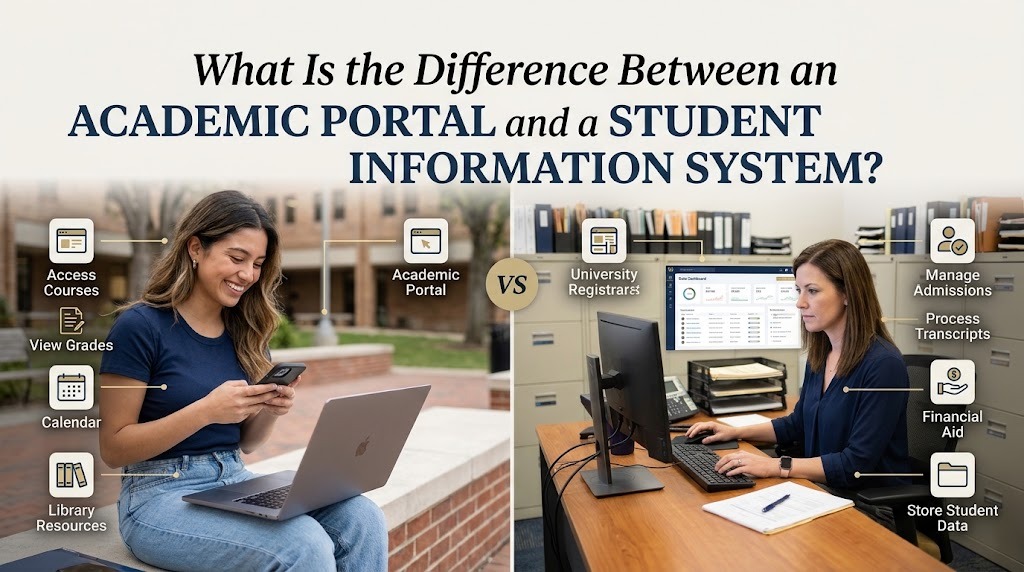
Universities use digital technology to manage academic activities, student records, and administrative services. Two terms that often appear in this context are academic portal and Student Information System (SIS). Although these systems may provide similar features, they can serve different purposes within a university's digital environment.
Understanding the difference between an academic portal and a Student Information System helps students, lecturers, and university staff recognize how academic information is managed and accessed. The exact distinction depends on the institution because some universities combine both functions into a single platform, while others use separate systems that exchange information.
UNDERSTANDING THE PURPOSE OF AN ACADEMIC PORTAL
An academic portal is a digital access point that allows users to view information and use academic services through an online interface. Students may use it to check class schedules, review grades, register for courses, and read university announcements. Lecturers may also use portal features to access teaching schedules or manage certain academic activities.
The main purpose of an academic portal is to make information and services accessible to authorized users. It provides a convenient interface through which users can interact with university systems. Depending on its design, the portal may connect to several databases or applications rather than storing every piece of information directly within the portal itself.
UNDERSTANDING THE PURPOSE OF A STUDENT INFORMATION SYSTEM
A Student Information System (SIS) is a system designed to manage student-related data and administrative processes. It may handle information such as student identities, enrollment records, course registrations, academic progress, and graduation status. Authorized university staff use this information to support administrative operations and maintain student records.
An SIS can also support processes such as course allocation, academic reporting, and the management of student information throughout the university's academic cycle. The system helps institutions organize records and make relevant information available to authorized users. Depending on the university's technology, an SIS may operate behind the scenes and supply information to an academic portal or other campus applications.
COMPARING THEIR MAIN FUNCTIONS
The primary difference between an academic portal and an SIS is often the role each plays in delivering and managing information. An academic portal focuses on providing users with access to services and information, while an SIS focuses on maintaining student records and supporting related administrative processes. However, these functions can overlap when a university integrates them into one system.
For example, a student may log in to an academic portal to register for a course or view a grade. The portal provides the interface, while an integrated SIS may process the registration or supply the academic record displayed on the screen. In some institutions, these actions occur within a single application, so users may not notice any separation between the systems.
EXAMINING USER ACCESS AND DATA MANAGEMENT
An academic portal is generally designed around the needs of its users. Students may see their own schedules and grades, lecturers may access teaching-related features, and administrative staff may use services appropriate to their responsibilities. The interface presents relevant information according to each user's permissions.
A Student Information System, meanwhile, focuses more directly on the organization and management of student data. It may support record updates, enrollment processing, and administrative reporting. Access must be controlled carefully because student records can contain personal and academic information. Both systems therefore require suitable security measures, although the specific controls depend on the university's implementation.
UNDERSTANDING HOW THE TWO SYSTEMS WORK TOGETHER
Many universities use an academic portal and an SIS as connected components of a broader university information system. The portal can serve as the main point of access for students and lecturers, while the SIS manages relevant records and administrative processes. Integration allows information to move between systems so users can complete tasks without manually repeating every step.
For instance, after a student registers for a course through the portal, the registration information may be processed or recorded in the SIS. The updated enrollment status can then appear in the portal. The exact workflow varies by institution, and some universities combine both functions into one platform rather than maintaining separate applications. Understanding this relationship helps users recognize that the visible portal may be only one part of the university's digital infrastructure.
CONCLUSION
The difference between an academic portal and a Student Information System generally lies in their primary functions. An academic portal provides an interface for accessing academic information and services, while an SIS manages student records and supports administrative processes related to enrollment, academic progress, and other student information.
However, the distinction is not universal because universities may integrate both functions into a single application. Students and staff should therefore refer to their institution's documentation to understand how its systems operate. When properly integrated and maintained, these technologies can help universities organize academic information and deliver services more efficiently.
Recent Posts

Bagaimana Sistem SKS pada Program Kuliah... 22.11.2026/57 View

How Does Technology Make Daily Evaluation... 21.11.2026/86 View

Apa Strategi Menghadapi Kesenjangan antara Kompetensi... 21.11.2026/84 View

Mengapa Inventaris Aset Penting bagi Kelancaran... 21.11.2026/82 View

When Should Musicians Join a Record... 21.11.2026/86 View
