

What Is The Difference Between Applied Research And Basic Research?
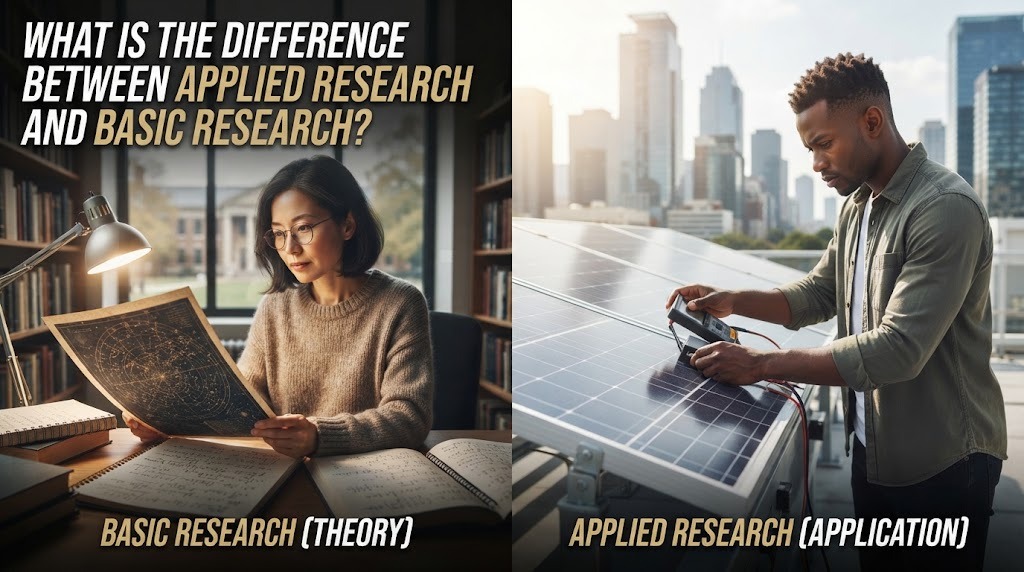
Research plays an important role in expanding knowledge, solving problems, and improving people's lives. In education, healthcare, technology, and business, researchers investigate questions to understand the world and develop better solutions. However, not all research has the same purpose. Applied research focuses on solving specific practical problems, while basic research aims to expand knowledge and improve understanding of fundamental concepts. Understanding the difference between these two approaches helps students, researchers, and organizations choose the right research method for their goals.
WHAT IS APPLIED RESEARCH?
Applied research is a systematic investigation designed to solve a specific problem or address a practical need. Researchers use scientific knowledge, data collection, experiments, and analysis to develop solutions that can be applied in real-world situations. This type of research is common in healthcare, education, agriculture, engineering, and business. For example, researchers may investigate how to improve student learning outcomes or develop a more effective method of preventing a particular disease. The main goal is to produce practical results that can improve existing conditions.
Applied research often begins with a problem that affects individuals, organizations, or communities. Researchers identify the causes of the problem, examine possible solutions, and evaluate whether those solutions work effectively. For instance, a company may study customer complaints to improve product quality and service. Similarly, agricultural researchers may test irrigation methods to help farmers use water more efficiently. These examples show how applied research connects scientific knowledge with practical action.
WHAT IS BASIC RESEARCH?
Basic research, also called fundamental or pure research, aims to increase knowledge and understand how things work. Instead of focusing primarily on solving an immediate practical problem, researchers investigate fundamental principles, patterns, and relationships. They may study natural processes, human behavior, physical laws, or biological systems to answer important scientific questions. For example, scientists may investigate how memory works in the human brain without developing a specific educational product. The main purpose is to expand scientific understanding and build a foundation for future discoveries.
Basic research is important because many technological and medical advances begin with discoveries that initially have no direct commercial application. Researchers may explore how certain cells function or how materials behave under different conditions. Although these studies may not produce immediate solutions, their findings can later support the development of medicines, technologies, and new research methods. Basic research also helps scientists develop theories and identify questions for further investigation. Therefore, basic research creates knowledge that can support future innovation and applied studies.
THE MAIN DIFFERENCES BETWEEN APPLIED RESEARCH AND BASIC RESEARCH
The main difference between applied research and basic research is their primary purpose. Applied research seeks to solve a specific practical problem, whereas basic research aims to improve general understanding. Their research questions often reflect these different goals. Applied research may ask how to reduce traffic congestion in a city, while basic research may investigate how human attention influences driving behavior. Both approaches use systematic investigation, but they focus on different outcomes.
Another difference involves how researchers evaluate the usefulness of their findings. Applied research often measures success through practical outcomes, such as improved performance, lower costs, or better health services. Basic research is commonly evaluated through the quality of its evidence, the knowledge it contributes, and its ability to explain fundamental processes. However, basic research can also lead to practical applications, and applied research can reveal new scientific questions. The distinction is mainly about the research objective, not whether the findings can eventually be useful.
DIFFERENCES IN RESEARCH METHODS AND APPROACHES
Applied research and basic research can use similar methods, including experiments, surveys, interviews, observations, and statistical analysis. The choice of method depends on the research question rather than whether the study is applied or basic. However, applied research often includes testing or evaluating a potential solution under practical conditions. For example, researchers may compare two teaching methods to determine which one helps students understand a topic more effectively. Their findings can guide teachers in improving classroom activities.
Basic research, on the other hand, often investigates underlying mechanisms or relationships to develop a deeper understanding of a subject. A scientist may conduct controlled experiments to examine how a particular chemical reaction occurs. The results may help explain a scientific process without immediately producing a product or service. Nevertheless, basic research can also involve field observations and real-world data, while applied research can include theoretical analysis. Both approaches require reliable evidence, suitable methods, and careful interpretation of results.
EXAMPLES OF APPLIED RESEARCH AND BASIC RESEARCH
Examples make the differences between these two research approaches easier to understand. In healthcare, basic research may investigate how a virus interacts with human cells to understand how infection develops. Applied research may use scientific knowledge to test a vaccine, improve diagnostic methods, or evaluate a disease prevention program. In education, basic research may examine how people acquire and retain information, while applied research may test a learning strategy designed to improve students' academic performance. These examples demonstrate how basic research builds understanding and applied research addresses practical needs.
The same distinction appears in technology and agriculture. A basic research project may investigate the physical properties of a new material, while applied research may test whether that material can improve battery performance. In agriculture, basic research may study how plants respond to different environmental conditions, whereas applied research may identify the most effective irrigation method for a particular crop. In business, basic research might explore general patterns in human decision-making, while applied research may use customer data to improve a company's marketing strategy. Although their objectives differ, both forms of research can contribute to progress across many fields.
HOW BASIC RESEARCH AND APPLIED RESEARCH WORK TOGETHER
Basic research and applied research are not competing approaches because they often support each other. Basic research provides scientific knowledge that researchers can use to develop practical solutions. Applied research, in turn, may reveal new problems or unexpected results that require further fundamental investigation. This relationship creates a continuous process in which knowledge leads to innovation and practical challenges inspire new scientific questions. Cooperation between both research approaches can strengthen scientific and technological development.
For example, fundamental studies of electricity and semiconductor materials contributed to the scientific knowledge behind modern electronic devices. Engineers and applied researchers later used this knowledge to develop and improve computers, smartphones, and other technologies. Similarly, basic studies of biological processes can provide insights that support medical research and the development of treatments. Not every basic discovery leads directly to an application, and not every practical solution requires a new fundamental discovery. However, long-term scientific progress often benefits from a combination of knowledge creation and practical problem-solving.
WHEN SHOULD RESEARCHERS CHOOSE EACH APPROACH?
Researchers should choose a research approach based on the purpose of their investigation. Applied research is suitable when a clear practical problem needs to be addressed and the findings are intended to support a decision, improve a process, or evaluate a solution. For example, a school that wants to reduce student absenteeism may investigate the reasons for absence and test suitable intervention programs. Businesses may also use applied research to understand customer needs or improve operational efficiency. In these situations, the focus is on finding evidence that can guide practical action.
Basic research is more appropriate when the main objective is to understand a concept, discover a fundamental relationship, or explain how a process works. A researcher studying how the brain processes language, for instance, may seek to expand scientific knowledge without targeting an immediate product or intervention. Some projects may combine both approaches, especially when fundamental questions and practical needs overlap. Researchers should consider the research question, available resources, ethical requirements, and expected contribution before making their choice. Selecting the appropriate approach helps ensure that the research methods and outcomes match the study's objectives.
CONCLUSION
The difference between applied research and basic research lies mainly in their purposes. Applied research focuses on solving specific real-world problems, while basic research seeks to expand knowledge and explain fundamental principles. Although they may use similar research methods, their objectives and expected outcomes can differ. Basic research can provide the foundation for future discoveries, while applied research can turn scientific knowledge into practical solutions. Ultimately, both approaches are essential for scientific progress, technological innovation, and improvements in society.
Recent Posts

Bagaimana Sistem SKS pada Program Kuliah... 22.11.2026/43 View

How Does Technology Make Daily Evaluation... 21.11.2026/72 View

Apa Strategi Menghadapi Kesenjangan antara Kompetensi... 21.11.2026/74 View

Mengapa Inventaris Aset Penting bagi Kelancaran... 21.11.2026/70 View

When Should Musicians Join a Record... 21.11.2026/74 View
