

What Is the Difference Between Arithmetic and Physiological Population Density?
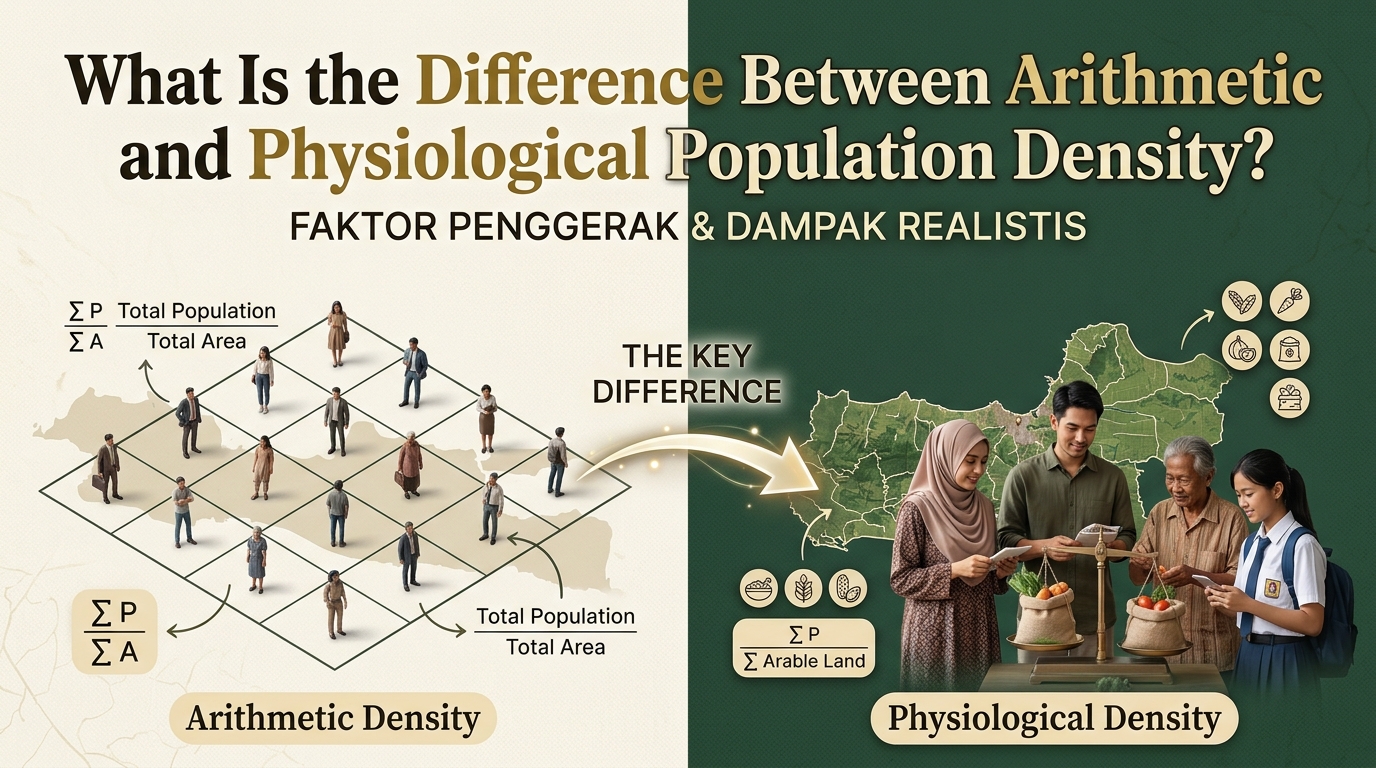
Population density is an important concept in geography because it helps explain how people are distributed across a particular area. However, population density can be measured in different ways depending on the information researchers want to understand. Two common measurements are arithmetic population density and physiological population density. Although both measurements compare population size with land area, they use different types of land in their calculations. Understanding the difference between these two concepts helps explain population distribution, agricultural resources, and the relationship between people and available land.
WHAT IS ARITHMETIC POPULATION DENSITY?
Arithmetic population density is the average number of people living within a specific unit of a country's total land area. It is calculated by dividing the total population by the total land area, including agricultural land, forests, mountains, and other types of land. The result is commonly expressed in people per square kilometer. This measurement provides a general overview of how densely populated a country or region is.
For example, if a country has a population of 10 million people and a total land area of 100,000 square kilometers, its arithmetic population density is 100 people per square kilometer. This means that the country has an average of 100 residents for every square kilometer of land. However, the calculation does not show whether people are concentrated in certain areas or spread evenly throughout the country. Therefore, arithmetic population density is useful for general comparisons but does not fully explain pressure on agricultural land.
WHAT IS PHYSIOLOGICAL POPULATION DENSITY?
Physiological population density measures the number of people living in a country compared with its arable land, which refers to land suitable for growing crops. Unlike arithmetic density, this measurement does not use the country's entire land area. Instead, it focuses on agricultural land that can support food production. This concept helps researchers understand the relationship between population size and the availability of cultivable land.
For example, a country may have 10 million residents but only 20,000 square kilometers of arable land. Its physiological population density would be 500 people per square kilometer of arable land. This figure indicates how many people are supported, on average, by each unit of potentially cultivable land. A high physiological density may suggest greater pressure on agricultural resources, although it does not directly measure food availability or actual farming productivity.
THE MAIN DIFFERENCES BETWEEN ARITHMETIC AND PHYSIOLOGICAL POPULATION DENSITY
The main difference between these two measurements is the type of land used in their calculations. Arithmetic population density uses the total land area of a region, while physiological population density uses only its arable land. Because the land areas are different, the resulting density figures can also be significantly different. Both measurements provide useful information, but they answer different geographical questions.
Arithmetic density is commonly used to compare the general population concentration of countries and regions. Physiological density is more focused on the relationship between population size and agricultural land availability. A country with extensive forests, deserts, or mountains may have relatively low arithmetic density but high physiological density. This happens because only a small proportion of its total territory may be suitable for crop production.
HOW ARE ARITHMETIC AND PHYSIOLOGICAL POPULATION DENSITY CALCULATED?
Both population density measurements use simple mathematical formulas. The difference lies in the land area included in each calculation. To calculate arithmetic density, researchers divide the total population by the total land area. To calculate physiological density, they divide the total population by the amount of arable land.
The formulas are:
Arithmetic Population Density = Total Population ÷ Total Land Area
Physiological Population Density = Total Population ÷ Arable Land Area
For example, imagine a country with the following characteristics:
- Total Population: 10,000,000 People
- Total Land Area: 100,000 km²
- Arable Land Area: 20,000 km²
The calculations are:
- Arithmetic Density: 10,000,000 ÷ 100,000 = 100 people/km²
- Physiological Density: 10,000,000 ÷ 20,000 = 500 people/km²
These results show that the physiological population density is higher because the calculation considers a smaller land area. The figures are averages and do not mean that residents are physically distributed equally across the land.
WHY IS ARITHMETIC POPULATION DENSITY IMPORTANT?
Arithmetic population density is useful for understanding the general distribution of people across a country or region. Governments and researchers can use this information to compare population concentrations between different locations. It also provides an initial overview of how many people live within a particular area. This information can support decisions about transportation, housing, infrastructure, and public facilities.
However, arithmetic density should not be used as the only indicator of population pressure. Two countries with similar arithmetic density may have very different geographical conditions and settlement patterns. One country may have large areas of usable land, while another may contain extensive deserts or mountainous regions. Therefore, additional geographical and demographic information is necessary to understand actual living conditions.
WHY IS PHYSIOLOGICAL POPULATION DENSITY IMPORTANT?
Physiological population density is important because it helps explain the relationship between population size and agricultural land availability. In countries where arable land is limited, a large population may place greater pressure on the land available for food production. This measurement can help researchers identify potential challenges related to agricultural resources and population growth. It is particularly useful when comparing countries with different amounts of cultivable land.
A high physiological density may indicate that many people depend on a relatively small area of arable land. However, it does not automatically mean that a country experiences food shortages. Agricultural technology, irrigation, crop productivity, food imports, and distribution systems also influence food availability. Therefore, physiological density should be considered together with other agricultural and economic indicators.
EXAMPLES OF THE DIFFERENCES IN REAL-WORLD CONDITIONS
Countries with large territories may have relatively low arithmetic population density because their populations are spread across extensive land areas. However, some of these countries may have high physiological population density if only a small proportion of their territory is suitable for agriculture. This situation can occur in countries with large desert regions, mountain ranges, or other challenging geographical environments. It demonstrates why total land area alone cannot explain the relationship between population and agricultural resources.
In contrast, countries with extensive fertile agricultural land may have lower physiological density relative to their total population. Their larger areas of cultivable land can reduce the average number of people depending on each square kilometer of arable land. Nevertheless, actual food production still depends on soil quality, climate, farming methods, and access to technology. These examples show that both measurements are necessary for understanding different aspects of population geography.
WHICH POPULATION DENSITY MEASUREMENT IS MORE USEFUL?
Neither arithmetic nor physiological population density is universally better because each measurement serves a different purpose. Arithmetic density is more suitable for understanding the general concentration of people within a country's total territory. It provides a simple basis for comparing population density between regions. Researchers can use it as an initial indicator when studying population distribution and urban development.
Physiological density is more useful when examining population pressure on agricultural land and potential food production resources. It provides a closer look at how population size relates to the land available for cultivation. For a more complete geographical analysis, researchers should consider both measurements alongside agricultural productivity, settlement patterns, and resource availability. Using multiple indicators provides a clearer understanding of population conditions.
CONCLUSION
Arithmetic and physiological population density are two important measurements used in population geography. Arithmetic population density compares the total population with the total land area, while physiological population density compares the population with the amount of arable land. The first measurement explains general population concentration, whereas the second focuses on the relationship between people and agricultural land availability.
Understanding both concepts helps researchers, students, and policymakers evaluate population distribution and resource pressure more accurately. Although neither measurement provides a complete picture on its own, combining them offers valuable information for geographical research, agricultural planning, and sustainable development.
Recent Posts

Bagaimana Sistem SKS pada Program Kuliah... 22.11.2026/33 View

How Does Technology Make Daily Evaluation... 21.11.2026/67 View

Apa Strategi Menghadapi Kesenjangan antara Kompetensi... 21.11.2026/67 View

Mengapa Inventaris Aset Penting bagi Kelancaran... 21.11.2026/65 View

When Should Musicians Join a Record... 21.11.2026/66 View
