

What Is the Difference Between Basic Research and Applied Research?
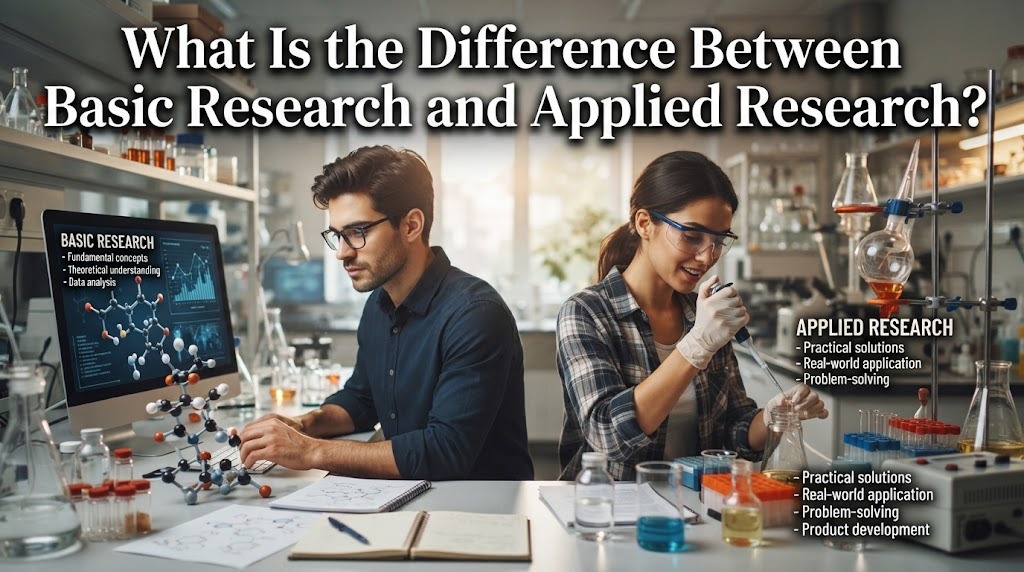
Basic research and applied research are two important types of research that contribute to scientific knowledge, technological development, and problem-solving. Although both use systematic methods to investigate questions, they have different purposes and approaches. Basic research focuses on understanding fundamental concepts, while applied research aims to solve specific practical problems. Understanding the difference between basic research and applied research helps students, researchers, and professionals choose the right research approach for their goals.
UNDERSTANDING BASIC RESEARCH
Basic research, also known as fundamental research or pure research, is conducted to expand knowledge and understand how things work. Its primary purpose is to explore theories, principles, and phenomena without necessarily seeking an immediate practical application. Researchers use this approach to investigate questions about nature, human behavior, mathematics, and other scientific fields. For example, a scientist might study how brain cells communicate to understand the mechanisms behind human memory. The findings may not produce an immediate product, but they can provide valuable knowledge for future discoveries.
Basic research is important because it establishes the foundation for further scientific investigation. It helps researchers develop new theories, test existing assumptions, and identify relationships between different phenomena. Although its benefits may take years to become visible, basic research can eventually support significant technological and medical advancements. Many innovations begin with scientific discoveries that initially have no obvious commercial purpose. Therefore, basic research plays a vital role in expanding human understanding and supporting long-term progress.
UNDERSTANDING APPLIED RESEARCH
Applied research is a systematic investigation designed to address a specific problem or practical need. Unlike basic research, it focuses on using existing knowledge or developing new knowledge to create useful solutions. Researchers often conduct applied research in fields such as healthcare, education, engineering, agriculture, and business. For example, a medical research team might investigate whether a particular treatment can reduce recovery time for patients with a specific condition. The goal is to obtain evidence that can guide decisions, improve practices, or develop effective solutions.
Applied research usually begins with a clearly defined problem and a practical objective. Researchers collect and analyze data, test possible solutions, and evaluate whether their approaches achieve the desired results. The outcomes may include improved products, more effective teaching methods, better medical treatments, or more efficient business processes. However, applied research does not always produce an immediate or successful solution, because the results must still be evaluated and verified. Its main value lies in connecting scientific investigation with real-world needs.
KEY DIFFERENCES BETWEEN BASIC RESEARCH AND APPLIED RESEARCH
The main difference between basic research and applied research lies in their objectives. Basic research seeks to increase understanding and develop scientific knowledge, whereas applied research focuses on solving particular problems. Their research questions also differ because basic research explores fundamental principles, while applied research investigates how knowledge can be used in specific situations. For instance, studying how bacteria grow is an example of basic research, while testing a method to prevent bacterial contamination in food production is an example of applied research. Both approaches use evidence and systematic investigation, but they emphasize different outcomes.
Another difference concerns their expected results and potential benefits. Basic research may produce theories, scientific explanations, or new insights that support future investigations. Applied research often produces practical recommendations, tested methods, improved technologies, or solutions to existing challenges. Basic research may require a longer period before its findings become useful in everyday life, while applied research is generally directed toward a more immediate or defined need. Nevertheless, both types can require substantial time, funding, and careful evaluation.
EXAMPLES OF BASIC RESEARCH AND APPLIED RESEARCH
In healthcare, basic research might examine how immune cells respond to viruses. Researchers conduct experiments to understand biological processes and identify patterns in the immune system. Applied research, on the other hand, might evaluate whether a new vaccine formulation produces an effective immune response and meets established safety requirements. The first investigation increases scientific understanding, while the second focuses on developing or evaluating a practical medical intervention. Both can contribute to better disease prevention and treatment.
In education, basic research might investigate how students process information and develop long-term memories. The results could help researchers understand the cognitive processes involved in learning. Applied research might use this knowledge to test whether spaced repetition or a particular teaching strategy improves student performance. In technology, basic research could explore the physical properties of new materials, while applied research could examine how those materials can be used to create stronger and more energy-efficient electronic devices. These examples demonstrate how different research objectives can complement one another.
WHY BASIC RESEARCH AND APPLIED RESEARCH ARE IMPORTANT
Basic research is important because it expands scientific knowledge and provides a foundation for future discoveries. Without a deeper understanding of fundamental principles, researchers may have limited opportunities to develop effective innovations. It also encourages critical thinking, scientific curiosity, and the development of new theories. Although the practical benefits may not be immediately apparent, its findings can influence many fields over time. Supporting basic research therefore helps create opportunities for long-term scientific advancement.
Applied research is equally important because it helps transform knowledge into practical improvements. It can support better healthcare services, more effective education, improved manufacturing processes, and solutions to environmental challenges. Businesses can use applied research to understand customer needs, improve products, and evaluate new strategies. Governments and public institutions can also use research findings to develop evidence-based policies and services. When combined with basic research, applied research helps ensure that scientific knowledge can address real-world needs.
HOW TO CHOOSE BETWEEN BASIC RESEARCH AND APPLIED RESEARCH
Choosing between basic research and applied research depends on the purpose of the investigation. If the main objective is to understand a phenomenon, explore a theory, or discover new scientific principles, basic research may be the most suitable approach. If the objective is to solve a defined problem, evaluate an intervention, or improve an existing process, applied research may be more appropriate. Researchers should also consider the research question, available resources, expected outcomes, and the type of evidence required. A clear understanding of these factors helps researchers design a study that matches their goals.
In some cases, a research project can combine elements of both approaches. For example, researchers developing a new educational technology may first investigate how people learn and process information before testing the technology in classrooms. The initial investigation may involve basic research, while the classroom evaluation may involve applied research. This combined approach can provide both theoretical understanding and practical evidence. Selecting the right approach, or combining the two when appropriate, can improve the value and relevance of research findings.
CONCLUSION
Basic research and applied research differ mainly in their purposes, although both contribute to scientific progress. Basic research focuses on expanding knowledge and understanding fundamental principles, while applied research uses scientific investigation to address specific practical problems. Basic research provides a foundation for discoveries, whereas applied research helps translate knowledge into useful solutions. Neither approach is more important in every situation because their value depends on the goals of the investigation. By understanding their differences and recognizing how they complement each other, students, researchers, and professionals can make better decisions when planning research projects and contributing to future innovation.
Recent Posts

Bagaimana Sistem SKS pada Program Kuliah... 22.11.2026/43 View

How Does Technology Make Daily Evaluation... 21.11.2026/72 View

Apa Strategi Menghadapi Kesenjangan antara Kompetensi... 21.11.2026/74 View

Mengapa Inventaris Aset Penting bagi Kelancaran... 21.11.2026/70 View

When Should Musicians Join a Record... 21.11.2026/74 View
