

What Is the Difference Between Big Data and Data Analytics?
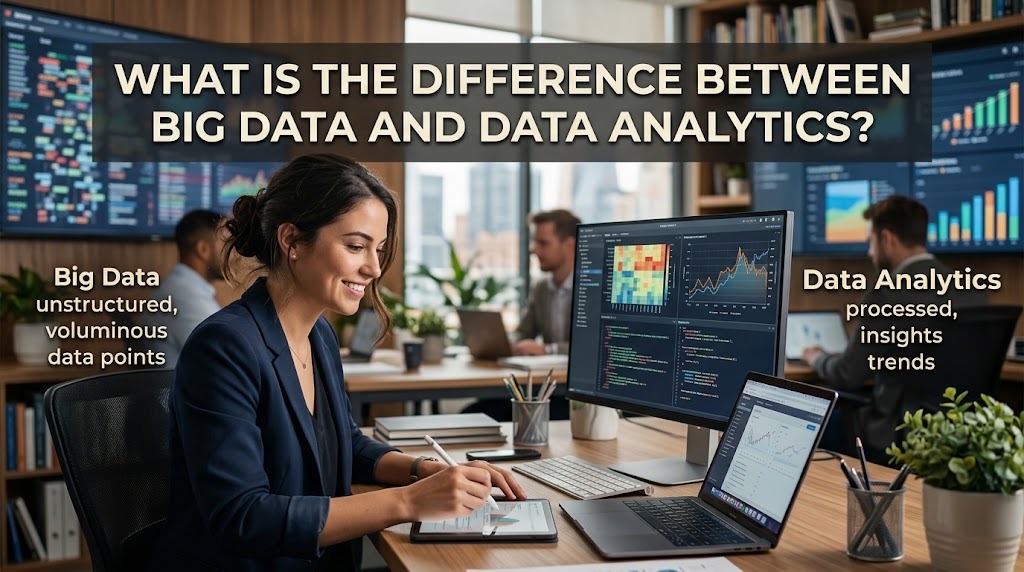
Big data and data analytics are closely related concepts that help businesses understand information and make better decisions. Although they are often used together, they have different meanings and purposes. Big data refers to large and complex collections of information, while data analytics is the process of examining data to discover patterns, trends, and useful insights.
Understanding the difference between big data and data analytics is important for businesses, students, and professionals who want to use information effectively. Both concepts support modern technology, business planning, and problem-solving. However, knowing how they work individually can help organizations choose the right tools and methods for their needs.
WHAT IS BIG DATA?
Big data refers to datasets that are so large, diverse, or rapidly generated that traditional data processing methods may struggle to manage them efficiently. These datasets can come from online transactions, social media, mobile applications, sensors, websites, and business operations. Big data may include structured information, such as spreadsheets, as well as unstructured information, such as images, videos, and customer comments. Its main characteristic is the scale and complexity of the information being handled.
Big data is commonly described through three characteristics known as volume, velocity, and variety. Volume refers to the amount of data, velocity describes how quickly it is generated and processed, and variety refers to the different formats and sources of information. Some organizations also consider data quality and its usefulness when evaluating big data systems. For example, an online retailer may collect millions of transactions and customer interactions to understand its overall business performance.
WHAT IS DATA ANALYTICS?
Data analytics is the process of examining, organizing, and interpreting data to discover meaningful information. It uses methods such as statistical analysis, data visualization, and computational techniques to identify patterns and support decision making. Data analytics can be applied to small datasets as well as large and complex collections of information. Its main purpose is to turn raw data into insights that people can use.
Businesses use data analytics to answer questions about their performance, customers, and markets. For example, a company can analyze monthly sales records to identify its best-selling products or determine why revenue has declined. Analysts may also use historical information to estimate future demand and evaluate possible business strategies. The results help managers make decisions based on evidence rather than relying entirely on assumptions.
THE MAIN DIFFERENCES BETWEEN BIG DATA AND DATA ANALYTICS
The main difference between big data and data analytics lies in their roles. Big data refers to the information itself, particularly when it is large, complex, or generated at high speed. Data analytics refers to the methods and processes used to examine information and produce useful insights. In simple terms, big data is the material being analyzed, while data analytics is the process used to understand it.
Another difference is their primary focus. Big data technologies concentrate on collecting, storing, processing, and managing large datasets efficiently. Data analytics focuses on asking questions, examining evidence, identifying patterns, and interpreting results. Although the two concepts have different purposes, they often depend on each other. Organizations may use big data infrastructure to manage information and data analytics tools to understand what that information reveals.
COMPARISON OF BIG DATA AND DATA ANALYTICS
Big data and data analytics differ in several important ways, including their purpose, tools, and expected outcomes. Big data systems are designed to handle the challenges of managing large and complex datasets. Data analytics methods help users extract meaning from those datasets and apply the findings to real situations.
These differences show that big data and data analytics perform complementary functions. Big data provides the information and infrastructure needed to handle complex datasets, while data analytics helps turn information into knowledge. Depending on the problem, businesses may need one concept more directly than the other. In many modern organizations, both are used together to improve performance and planning.
EXAMPLES OF BIG DATA AND DATA ANALYTICS IN BUSINESS
An online shopping company provides a useful example of how these concepts work together. The company may collect millions of records from purchases, website visits, product searches, and customer reviews. Managing these records efficiently is a big data challenge because the information may be large, diverse, and continuously updated. The company needs appropriate systems to store and process the information reliably.
Data analytics is then used to examine the collected information and identify customer preferences, popular products, and purchasing patterns. The company may discover that certain products are frequently purchased together or that demand increases during particular periods. Managers can use these findings to improve product recommendations, manage inventory, and develop marketing campaigns. In this example, big data provides the information, while data analytics helps the business understand and use it.
TYPES OF DATA ANALYTICS USED WITH BIG DATA
Data analytics includes several approaches that help organizations understand different aspects of their operations. Descriptive analytics explains what happened by summarizing historical information, such as monthly revenue or website traffic. Diagnostic analytics investigates why something happened by examining relationships and possible causes. These approaches help businesses understand past performance and identify areas that require attention.
Predictive analytics uses historical data and analytical models to estimate what may happen in the future. Prescriptive analytics goes further by evaluating possible actions and recommending options that may help achieve specific goals. For example, a retailer may predict seasonal demand and compare different inventory strategies. These methods can support better decisions, but their accuracy depends on data quality, suitable models, and changing real-world conditions.
BENEFITS OF COMBINING BIG DATA AND DATA ANALYTICS
Combining big data with data analytics helps businesses understand complex situations and make more informed decisions. Organizations can examine information from multiple sources to identify patterns that may not be visible when each dataset is considered separately. This can improve customer understanding, operational efficiency, and strategic planning. It can also help businesses respond more quickly to changes in market conditions.
The combination can support cost reduction, risk management, and innovation. For example, manufacturers can analyze equipment data to identify unusual patterns and plan maintenance before major failures occur. Financial organizations can examine transaction patterns to detect potentially suspicious activity. However, these benefits depend on responsible data management, suitable technology, and employees who can interpret results correctly.
CHALLENGES OF USING BIG DATA AND DATA ANALYTICS
Although both concepts offer valuable benefits, implementing them can create several challenges. Large datasets may contain inaccurate, incomplete, duplicated, or inconsistent information. If organizations fail to address these problems, their analytical results may be misleading. Businesses should therefore establish clear data quality standards and regularly check the information they collect.
Privacy, security, and technical skills are also important considerations. Organizations must protect sensitive information, control access to systems, and comply with applicable data protection regulations. They may need suitable infrastructure and trained professionals to manage datasets and interpret analytical results. Starting with clear objectives and manageable projects can help organizations control costs and develop their capabilities gradually.
CONCLUSION
The difference between big data and data analytics is mainly their purpose and function. Big data refers to large and complex collections of information that require suitable methods for storage and processing. Data analytics is the process of examining and interpreting information to discover patterns, answer questions, and support better decisions.
Both concepts are important in modern business because they work together to turn information into practical value. Big data makes it possible to manage extensive datasets, while data analytics helps organizations understand what those datasets reveal. By combining appropriate technology, reliable information, and careful analysis, businesses can improve efficiency, understand customers, and develop more effective strategies.
Recent Posts

Bagaimana Sistem SKS pada Program Kuliah... 22.11.2026/45 View

How Does Technology Make Daily Evaluation... 21.11.2026/73 View

Apa Strategi Menghadapi Kesenjangan antara Kompetensi... 21.11.2026/75 View

Mengapa Inventaris Aset Penting bagi Kelancaran... 21.11.2026/71 View

When Should Musicians Join a Record... 21.11.2026/75 View
