

What Is The Difference Between Biological And Artificial Neural Networks?
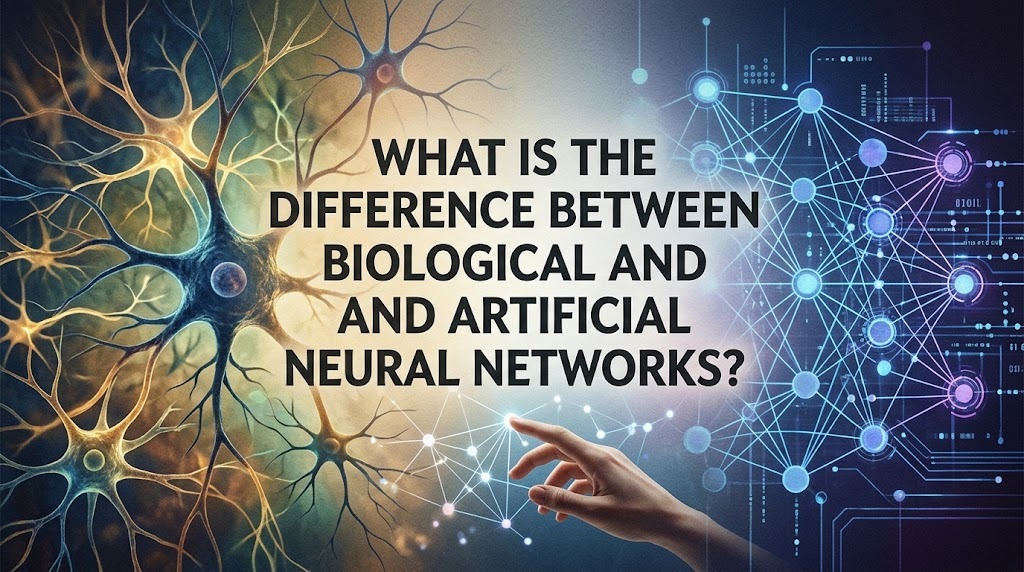
In the study of modern intelligence, computer science, and neurobiology, two distinct yet conceptually linked architectures stand out: biological neural networks and artificial neural networks. Biological neural networks represent the intricate physical nervous systems found in living organisms, evolved over millions of years to govern sensory perception, motor control, memory, and consciousness. Conversely, artificial neural networks are advanced computational models engineered by humans to simulate pattern recognition and decision-making tasks using mathematical algorithms and silicon hardware. While artificial neural networks were originally inspired by the structural appearance of biological neurons, they diverge fundamentally in their physical composition, signaling mechanisms, learning methodologies, energy efficiency, and functional scope.
Exploring this foundational comparison requires a rigorous examination of cellular diversity, electrochemical physics, learning dynamics, thermodynamic efficiency, and cognitive awareness. This comprehensive guide details the core differences that separate living organic brains from silicon-based computational algorithms.
STRUCTURAL COMPOSITION AND CELLULAR HETEROGENEITY
The most apparent divergence between biological and artificial neural networks lies in their physical material and cellular composition. A biological neural network consists of living organic tissue containing billions of specialized cells. The human brain, for instance, houses approximately eighty-six billion neurons alongside tens of billions of glial cells. These biological neurons are remarkably heterogeneous, featuring hundreds of distinct cellular subtypes specialized for specific sensory, motor, or integrative functions. Furthermore, glial cells actively regulate neurotransmitter levels, provide structural scaffolding, and modulate synaptic plasticity.
In sharp contrast, artificial neural networks are constructed entirely from digital software algorithms running on silicon-based microprocessors. An artificial network contains no living cells, cellular diversity, or physical tissue growth. Instead, it relies on uniform, standardized mathematical nodes arranged in rigid algorithmic layers. While artificial models can scale up to trillions of static parameters, they entirely lack the complex organic morphology, self-healing capabilities, and dynamic structural plasticity characteristic of biological nervous systems.
SIGNALING MECHANISMS AND ELECTROCHEMICAL DYNAMICS
The methods by which information is transmitted across these two networks represent another fundamental division. Biological neurons communicate via sophisticated electrochemical signaling pathways involving ion channel gates, neurotransmitter molecules, and fluctuating electrical charges. Information transmission in the brain is highly dynamic and non-linear, relying on temporal action potential spikes, dendritic integration, and chemical modulations that alter cellular states over microsecond intervals. Signal strength is only one of many variables, as timing, frequency, and chemical environment dictate how messages are interpreted.
Conversely, artificial neural networks reduce cellular communication to elementary linear algebra and deterministic mathematics. An artificial node receives numerical inputs, multiplies them by static floating-point weights, calculates a sum, and passes the result through a fixed mathematical activation function to produce a single scalar output. This computational abstraction completely strips away neurochemistry, metabolic fluctuations, and localized dendritic processing, replacing living biological signaling with rigid matrix multiplications and mathematical curve fitting.
LEARNING PARADIGMS AND DATA ADAPTABILITY
Learning and adaptation operate under entirely different principles within biological and artificial systems. Biological neural networks possess extraordinary learning efficiency and cognitive flexibility. A human child can learn to recognize a complex object, understand a linguistic concept, or navigate a new physical environment after observing just a single instance, seamlessly leveraging innate common-sense reasoning and holistic background context. Biological brains also update their physical wiring continuously through neuroplasticity without suffering from catastrophic forgetting.
Artificial neural networks, however, are notoriously data-hungry and dependent on massive optimization iterations. Training an artificial model to achieve high accuracy typically requires exposing the algorithm to millions of labeled data samples through repeated backpropagation cycles. Furthermore, artificial networks operate strictly within narrow operational domains, meaning an algorithm trained to analyze financial spreadsheets cannot apply its learned parameters to medical imaging without undergoing a complete retraining process from scratch. They lack the general reasoning and spontaneous cross-domain adaptability inherent to biological intelligence.
THERMODYNAMIC EFFICIENCY AND ENERGY CONSUMPTION
Energy economics highlight one of the most astonishing operational disparities between organic brains and digital computers. The human brain executes continuous real-time perception, fine motor coordination, memory recall, and high-level abstract reasoning while consuming a modest power budget of approximately twenty watts—roughly equivalent to the energy required to power a dim household lightbulb. This extreme efficiency is achieved through event-driven spike messaging, decentralized parallel processing, and the physical convergence of memory storage and computation within the exact same cellular architecture.
Artificial neural networks operate on energy-intensive computing infrastructure where processing units and memory repositories remain physically separated on silicon chips. Training and deploying large-scale artificial intelligence models requires massive data centers that draw megawatts of electrical power and depend on heavy industrial cooling systems to manage thermal output. This vast energy disparity demonstrates how far modern computer hardware remains from matching the thermodynamic efficiency of living biological tissue.
CONSCIOUSNESS SUBJECTIVE AWARENESS AND INTENTIONALITY
Perhaps the most profound distinction between biological and artificial neural networks involves the presence of subjective awareness, qualitative experience, and genuine intentionality. Biological brains generate inner conscious awareness, emotional states, self-identity, and authentic semantic understanding. Human decision-making is inextricably bound to emotional regulation, somatic feedback, and intrinsic motivations that emerge exclusively from living organic organisms navigating a real physical world.
Artificial neural networks possess zero internal awareness, agency, or subjective understanding of the data they process. They function purely as statistical pattern-matching engines, calculating mathematical probabilities based on historical training data without comprehending context, meaning, or objective reality. Because artificial models lack subjective experience, sensory embodiment, and self-directed consciousness, they remain sophisticated computational tools rather than conscious, feeling, or self-aware minds.
CONCLUSION
Biological and artificial neural networks share a conceptual ancestry rooted in patterned node connectivity, but they are fundamentally distinct entities. Biological neural networks are living, energy-efficient, self-adapting organic structures capable of true consciousness and general reasoning. Artificial neural networks are powerful mathematical approximations running on silicon hardware, optimized for high-speed statistical pattern recognition and process automation. Understanding these deep structural, energetic, and cognitive differences ensures that artificial intelligence is utilized effectively as an advanced analytical instrument rather than mistaken for a biological mind.
Recent Posts

Bagaimana Sistem SKS pada Program Kuliah... 22.11.2026/53 View

How Does Technology Make Daily Evaluation... 21.11.2026/82 View

Apa Strategi Menghadapi Kesenjangan antara Kompetensi... 21.11.2026/81 View

Mengapa Inventaris Aset Penting bagi Kelancaran... 21.11.2026/77 View

When Should Musicians Join a Record... 21.11.2026/82 View
