

What Is The Difference Between Bodily Kinesthetic Intelligence And Other Intelligences?
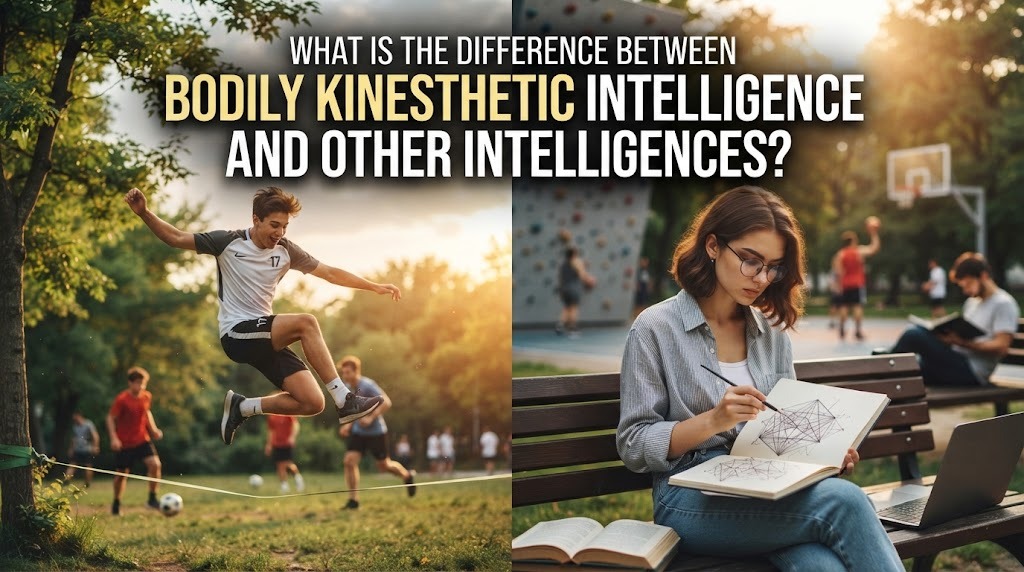
Bodily kinesthetic intelligence is the ability to use the body effectively for movement, coordination, physical expression, and practical activities. It is one of the intelligence types described in Howard Gardner’s theory of multiple intelligences. Unlike some forms of intelligence that mainly focus on language, numbers, or abstract ideas, bodily kinesthetic intelligence emphasizes learning and performing through physical action. Understanding these differences can help people recognize that intelligence can appear in many forms.
WHAT IS BODILY KINESTHETIC INTELLIGENCE?
Bodily kinesthetic intelligence involves using the body with control, coordination, balance, and precision. People with strong abilities in this area may enjoy sports, dancing, acting, crafts, cooking, building, or other hands on activities. They often learn effectively when they can practice something directly rather than only reading or listening to an explanation. Physical experience can help them understand how a process works.
This intelligence is not limited to athletic ability. It can also involve fine motor skills, body awareness, timing, and practical problem solving. For example, a chef needs precise hand movements, while a craft worker may need excellent control when working with small materials. Therefore, bodily kinesthetic intelligence can be useful in both physical and creative activities.
BODILY KINESTHETIC AND LINGUISTIC INTELLIGENCE
Linguistic intelligence focuses on the effective use of language and words. People with strong linguistic abilities may enjoy reading, writing, speaking, storytelling, or learning new languages. They often use words to communicate ideas, explain information, and express their thoughts. Bodily kinesthetic intelligence, in contrast, emphasizes physical action and body control.
The two intelligences can also work together. An actor, for example, may need strong language skills to understand a script while also using body movements to communicate emotions. A teacher may use clear explanations together with demonstrations. This shows that different intelligences can support each other rather than functioning completely separately.
BODILY KINESTHETIC AND LOGICAL MATHEMATICAL INTELLIGENCE
Logical mathematical intelligence involves reasoning, patterns, numbers, problem solving, and logical relationships. People who are strong in this area may enjoy mathematics, experiments, puzzles, data, or analytical tasks. Bodily kinesthetic intelligence focuses more directly on physical movement and practical interaction with objects. One emphasizes logical relationships, while the other emphasizes controlled physical action.
However, physical activities can also require logical thinking. An athlete may analyze movement and strategy, while a mechanic may use measurements and logical reasoning to identify a problem. A scientist conducting a practical experiment may need both analytical thinking and physical coordination. This demonstrates that different forms of intelligence can overlap in real situations.
BODILY KINESTHETIC AND SPATIAL INTELLIGENCE
Spatial intelligence involves understanding shapes, distances, positions, directions, and visual relationships. Architects, designers, artists, and some engineers may use spatial abilities when working with objects or visual information. Bodily kinesthetic intelligence is more focused on controlling the body and using physical movement effectively. Although they are different, the two can be closely connected.
For example, a dancer needs to understand where their body is positioned in relation to other dancers. A basketball player needs to judge distance and position while moving around a court. These activities require both body coordination and spatial awareness. Therefore, someone can use bodily kinesthetic and spatial abilities at the same time.
BODILY KINESTHETIC AND MUSICAL INTELLIGENCE
Musical intelligence involves recognizing and working with rhythm, melody, pitch, and musical patterns. Musicians and singers often use this intelligence when creating or performing music. Bodily kinesthetic intelligence, on the other hand, focuses on physical movement and body control. The main difference is whether the primary ability involves musical patterns or physical action.
The two can strongly interact in activities such as dancing and performing music. A dancer may need to follow rhythm while controlling their movements, while a drummer needs precise hand coordination to maintain a beat. This means music and movement can be connected through practice and performance. A person may also have strengths in both areas.
BODILY KINESTHETIC AND INTERPERSONAL INTELLIGENCE
Interpersonal intelligence refers to the ability to understand and interact effectively with other people. It can involve communication, cooperation, empathy, and awareness of social situations. Bodily kinesthetic intelligence is primarily related to how a person uses their own body and movement. Therefore, the focus of each intelligence is different.
However, many activities require both skills. Team sports involve physical coordination while also requiring communication and cooperation with teammates. A dance group needs performers to coordinate their movements with other people. Social interaction and physical coordination can work together in many real-life situations.
BODILY KINESTHETIC AND INTRAPERSONAL INTELLIGENCE
Intrapersonal intelligence involves understanding one’s own emotions, motivations, strengths, and weaknesses. People with strong intrapersonal abilities may spend time reflecting on their experiences and understanding their personal goals. Bodily kinesthetic intelligence focuses more on physical action and body control. One is primarily concerned with self-understanding, while the other emphasizes physical interaction.
Even so, self-awareness can support physical development. An athlete needs to recognize personal strengths, limitations, emotions, and responses during training. A dancer may also use self-reflection to understand which movements need improvement. Knowing oneself can help a person manage and develop physical abilities more effectively.
INTELLIGENCES CAN WORK TOGETHER
The differences between intelligences do not mean that people must have only one type. In real life, people often use several abilities at the same time. A surgeon may need bodily coordination, logical reasoning, spatial awareness, and interpersonal communication. A teacher may combine linguistic, interpersonal, and bodily kinesthetic skills when explaining a practical lesson.
This is why bodily kinesthetic intelligence should not be viewed as better or worse than other forms of intelligence. Each type describes a different way of using abilities and interacting with information. Recognizing multiple strengths can help people understand their learning preferences and develop a wider range of skills.
CONCLUSION
The main difference between bodily kinesthetic intelligence and other intelligences is the type of ability being emphasized. Bodily kinesthetic intelligence focuses on movement, body control, coordination, practical action, and physical expression, while other intelligences may emphasize language, logic, music, visual information, or social understanding. However, these abilities can overlap and support one another in everyday activities. A person can develop strengths in multiple areas rather than being limited to a single intelligence type. Understanding these differences can help people recognize their abilities and choose learning activities that suit their strengths.
Recent Posts

Bagaimana Sistem SKS pada Program Kuliah... 22.11.2026/28 View

How Does Technology Make Daily Evaluation... 21.11.2026/65 View

Apa Strategi Menghadapi Kesenjangan antara Kompetensi... 21.11.2026/65 View

Mengapa Inventaris Aset Penting bagi Kelancaran... 21.11.2026/62 View

When Should Musicians Join a Record... 21.11.2026/63 View
