

What Is the Difference Between Bookkeeping and Accounting in Business?
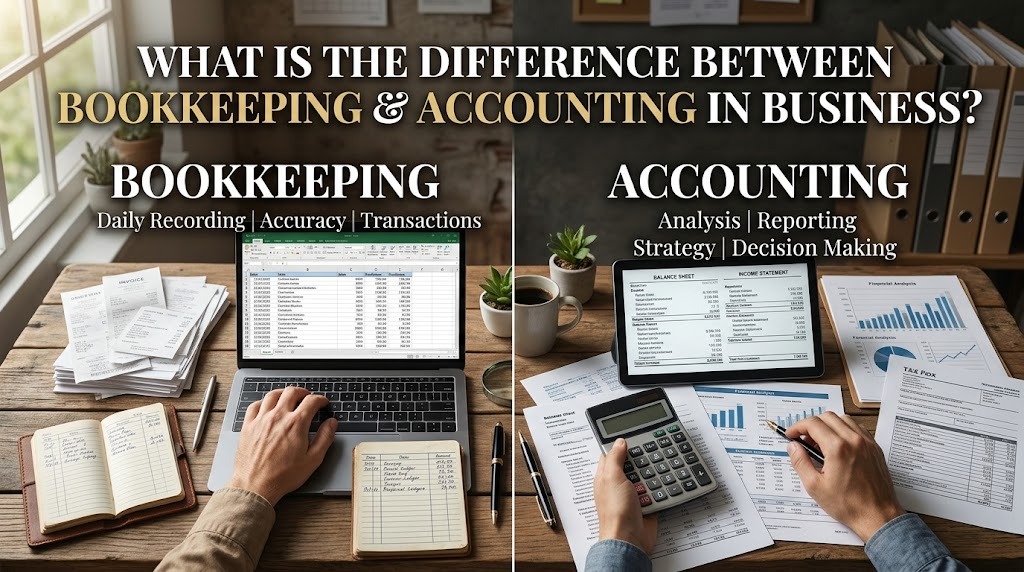
Many small business owners mistakenly use the terms bookkeeping and accounting interchangeably, assuming they refer to the exact same financial process. While both functions deal with financial management and are vital for corporate success, they serve distinct roles within an enterprise. Business bookkeeping is the foundational process of systematically recording, organizing, and categorizing daily financial transactions. On the other hand, business accounting takes those recorded figures and interprets, analyzes, and transforms them into strategic insights. Understanding the difference between these two disciplines helps entrepreneurs hire the right financial professionals at each stage of company growth.
Without accurate bookkeeping, accountants have no reliable data to analyze, which can lead to miscalculated profit metrics and faulty business forecasts. Conversely, keeping organized financial books without performing high-level accounting analysis leaves a company rich in data but lacking strategic direction. Bookkeeping provides the structural foundation, while accounting provides the analytical intelligence needed for sustainable expansion. Both disciplines must work together seamlessly to maintain accurate financial records and ensure operational stability. Balancing both functions protects your business from costly operational mistakes and compliance issues.
WHAT ARE THE PRIMARY RESPONSIBILITIES OF A BOOKKEEPER?
A bookkeeper handles the day-to-day administrative tasks required to keep a company's financial records up to date, consistent, and error-free. Their primary responsibilities include logging daily sales receipts, processing vendor invoices, running employee payroll, and updating the general ledger. They perform routine bank reconciliation to match internal accounting entries against official bank statements, catching discrepancies quickly. Bookkeepers maintain absolute accuracy in raw financial data, ensuring that every incoming and outgoing dollar is accounted for properly.
Additionally, bookkeepers manage accounts receivable to ensure clients pay their invoices on time, directly supporting healthy cash flow management. They also manage accounts payable, settling vendor bills promptly to maintain strong supplier relationships and avoid late payment penalties. By keeping financial documents neatly organized, bookkeepers create an audit-ready paper trail that simplifies end-of-year tax filing. Their consistent daily work provides the reliable dataset that business owners and accountants depend on for decision-making.
WHAT ARE THE KEY FUNCTIONS OF AN ACCOUNTANT?
An accountant builds upon the financial foundation laid by the bookkeeper to perform high-level financial analysis, strategic planning, and risk management. Accountants review financial data to prepare official financial statements, such as balance sheets, income statements, and cash flow reports. They analyze cost trends, evaluate overall profit margins, and identify operational inefficiencies that may be draining corporate resources. Their primary goal is to provide business leaders with actionable insights that drive long-term commercial profitability.
Furthermore, certified accountants specialize in complex tax strategies, ensuring that companies minimize their overall tax liability legally while maintaining strict regulatory compliance. They guide businesses through routine tax audits, assist with complex corporate restructuring, and perform long-term financial forecasting. While bookkeepers track where your money went in the past, accountants help you determine where your capital should be directed in the future. Their strategic oversight is essential for navigating complex economic conditions and securing expansion funding.
HOW DO BOOKKEEPING AND ACCOUNTING DIFFER IN DAILY WORKFLOWS?
The differences in daily workflows between bookkeeping and accounting lie primarily in the tools used, the depth of analysis, and the required professional qualifications. Bookkeepers rely heavily on automated bookkeeping software to streamline data entry, organize receipts, and manage transactional workflows. Their work is transactional, repetitive, and focused on maintaining daily operational accuracy across all company accounts. Bookkeeping requires high attention to detail, organizational discipline, and a strong understanding of basic debit and credit principles.
In contrast, accounting workflows are analytical, consultative, and periodic, often occurring on a monthly, quarterly, or annual basis. Accountants use specialized financial modeling tools and advanced reporting frameworks to evaluate corporate solvency, valuation, and investment efficiency. Becoming a certified accountant typically requires advanced academic degrees, rigorous professional certifications, and a deep knowledge of tax codes and auditing standards. Understanding these workflow differences helps management allocate financial budgets effectively without overpaying for basic administrative tasks.
HOW DO BOTH DISCIPLINES COLLABORATE TO ENSURE TAX COMPLIANCE?
Achieving seamless tax compliance requires close collaboration between your bookkeeping team and your tax accountant throughout the operating year. The bookkeeper ensures that every business purchase is accurately categorized into its proper expense bucket, capturing every receipt and vendor invoice. When tax season arrives, this organized dataset allows the accountant to quickly identify and claim all eligible tax deductions. Disorganized books delay tax preparation, increase billable accounting hours, and heighten the risk of expensive tax filing errors.
When your bookkeeper and accountant work in harmony, preparing for state or federal tax filings becomes a routine, stress-free operation. The accountant can trust the integrity of the underlying data, allowing them to focus on optimizing your tax strategy rather than manually fixing entry errors. This collaborative partnership protects your enterprise from government fines, late penalties, and interest charges during tax reviews. Maintaining organized books and seeking expert accounting advice guarantees long-term peace of mind for every entrepreneur.
WHICH FINANCIAL SERVICE DOES YOUR SMALL BUSINESS NEED RIGHT NOW?
Determining whether your business needs a bookkeeper, an accountant, or both depends on your operational scale, transaction volume, and growth trajectory. In the early startup phase, utilizing user-friendly accounting software alongside a freelance bookkeeper may be sufficient to manage basic small business bookkeeping. However, as your enterprise hires employees, manages inventory, or seeks business loans, hiring an accountant for strategic tax planning and auditing becomes essential. Evaluating your current stage of growth prevents overspending while ensuring adequate financial management.
Many growing companies adopt a hybrid approach by employing a bookkeeper for ongoing daily tracking while consulting a certified accountant annually or quarterly. This cost-effective strategy provides accurate daily record-keeping without sacrificing high-level strategic guidance and tax optimization. Continuously assessing your financial processes ensures that your record-keeping infrastructure expands smoothly alongside your commercial operations. Investing in the right financial expertise guarantees long-term business resilience and commercial success.
CONCLUSION
Understanding the difference between business bookkeeping and business accounting empowers entrepreneurs to maintain accurate financial records, ensure tax compliance, and build a strong foundation for business growth.
Recent Posts

Bagaimana Sistem SKS pada Program Kuliah... 22.11.2026/54 View

How Does Technology Make Daily Evaluation... 21.11.2026/83 View

Apa Strategi Menghadapi Kesenjangan antara Kompetensi... 21.11.2026/81 View

Mengapa Inventaris Aset Penting bagi Kelancaran... 21.11.2026/78 View

When Should Musicians Join a Record... 21.11.2026/82 View
