

What Is The Difference Between Digital Notes And Handwritten Notes?
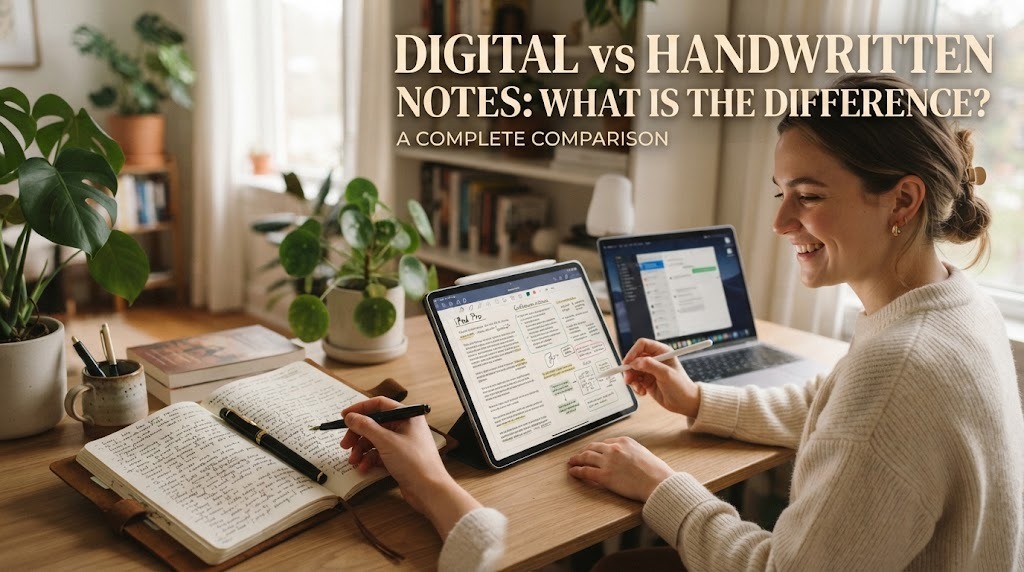
Taking notes is a common activity for students, workers, and anyone who needs to remember important information. Today, people can choose between digital notes and handwritten notes depending on their needs and habits. Digital notes are created and stored using electronic devices, while handwritten notes are written directly on paper. Both methods can help people record and review information, but they provide different experiences. Understanding their differences can help users choose a note taking method that fits their daily activities.
WHAT ARE DIGITAL NOTES?
Digital notes are notes created using smartphones, tablets, laptops, or computers. Users can type information through note taking applications and organize it into folders, categories, or notebooks. Many applications also allow users to add images, links, checklists, recordings, and other digital content. Digital notes can usually be edited without rewriting the entire page. They may also be synchronized across devices when the application supports this feature.
Another advantage is that digital notes can be searched using specific words or phrases. This can make finding older information faster, especially when a person has many notes. However, digital notes depend on electronic devices, software, and sometimes internet access for certain features.
WHAT ARE HANDWRITTEN NOTES?
Handwritten notes are created by writing information on paper, notebooks, or other physical materials. This method does not require a battery, application, or electronic device. Many people prefer handwriting because it feels direct and allows them to freely draw symbols, diagrams, or personal marks. Handwritten notes can also be customized through handwriting styles, colors, and page layouts. They are commonly used in classrooms, meetings, personal planning, and creative activities.
Writing by hand can also encourage people to process information while recording it. Instead of copying every word quickly, users may naturally select important points. However, handwritten notes can become difficult to organize when there are many notebooks or pages. Finding a specific piece of information may require looking through the pages manually.
DIFFERENCES IN THE NOTE TAKING PROCESS
Digital and handwritten notes differ in how information is recorded. Digital notes are usually created by typing, while handwritten notes are produced using a pen or pencil. Typing can be faster for people who are comfortable with keyboards, especially when recording large amounts of information. Handwriting may be slower, but it allows users to create symbols, drawings, and personal layouts easily. The most suitable method can depend on the activity and individual preference.
The environment can also influence the choice. A person working on a laptop may find digital notes more convenient, while someone attending a class may prefer a notebook. Both methods can be effective when users focus on understanding and organizing the information.
DIFFERENCES IN STORAGE AND ACCESS
Digital notes require electronic storage, either on a device or through an online service. A large collection of notes can fit into relatively little physical space. If synchronization or cloud storage is available, users may also access their notes from multiple devices. This can be useful for people who frequently move between locations.
Handwritten notes require physical storage such as notebooks, folders, shelves, or drawers. Carrying several notebooks can become inconvenient when someone has information from many subjects or activities. However, handwritten notes can be accessed without electricity or internet access. This gives paper notes an advantage in situations where electronic devices are unavailable.
DIFFERENCES IN EDITING AND CORRECTION
Digital notes are generally easier to edit because users can delete, move, replace, or add text without changing the entire document. This is useful when information needs frequent updates. Users can also reorganize sections and improve the structure of a note after it has been created. Some applications provide additional tools such as version history or undo functions. These features can make editing more flexible.
Handwritten notes can also be corrected, but the process is more physical. Users may need an eraser, correction tape, or a new page to make changes. Large changes can make a page look crowded or difficult to read. For this reason, digital notes may be more convenient for information that changes frequently.
DIFFERENCES IN SEARCHING INFORMATION
One of the clearest differences is the ability to search for information. Digital applications often provide a search function that can locate words or phrases within stored notes. This can save time when users need to find information from a large collection. Some applications may also allow users to search notes by folders, tags, or dates. These features are particularly useful for students and workers who manage many documents.
Handwritten notes generally do not provide the same instant search function. Users need to remember which notebook or page contains the required information. Good handwriting and clear page organization can make this easier. However, searching through many physical pages usually takes more manual effort.
DIFFERENCES IN LEARNING EXPERIENCE
Digital and handwritten notes can provide different learning experiences. Typing allows users to record information quickly, which can be useful during fast lectures or meetings. Handwriting may encourage users to summarize information in their own words because writing is often slower than typing. This can encourage active processing of information in some learning situations. However, the effectiveness of either method can depend on the person, subject, and way the notes are used.
The quality of learning depends on more than the format. A student who simply copies information without understanding it may gain less from either method. Reviewing, summarizing, asking questions, and practicing the material are also important. Therefore, the best method is often the one that helps a learner understand, remember, and review information effectively.
DIFFERENCES IN CONVENIENCE AND FLEXIBILITY
Digital notes offer flexibility through features such as multimedia, synchronization, search, and sharing. Users can add pictures, links, recordings, or checklists depending on the application. Notes can also be accessed on supported devices when synchronization is enabled. This makes digital notes useful for people who work with different types of information.
Handwritten notes offer a different type of flexibility. Users can draw freely, create unusual layouts, or write without worrying about application settings. Paper also works without charging or internet access. The choice therefore depends on whether a person values digital features or physical simplicity more for a particular task.
ADVANTAGES AND LIMITATIONS OF BOTH METHODS
Digital notes can be convenient, searchable, easy to edit, and simple to organize. They can also reduce the amount of physical storage needed for large collections of information. However, they depend on devices and may involve risks such as device failure, account problems, data loss, or digital distractions. Users should protect important information with secure accounts and backups.
Handwritten notes are simple, accessible without technology, and easy to personalize. They can be useful when drawing diagrams or when a person prefers writing by hand. However, paper notes can take up more space, become damaged, and require more effort to search. Neither method is perfect for every situation, so users can choose based on their specific needs and circumstances.
WHICH METHOD SHOULD YOU USE?
There is no single method that is suitable for everyone. Students may use handwritten notes during lessons and digital notes when organizing study materials at home. Workers may prefer digital notes for meetings and projects while using paper for quick reminders. Some people may also combine both methods to take advantage of their different features. The important point is to choose a system that supports the way information is recorded and used.
Consider factors such as speed, organization, accessibility, learning habits, available technology, and personal preference. Trying both methods can help users discover which one works better for different situations. The goal of taking notes is not simply to create a record, but to make information easier to understand and use.
CONCLUSION
Digital notes and handwritten notes both provide useful ways to record information, but they have important differences. Digital notes offer easy editing, searching, storage, sharing, and access across supported devices. Handwritten notes provide simplicity, physical flexibility, and independence from electronic devices. The learning experience can also differ depending on how each method is used. Instead of focusing on which method is universally better, users should consider their purpose and personal needs. Combining both methods can also be a practical solution for people who want the advantages of each approach.
Recent Posts

Bagaimana Sistem SKS pada Program Kuliah... 22.11.2026/31 View

How Does Technology Make Daily Evaluation... 21.11.2026/67 View

Apa Strategi Menghadapi Kesenjangan antara Kompetensi... 21.11.2026/66 View

Mengapa Inventaris Aset Penting bagi Kelancaran... 21.11.2026/64 View

When Should Musicians Join a Record... 21.11.2026/65 View
