

What Is the Difference Between Government Subsidies and Social Assistance?
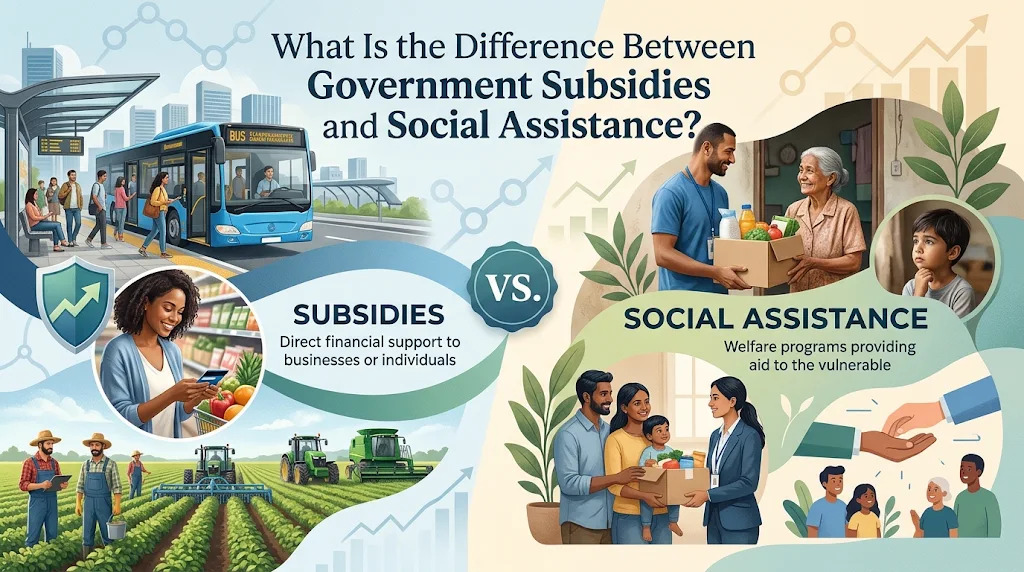
Government subsidies and social assistance are two important instruments used by governments to improve public welfare and support people facing financial difficulties. Both programs involve government funding and are intended to provide benefits to individuals, households, or specific economic sectors. However, they have different purposes, distribution methods, and target beneficiaries. Understanding the difference between government subsidies and social assistance can help people recognize how public support programs work and who can receive them.
Although these terms are sometimes used interchangeably, they are not exactly the same. Subsidies generally reduce the cost of particular goods, services, or economic activities, while social assistance focuses more directly on helping individuals and families meet their basic needs. Both contribute to economic stability, but they address different challenges within society.
UNDERSTANDING GOVERNMENT SUBSIDIES
Government subsidies are financial support provided by the government to reduce the cost of goods, services, or production activities. They are commonly used to make essential products and services more affordable for the public. For example, the Indonesian government provides certain subsidies in sectors such as energy, agriculture, and transportation. These programs can help reduce the financial burden associated with everyday expenses.
Subsidies may also support businesses, farmers, and other economic sectors that contribute to national development. For instance, agricultural subsidies can help farmers access certain production inputs at more affordable prices. Energy subsidies can reduce the cost of specific energy products for eligible consumers. Through these policies, the government aims to maintain affordability, support economic activities, and protect purchasing power.
UNDERSTANDING SOCIAL ASSISTANCE
Social assistance refers to government support provided to individuals or households that need help meeting essential living requirements. These programs are generally designed to protect vulnerable communities, reduce poverty, and improve access to basic necessities. In Indonesia, examples include the Family Hope Program (PKH), the Non-Cash Food Assistance Program (BPNT), and other forms of social protection. Their benefits may be distributed through cash transfers, food assistance, or other support mechanisms.
Unlike many subsidies that influence the prices of particular goods or services, social assistance is more directly focused on the welfare of eligible beneficiaries. The government generally determines recipients based on socioeconomic conditions and program-specific requirements. Some assistance programs also aim to improve access to education, healthcare, and other essential services. As a result, social assistance plays an important role in reducing inequality and supporting households experiencing financial hardship.
KEY DIFFERENCES BETWEEN SUBSIDIES AND SOCIAL ASSISTANCE
The main difference between subsidies and social assistance lies in how the government provides support and what each program aims to achieve. Subsidies usually reduce the cost of specific products, services, or economic activities. Social assistance, on the other hand, provides direct benefits to eligible individuals or households to help them meet their basic needs. This distinction influences how each program is designed and distributed.
Another difference involves the groups that benefit from these programs. Certain subsidies may be available to consumers or economic sectors that meet specific conditions, while social assistance is generally targeted at people or households experiencing socioeconomic difficulties. Their distribution methods can also vary. Subsidies may be applied through regulated prices or reduced production costs, whereas social assistance may be delivered through cash transfers, food support, or other direct benefits.
EXAMPLES OF SUBSIDIES AND SOCIAL ASSISTANCE IN INDONESIA
Indonesia implements various government subsidy programs to support essential sectors and maintain economic affordability. Examples include subsidized fuel for eligible consumers, electricity subsidies for qualifying households, and fertilizer subsidies for eligible farmers. These programs are intended to reduce specific costs and support economic activities. Their availability and eligibility conditions depend on government regulations and the relevant distribution mechanisms.
Meanwhile, social assistance programs are designed to support people and families who need additional financial protection. The Family Hope Program (PKH), for example, provides conditional assistance to eligible families based on established program requirements. The Non-Cash Food Assistance Program (BPNT) supports eligible households in accessing food necessities. These examples demonstrate that subsidies and social assistance can serve different purposes while contributing to the same broader goal of improving public welfare.
WHY BOTH PROGRAMS ARE IMPORTANT FOR SOCIETY
Government subsidies and social assistance are important because they address different economic and social challenges. Subsidies can help control the cost of essential goods and services, making them more affordable for eligible consumers. They can also support important economic sectors, maintain production activities, and protect purchasing power. When implemented effectively, these policies can contribute to greater economic stability.
Social assistance provides another layer of protection by helping vulnerable households meet their basic needs. It can reduce financial pressure, improve access to essential services, and support efforts to overcome poverty. However, both programs require accurate beneficiary data, transparent management, and effective monitoring to ensure that public funds are used appropriately. Combining well-targeted subsidies with effective social assistance can strengthen social protection and promote more inclusive economic development.
CONCLUSION
The difference between government subsidies and social assistance lies mainly in their purposes and distribution methods. Subsidies generally reduce the cost of particular goods, services, or economic activities, while social assistance provides direct support to eligible individuals and households facing financial difficulties. Both programs are important for protecting public welfare, reducing economic pressure, and supporting national development. Effective implementation ensures that government support reaches the appropriate beneficiaries.
Recent Posts

Bagaimana Sistem SKS pada Program Kuliah... 22.11.2026/27 View

How Does Technology Make Daily Evaluation... 21.11.2026/65 View

Apa Strategi Menghadapi Kesenjangan antara Kompetensi... 21.11.2026/65 View

Mengapa Inventaris Aset Penting bagi Kelancaran... 21.11.2026/62 View

When Should Musicians Join a Record... 21.11.2026/63 View
