

What Is the Difference Between Historic Buildings and Heritage Buildings?
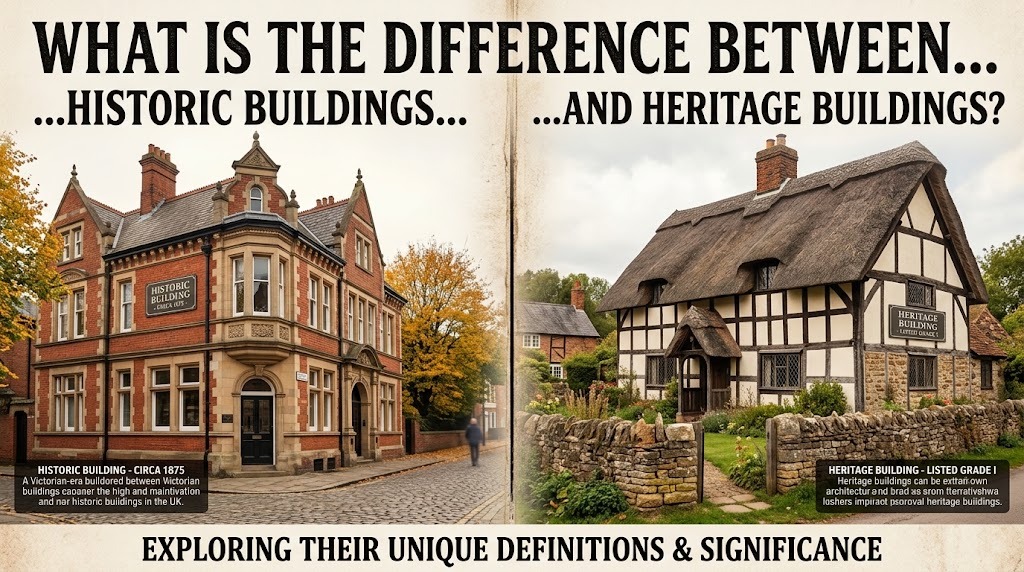
Historic buildings and heritage buildings are often discussed together because both are connected to the past. They may preserve architectural styles, represent important events, or provide evidence of how communities lived in earlier periods. Although the terms are sometimes used interchangeably, they can have different meanings depending on the context and the rules used to identify and protect buildings.
Understanding the difference between historic buildings and heritage buildings helps explain why certain structures attract public interest, receive official protection, or become cultural tourism destinations. Their significance may come from their age, architectural design, historical associations, cultural value, or importance to a particular community.
THE MEANING OF HISTORIC BUILDINGS
Historic buildings are structures associated with a particular period, event, person, or stage of social development. They can provide evidence of how architecture, technology, government, commerce, and everyday life changed over time. Examples include former railway stations, colonial-era offices, old schools, and buildings connected to significant national events.
A building does not necessarily need to be extremely old to have historical importance. A relatively recent structure may be considered historic if it represents a major event or an important development in society. The term generally emphasizes the building's connection to the past and its value as a source of historical information.
THE MEANING OF HERITAGE BUILDINGS
Heritage buildings are structures recognized for their cultural, architectural, historical, social, or other forms of heritage value. They may represent traditional building techniques, community identity, artistic achievements, or important stages in a region's development. Their value can extend beyond their physical appearance to include the meanings and traditions associated with them.
In some countries, the term heritage building is closely connected to formal recognition or legal protection. However, the precise definition depends on the relevant laws and heritage management systems. A building may be widely regarded as part of a community's heritage even before it receives formal designation, although legal protection may depend on official procedures.
THE MAIN DIFFERENCES BETWEEN HISTORIC AND HERITAGE BUILDINGS
The main difference lies in the emphasis of each term. A historic building is generally described through its relationship with a particular time, event, or historical development. A heritage building, meanwhile, is often discussed in terms of its broader cultural significance and the need to preserve its value for future generations.
The two categories can overlap considerably. For example, an old government building may be historic because of its role in an important political period and also be a heritage building because of its architecture and cultural significance. However, not every building described as historic automatically receives formal heritage status. Whether it is officially protected depends on the applicable assessment criteria and legal framework.
WHY HISTORIC AND HERITAGE BUILDINGS MATTER
Both historic and heritage buildings help communities understand their past. They provide tangible evidence of architectural development, social relationships, economic activities, and cultural practices. Students and researchers can use them to study how people designed spaces, responded to environmental conditions, and organized public life in different periods.
These buildings can also contribute to tourism and local identity. Visitors may explore historic landmarks to learn about significant events, while heritage buildings can represent traditions and values that communities wish to maintain. Their preservation can support educational activities and cultural awareness, provided that tourism and new uses do not damage the structures or undermine their significance.
HOW THESE BUILDINGS ARE IDENTIFIED AND PRESERVED
The process of identifying and protecting historic or heritage buildings varies by country and locality. Assessments may consider a building's age, architectural design, historical associations, rarity, integrity, cultural meaning, and relationship with its surroundings. Documentation, expert research, community input, and official evaluations may all contribute to decisions about preservation.
In Indonesia, the protection of cultural heritage is governed by Law No. 11 of 2010 concerning Cultural Heritage. Under this framework, cultural heritage includes objects, buildings, structures, sites, and areas that meet specified criteria and undergo the applicable designation process. Responsible preservation may involve maintenance, research, restoration, public education, and careful management of new uses. These measures help ensure that significant buildings remain meaningful and accessible to future generations.
CONCLUSION
The difference between historic buildings and heritage buildings mainly concerns how their significance is described. Historic buildings are generally associated with particular periods, events, or developments, while heritage buildings are valued for their broader historical, cultural, architectural, or social importance. In practice, the categories frequently overlap, and the terminology may vary between countries and institutions.
Both types of buildings can contribute to education, tourism, and community identity. Their protection depends on understanding their significance, maintaining their physical condition, and following the relevant preservation rules. By recognizing and caring for these structures, communities can retain important evidence of the past while passing cultural and historical knowledge to future generations.
Recent Posts

Bagaimana Sistem SKS pada Program Kuliah... 22.11.2026/51 View

How Does Technology Make Daily Evaluation... 21.11.2026/81 View

Apa Strategi Menghadapi Kesenjangan antara Kompetensi... 21.11.2026/81 View

Mengapa Inventaris Aset Penting bagi Kelancaran... 21.11.2026/77 View

When Should Musicians Join a Record... 21.11.2026/82 View
