

What Is the Difference Between Inflation and Deflation?
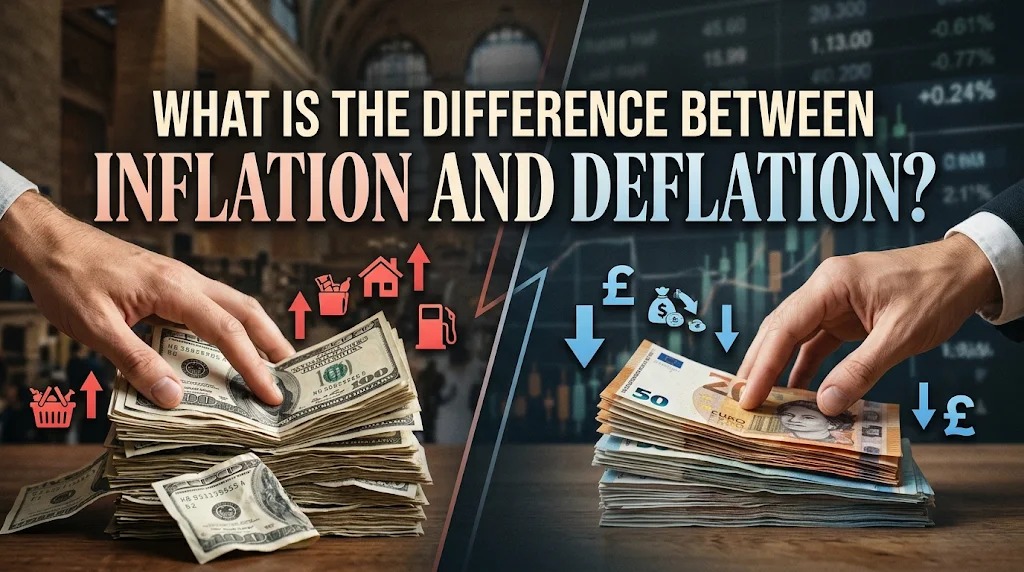
Inflation and deflation are two economic conditions that describe changes in the general prices of goods and services. Although both influence purchasing power, they have opposite effects on the economy. Inflation occurs when prices increase over time, while deflation happens when the general price level decreases continuously. Understanding the difference between these conditions helps consumers, businesses, and policymakers recognize how changes in prices affect economic stability.
UNDERSTANDING THE MEANING OF INFLATION
Inflation is an economic condition characterized by a continuous increase in the general prices of goods and services over a certain period. When inflation occurs, consumers need more money to purchase the same products they previously bought at lower prices. This means the purchasing power of money decreases.
Inflation can be caused by several factors, including increasing consumer demand, higher production costs, supply shortages, and rising energy prices. For example, when the prices of food, transportation, electricity, and housing increase across the economy, households may need to adjust their monthly budgets. Moderate inflation can be consistent with economic growth, but excessive inflation can create financial pressure and uncertainty for consumers and businesses.
UNDERSTANDING THE MEANING OF DEFLATION
Deflation is an economic condition in which the general prices of goods and services decline continuously over a period of time. Unlike inflation, deflation increases the purchasing power of money because consumers can theoretically buy more products with the same amount of money. However, persistent deflation can indicate weak economic activity and create significant challenges.
Deflation may occur when consumer demand decreases, businesses reduce prices to attract customers, or the supply of goods becomes greater than demand. It can also develop during periods of economic contraction when households and businesses become more cautious about spending. Although lower prices may initially benefit consumers, prolonged deflation can discourage purchases and investment if people expect prices to continue falling.
THE MAIN DIFFERENCES BETWEEN INFLATION AND DEFLATION
The most important difference between inflation and deflation is the direction in which the general price level moves. Inflation involves increasing prices, whereas deflation involves decreasing prices. These conditions also influence consumer behavior, business decisions, and the real value of money in different ways.
During inflation, consumers generally experience declining purchasing power because goods and services become more expensive. Businesses may increase their selling prices to cover higher production costs, while households may reduce unnecessary spending to manage their budgets. In contrast, deflation can increase the purchasing power of money because products become cheaper over time.
However, the effects of deflation are not always positive. When consumers expect prices to continue declining, they may postpone purchases in anticipation of lower prices. This behavior can reduce business revenue and discourage companies from expanding their operations. Therefore, both inflation and deflation can create economic challenges when they become excessive or continue for an extended period.
THE EFFECTS OF INFLATION AND DEFLATION ON HOUSEHOLDS AND BUSINESSES
Inflation can increase household expenses because essential goods and services become more expensive. Families may need to spend a larger portion of their income on food, transportation, housing, and healthcare. Businesses may also face higher production costs, although some companies can adjust their selling prices to maintain revenue.
Deflation can create a different set of challenges. Consumers may delay purchases because they expect products to become cheaper in the future. When many people postpone spending, businesses may experience declining sales and reduce production or employment. Companies with existing debts can also face greater repayment pressure because the real value of their debt increases when prices and incomes decline. Therefore, prolonged deflation can weaken economic activity even though consumers initially benefit from lower prices.
HOW GOVERNMENTS AND CENTRAL BANKS RESPOND TO BOTH CONDITIONS
Governments and central banks use different economic policies to manage inflation and deflation. When inflation becomes excessive, central banks may increase interest rates to reduce borrowing and moderate consumer and business spending. Governments can also improve product distribution, strengthen domestic production, and implement appropriate fiscal measures to reduce price pressures.
When deflation threatens economic activity, central banks may lower interest rates to encourage borrowing, spending, and investment. Governments may also introduce fiscal measures to support employment, household consumption, and business activities. The effectiveness of these policies depends on the causes of the economic problem and the condition of the financial system. Careful coordination between monetary and fiscal policies is important for maintaining economic stability.
CONCLUSION
The main difference between inflation and deflation lies in how the general prices of goods and services change over time. Inflation involves rising prices and declining purchasing power, while deflation involves falling prices and can increase the real value of money. However, both conditions can create economic problems when they become excessive or persistent. Maintaining price stability requires effective economic policies that support consumer confidence, business activities, and sustainable growth.
Recent Posts

Bagaimana Sistem SKS pada Program Kuliah... 22.11.2026/35 View

How Does Technology Make Daily Evaluation... 21.11.2026/69 View

Apa Strategi Menghadapi Kesenjangan antara Kompetensi... 21.11.2026/69 View

Mengapa Inventaris Aset Penting bagi Kelancaran... 21.11.2026/67 View

When Should Musicians Join a Record... 21.11.2026/68 View
