

What Is the Difference Between Learning Research and Educational Research?
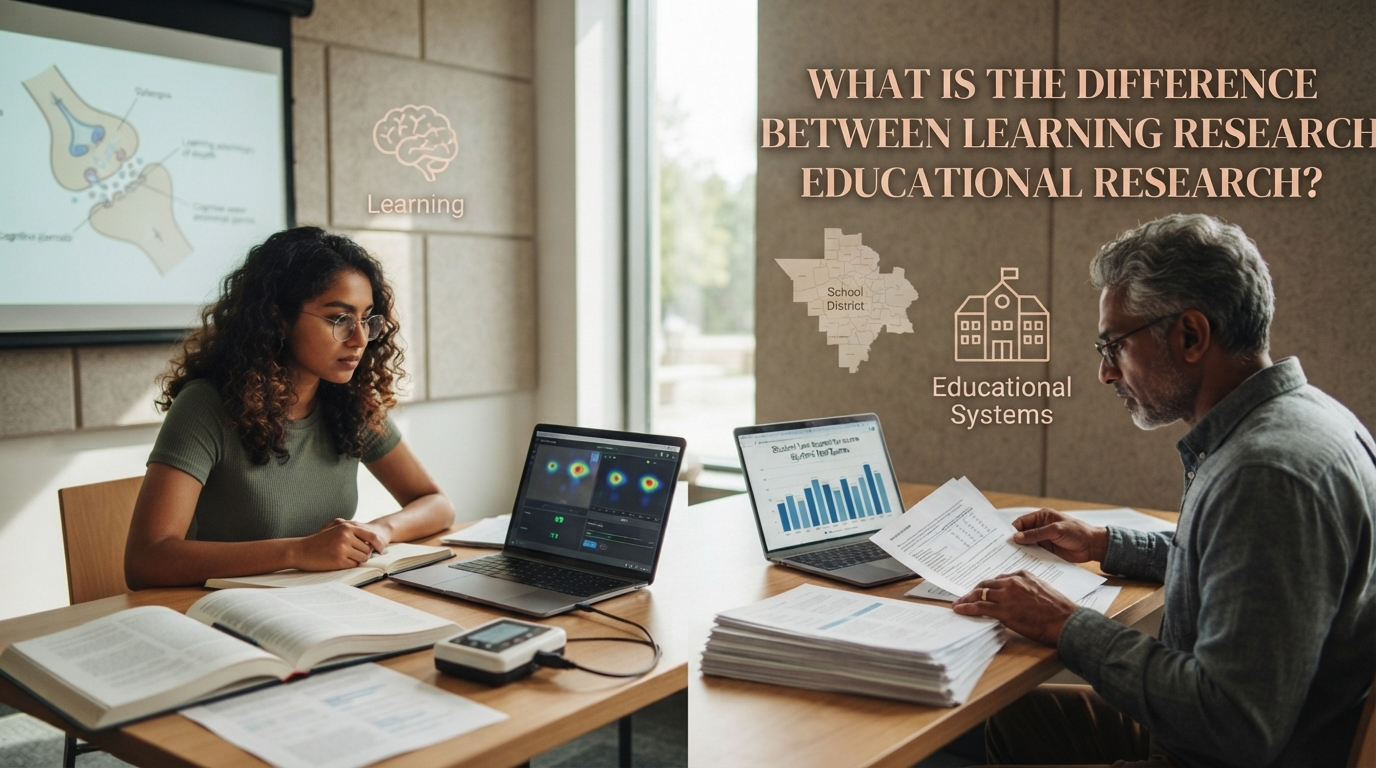
Research plays an important role in improving the quality of knowledge and educational practices. In the academic world, two terms that are often discussed are learning research and educational research. Although both are closely related to the field of education, they have different focuses, objectives, and areas of investigation. Understanding these differences helps students, teachers, and researchers choose the right research approach for their academic activities.
Learning research generally focuses on understanding how individuals acquire knowledge, develop skills, and respond to different learning experiences. Meanwhile, educational research covers a broader range of topics, including teaching systems, school management, curriculum development, educational policies, and learning processes. Both contribute to educational improvement, but they approach educational challenges from different perspectives. By understanding their characteristics, researchers can identify which approach is most appropriate for a particular study.
UNDERSTANDING THE MEANING OF LEARNING RESEARCH
Learning research is a systematic investigation that focuses on how individuals learn, understand information, develop abilities, and improve their knowledge. It examines different factors that influence the learning process, such as student motivation, learning strategies, cognitive development, classroom interactions, and learning environments. Researchers use observations, experiments, interviews, and assessments to understand how students respond to various learning experiences. The main purpose is to discover ways to make learning more effective and meaningful. Its findings can help educators understand students' needs and improve learning activities.
For example, a researcher may investigate whether visual learning materials help university students understand complex subjects more easily. Another study may examine how group discussions influence students' motivation and participation in the classroom. These investigations focus directly on the learning process and the factors that influence individual learning outcomes. Learning research can also explore independent learning, memory, problem-solving, and critical thinking. Therefore, its primary concern is understanding and improving how people acquire knowledge and skills.
UNDERSTANDING THE MEANING OF EDUCATIONAL RESEARCH
Educational research is a broader and systematic study of educational processes, institutions, policies, and practices. It examines various aspects of education, including teaching methods, curriculum design, teacher development, school leadership, educational technology, and student achievement. Researchers use scientific methods to identify educational problems, evaluate existing systems, and develop solutions based on evidence. The purpose is to improve the overall quality, effectiveness, and accessibility of education. Its findings can benefit students, teachers, schools, universities, and policymakers.
For example, educational research may examine how curriculum changes influence student achievement across several schools. Other studies may investigate the effectiveness of teacher training programs, the management of school facilities, or the impact of government education policies. These topics extend beyond individual learning experiences because they also consider institutional and social factors. Educational research helps decision-makers understand how educational systems operate and what improvements are necessary. Therefore, it covers a wider range of issues than research that focuses specifically on learning.
THE MAIN DIFFERENCES BETWEEN LEARNING RESEARCH AND EDUCATIONAL RESEARCH
The main difference between learning research and educational research lies in their scope and primary focus. Learning research concentrates on the processes through which individuals acquire knowledge and develop skills. It examines factors such as motivation, memory, learning behavior, information processing, and student engagement. Educational research, on the other hand, investigates broader educational activities, including institutional management, curriculum policies, teaching practices, and education systems. This means that learning research is generally more focused on the learning experience, while educational research can examine the entire educational environment.
Another difference can be seen in the problems investigated and the use of research findings. Learning research may help teachers understand why students struggle with particular concepts or which learning strategies improve understanding. Educational research may help school administrators evaluate curriculum effectiveness or identify ways to improve educational access. However, their methods can overlap because both may use surveys, interviews, observations, experiments, and statistical analysis. The key distinction is their research focus, not necessarily the methods they use.
DIFFERENCES IN RESEARCH OBJECTIVES
Learning research aims to understand and improve the way individuals acquire knowledge and develop abilities. Researchers may investigate how students remember information, solve problems, or respond to different teaching strategies. The findings can help educators create learning activities that match students' needs and support better academic performance. Another objective is to identify factors that make learning easier or more challenging. Improving individual learning experiences is therefore one of its central goals.
Educational research has broader objectives because it seeks to improve the overall education system. It may evaluate school programs, examine educational policies, develop better curricula, and identify ways to improve teacher performance. Researchers can also investigate educational inequality and access to learning opportunities. These findings can support decisions made by school administrators and education policymakers. Improving educational quality and institutional effectiveness is one of its main objectives.
DIFFERENCES IN RESEARCH SUBJECTS AND AREAS OF STUDY
Learning research commonly examines individuals or groups of learners and their experiences during the learning process. Its research subjects may include elementary school students, university students, adult learners, or individuals participating in training programs. The areas of study often involve learning motivation, memory, concentration, cognitive development, and problem-solving skills. Researchers may also examine how students interact with learning materials and respond to classroom activities. These subjects help explain how knowledge and abilities develop.
Educational research involves a wider range of research subjects and educational settings. It may study students, teachers, school principals, parents, educational institutions, government policies, and curriculum systems. The research topics can include teacher qualifications, school leadership, educational funding, classroom management, and access to education. This broader perspective helps researchers understand the relationships between different elements of an education system. Learning research focuses more directly on learners, while educational research can involve the entire educational structure.
DIFFERENCES IN RESEARCH METHODS AND APPROACHES
Both learning research and educational research can use qualitative, quantitative, and mixed-method approaches. Qualitative research is useful for understanding experiences, opinions, and behaviors through interviews or observations. Quantitative research examines numerical information through surveys, assessments, and statistical analysis. Mixed-method research combines both approaches to provide a more comprehensive understanding of a research problem. The selection of a method depends on the research questions, objectives, and available data.
However, the application of these methods may differ according to the research focus. Learning research may use classroom experiments to compare the effectiveness of different learning strategies or assessments to measure students' understanding. Educational research may use surveys across multiple schools to evaluate curriculum implementation or interview administrators about educational management. Research methods should match the questions being investigated, rather than being selected simply because they are commonly used. Both approaches require reliable data, appropriate analysis, and ethical research practices.
EXAMPLES OF LEARNING RESEARCH AND EDUCATIONAL RESEARCH
An example of learning research is a study examining how interactive learning applications influence students' understanding of mathematics. Researchers may compare students' performance before and after using the applications. They may also interview students to understand their experiences and identify difficulties during the learning process. Another example is investigating whether collaborative learning improves students' communication and problem-solving abilities. These studies focus on how particular learning experiences influence students.
Meanwhile, an example of educational research is a study examining how a new curriculum affects the quality of education in different schools. Researchers may analyze teacher readiness, learning facilities, curriculum implementation, and student achievement. Another example is investigating the relationship between school leadership and teacher performance. These studies examine broader educational conditions rather than focusing only on individual learning experiences. The examples show that both research areas can address similar educational concerns but approach them from different perspectives.
THE RELATIONSHIP BETWEEN LEARNING RESEARCH AND EDUCATIONAL RESEARCH
Although learning research and educational research have different focuses, they are closely connected and can support each other. Learning research provides information about how students acquire knowledge and which learning strategies are effective. Educational research can use these findings to improve curriculum development, teaching programs, and institutional policies. This relationship allows educational institutions to make decisions based on a better understanding of students' actual learning needs. As a result, both research approaches contribute to improving educational quality.
For example, findings from learning research may show that students understand certain subjects more effectively through practical activities. Educational researchers can use this information to evaluate whether school curricula provide enough opportunities for practical learning. Teachers and school administrators can then consider appropriate changes to classroom activities and educational programs. Combining both research perspectives creates a stronger foundation for developing effective and student-centered education. Their collaboration also encourages continuous improvement across different educational environments.
WHICH RESEARCH APPROACH SHOULD STUDENTS CHOOSE?
Students should choose between learning research and educational research based on their interests, academic objectives, and the problems they want to investigate. If they are interested in student motivation, memory, learning strategies, or academic understanding, learning research may be more suitable. This approach allows them to explore how individuals learn and what factors influence their learning experiences. It is particularly relevant for students interested in learning psychology, teaching strategies, and student development.
However, students who want to examine curriculum development, school management, teacher performance, or education policies may find educational research more appropriate. They should also consider the availability of research participants, data sources, time, and academic guidance. Discussing the research topic with a lecturer or academic supervisor can help students determine the most suitable approach. Choosing the right research focus makes the investigation more organized, relevant, and manageable. Most importantly, the selected approach should be able to answer the research questions clearly.
CONCLUSION
Learning research and educational research are two important areas that contribute to the development of knowledge and the improvement of education. Learning research focuses on understanding how individuals acquire knowledge, develop skills, and respond to learning experiences. In contrast, educational research has a broader scope because it examines teaching systems, curriculum development, institutional management, educational policies, and other aspects of education.
Although their objectives and research focuses are different, both approaches complement each other in creating better educational practices. Learning research provides insights into students' learning needs, while educational research helps transform relevant findings into improvements across educational institutions. Ultimately, understanding the difference between learning research and educational research helps students and educators select appropriate research approaches and contribute to a more effective, inclusive, and higher-quality education system.
Recent Posts

How Does Technology Make Daily Evaluation... 21.11.2026/62 View

Apa Strategi Menghadapi Kesenjangan antara Kompetensi... 21.11.2026/63 View

Mengapa Inventaris Aset Penting bagi Kelancaran... 21.11.2026/59 View

When Should Musicians Join a Record... 21.11.2026/58 View

Daily Evaluation or Daily Planning Which... 21.11.2026/66 View
