

What Is the Difference Between Logical Intelligence and Memorization Skills?
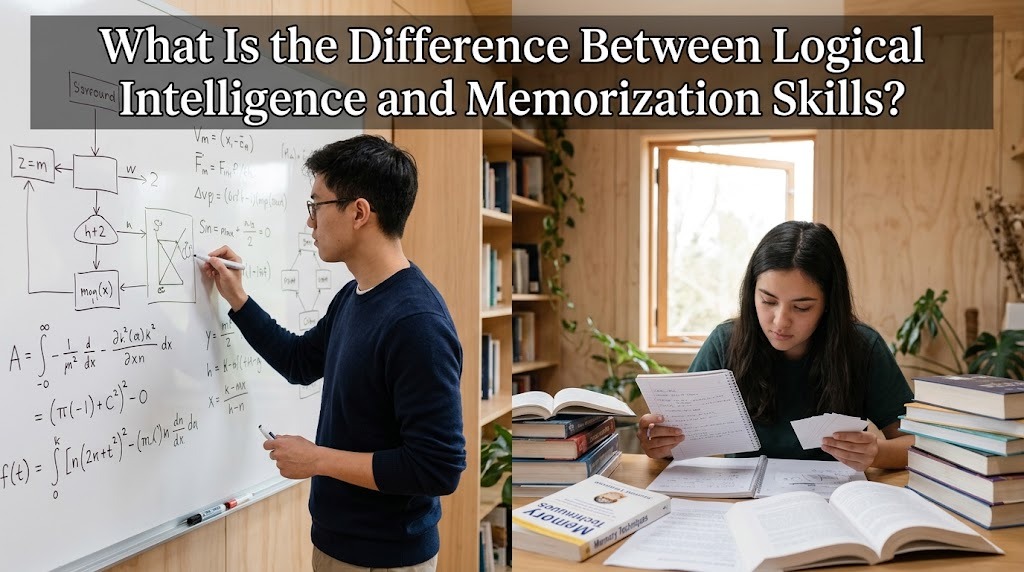
Logical intelligence and memorization skills are both useful abilities in the learning process, but they work in different ways. Logical intelligence focuses on reasoning, analyzing information, recognizing patterns, and understanding relationships. Memorization skills focus more on storing and recalling information when it is needed. Understanding the difference can help students use both abilities effectively in their studies.
UNDERSTANDING LOGICAL INTELLIGENCE
Logical intelligence is the ability to use reasoning and structured thinking to understand information and solve problems. A student uses logical intelligence when they identify patterns, compare ideas, analyze causes and effects, or determine how different concepts are connected. This ability helps students understand why something happens rather than simply remembering that it happens. It can be applied to many subjects and everyday situations.
Logical thinking often involves several steps. A student may identify the problem, examine relevant information, consider possible explanations, and reach a conclusion based on reasoning. This process can help students deal with unfamiliar questions because they can apply what they understand to a new situation. Therefore, logical intelligence is closely related to problem solving and analytical thinking.
UNDERSTANDING MEMORIZATION SKILLS
Memorization skills refer to the ability to store and recall information. Students use these skills when remembering vocabulary, formulas, dates, definitions, names, or other important facts. Memorization can provide a useful foundation because students need basic information before they can apply it in more complex tasks. However, remembering information and understanding its meaning are not always the same thing.
Effective learning often requires more than repeating information several times. Students can improve recall by using techniques such as spaced practice, active recall, organization, and meaningful connections. Connecting new information to concepts that students already understand can also make it easier to remember. These methods can make memorization more useful as part of a broader learning process.
DIFFERENCES IN HOW THEY WORK
The main difference is that logical intelligence focuses on understanding and reasoning, while memorization skills focus on storing and recalling information. For example, a student may memorize a mathematical formula without fully understanding why it works. Another student may understand the relationship behind the formula and use that understanding to solve a new type of problem. The two abilities therefore contribute to learning in different ways.
Logical intelligence is especially useful when students encounter unfamiliar situations that require them to apply knowledge. Memorization can be particularly useful when certain information needs to be recalled accurately and quickly. Neither ability completely replaces the other. Understanding and remembering can work together to create a stronger learning process.
HOW LOGICAL INTELLIGENCE AND MEMORY SUPPORT EACH OTHER
Although they are different, logical intelligence and memorization skills can complement one another. Students need stored knowledge to provide information that can be used during reasoning. At the same time, logical thinking can help students organize and connect information, making it easier to understand and remember. This relationship shows why effective learning usually involves both knowledge and reasoning.
For example, a student learning a new subject may first memorize important terms and basic concepts. After understanding those concepts, the student can analyze how they are related and apply them to a problem. This process combines memory, comprehension, and logical reasoning. Using both abilities can make learning more meaningful than relying entirely on memorization.
BALANCING MEMORIZATION AND LOGICAL THINKING
Students can benefit from using different learning methods depending on the type of material they are studying. Facts, vocabulary, formulas, and definitions may require deliberate memorization and repeated recall. More complex tasks may require students to analyze information, compare possibilities, and apply concepts to new situations. Combining these approaches can provide a more complete learning strategy.
Teachers can support this balance by giving students opportunities to both recall information and explain their reasoning. Students can also review basic knowledge before working on tasks that require deeper analysis. This allows memorized information to become a foundation for critical thinking and problem solving. Over time, students can learn when to rely on memory and when to use logical reasoning.
CONCLUSION
The difference between logical intelligence and memorization skills mainly lies in how they are used. Logical intelligence involves reasoning, analysis, pattern recognition, and understanding relationships, while memorization skills involve storing and recalling information. Both abilities are valuable because students need knowledge to support reasoning and reasoning to apply knowledge effectively. A balanced learning process can combine memorization with understanding, analysis, and practical application. By developing both abilities, students can become more effective, flexible, and independent learners.
Recent Posts

Bagaimana Sistem SKS pada Program Kuliah... 22.11.2026/21 View

How Does Technology Make Daily Evaluation... 21.11.2026/64 View

Apa Strategi Menghadapi Kesenjangan antara Kompetensi... 21.11.2026/65 View

Mengapa Inventaris Aset Penting bagi Kelancaran... 21.11.2026/62 View

When Should Musicians Join a Record... 21.11.2026/61 View
