

What Is the Difference Between National Provincial and Regional Election Commissions?
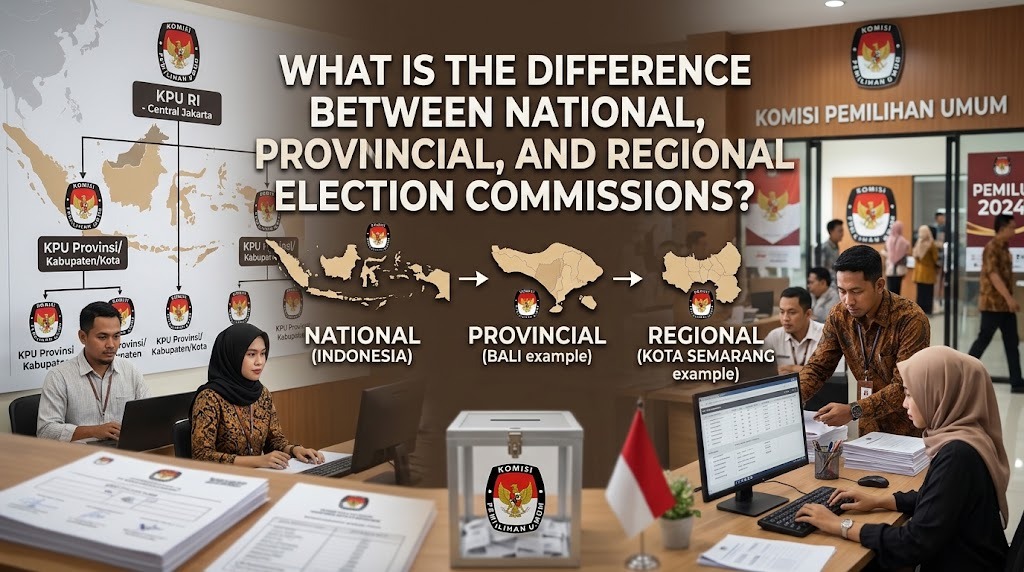
The General Elections Commission (KPU) is an institution responsible for organizing general elections in Indonesia. Because Indonesia has a large geographical area and a complex administrative structure, election management requires cooperation between institutions at different levels. The KPU operates nationally, provincially, and at the regency or municipal level to ensure that election activities can be implemented effectively throughout the country. Each level has different responsibilities, but all of them work toward the same goal of conducting fair, transparent, and orderly elections.
Understanding the differences between national, provincial, and regional election commissions is important because each institution has a specific role in the electoral process. The national KPU is responsible for establishing general policies and coordinating election implementation across Indonesia. Provincial KPU offices manage election activities within their respective provinces, while regency and municipal KPU offices handle implementation at the local level. Through this organizational structure, election management can be coordinated more effectively, allowing citizens in different regions to exercise their democratic rights.
NATIONAL GENERAL ELECTIONS COMMISSION
The National General Elections Commission (KPU RI) is the highest level of the KPU organizational structure in Indonesia. It is responsible for organizing national elections and establishing policies that guide election implementation throughout the country. Its responsibilities include preparing election schedules, developing technical regulations, managing national election programs, and coordinating with provincial and regency or municipal KPU offices. The national commission also handles important administrative processes related to political parties, presidential and vice-presidential candidates, and national election results according to applicable laws.
Another important responsibility of the national KPU is ensuring that election management follows national regulations and democratic principles. It coordinates with government institutions, the Election Supervisory Agency (Bawaslu), and other relevant organizations to support the electoral process. The national commission also manages election information systems and publishes official information about election activities. National coordination is essential because decisions and policies must be implemented consistently across different regions. Through these responsibilities, KPU RI provides overall direction for election administration in Indonesia.
PROVINCIAL GENERAL ELECTIONS COMMISSION
The Provincial General Elections Commission (KPU Provinsi) is responsible for organizing and coordinating election activities within a particular province. It operates under the national KPU and implements election policies according to the geographical and administrative conditions of its region. Its duties include coordinating regency and municipal KPU offices, managing provincial election administration, and supporting the implementation of national and regional elections. The provincial commission also helps ensure that election procedures are carried out consistently across different areas within the province.
In addition, the provincial KPU handles election administration related to the selection of provincial legislative representatives and other responsibilities assigned by election regulations. It coordinates with provincial government institutions and relevant election organizations to support preparations and implementation. The commission also monitors administrative progress and helps address operational challenges faced by local election offices. Provincial coordination is important because each province may have different geographical conditions, population characteristics, and logistical requirements. Therefore, the provincial KPU serves as an important link between national election policies and local implementation.
REGENCY AND MUNICIPAL GENERAL ELECTIONS COMMISSION
The Regency and Municipal General Elections Commission (KPU Kabupaten/Kota) operates at the local administrative level and is responsible for organizing elections within a regency or municipality. Its duties include managing local election preparations, updating voter information, coordinating polling station activities, and handling election administration in its working area. This commission also coordinates with district election committees and polling station officers to ensure that voting activities are properly organized. Its work is important because it directly supports the implementation of elections within local communities.
The regency or municipal KPU also helps manage election logistics, distribute voting materials, and conduct vote-counting recapitulation according to established procedures. It provides information to local residents about voter registration, polling locations, and election schedules. Because it works closer to communities, this institution often deals directly with practical challenges experienced by voters and election officers. Local election administration requires accurate data, effective communication, and strong coordination. These responsibilities help ensure that election services reach citizens across different neighborhoods and communities.
DIFFERENCES IN DUTIES AND RESPONSIBILITIES
The main difference between national, provincial, and regency or municipal election commissions lies in their administrative scope and responsibilities. The national KPU focuses on national policies, overall coordination, and responsibilities assigned to it by election laws. Provincial KPU offices coordinate election activities within their provinces and supervise the implementation of relevant programs at the regional level. Meanwhile, regency and municipal KPU offices focus on practical election administration within their respective working areas. Although their duties are different, all levels must follow the same legal framework.
These differences allow election management to become more organized and efficient. For example, national policies can be established centrally, while provincial and local commissions adapt their implementation to regional conditions within the applicable regulations. This structure also helps distribute administrative responsibilities so that the national institution does not have to handle every operational activity directly. Clear division of responsibilities is necessary to avoid confusion and improve coordination between election organizers. Each level must communicate effectively to ensure that election activities are conducted according to established standards.
COORDINATION BETWEEN DIFFERENT ELECTION COMMISSIONS
Coordination between national, provincial, and regency or municipal KPU offices is essential for successful election management. The national commission provides policies and technical guidelines, while provincial and local commissions implement the required activities within their respective areas. Information about voter registration, election logistics, candidate administration, and voting results must be communicated through appropriate administrative channels. Effective coordination helps ensure that every institution understands its responsibilities and can complete assigned tasks on schedule.
Furthermore, cooperation is important when addressing election-related challenges. Indonesia has regions with different geographical conditions, population sizes, and transportation facilities. Some areas may require additional logistical preparation, while others may face challenges involving voter data or limited infrastructure. Through coordination, election commissions can exchange information and develop appropriate solutions. Institutional cooperation also supports transparency and accountability because each level can report its activities and follow established procedures.
THE IMPORTANCE OF THE ELECTION COMMISSION STRUCTURE FOR DEMOCRACY
The organizational structure of the KPU plays an important role in supporting democracy throughout Indonesia. By dividing responsibilities between national, provincial, and regency or municipal levels, election administration can reach a wider population. This structure helps ensure that election preparations, voting activities, and administrative services are managed according to regional needs. It also allows citizens to access election-related information and services through institutions operating closer to their communities.
Moreover, an organized election commission structure helps improve public confidence in democratic institutions. Citizens need to know that elections are managed professionally and that their voting rights are protected regardless of where they live. Each KPU level must maintain neutrality, transparency, and accountability when carrying out its responsibilities. Professional election management supports public participation and helps protect the credibility of election results. Through effective cooperation at every level, the KPU contributes to strengthening democracy in Indonesia.
CONCLUSION
The national, provincial, and regency or municipal General Elections Commissions have different responsibilities but share the same purpose of organizing elections in Indonesia. The national KPU establishes policies and manages overall election coordination, the provincial KPU coordinates activities within its province, and the regency or municipal KPU handles election administration at the local level. Their cooperation is essential for managing voter registration, election logistics, voting activities, and vote-counting procedures. Understanding these differences helps citizens recognize how election institutions work together. Ultimately, an effective KPU organizational structure supports fair elections, public participation, and stronger democracy in Indonesia.
Recent Posts

Bagaimana Sistem SKS pada Program Kuliah... 22.11.2026/47 View

How Does Technology Make Daily Evaluation... 21.11.2026/74 View

Apa Strategi Menghadapi Kesenjangan antara Kompetensi... 21.11.2026/75 View

Mengapa Inventaris Aset Penting bagi Kelancaran... 21.11.2026/72 View

When Should Musicians Join a Record... 21.11.2026/75 View
