

What Is the Difference Between Operations Management and Production Management?
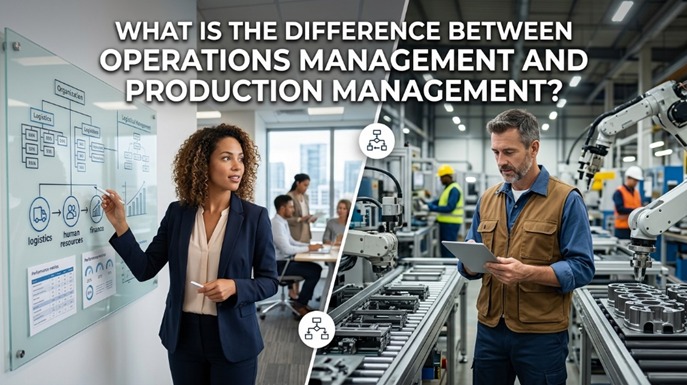
In every business, effective management is essential to ensure that activities run smoothly and organizational goals can be achieved. Two important areas that often appear in business discussions are operations management and production management. Although these terms are closely related, they have different responsibilities, focuses, and scopes.
Many people assume that operations management and production management mean the same thing because both involve managing processes and resources. However, operations management has a broader scope, while production management focuses more specifically on the process of creating goods. Understanding the difference between them can help businesses organize their activities, improve efficiency, and deliver better results.
1. UNDERSTANDING OPERATIONS MANAGEMENT
Operations management is the process of planning, organizing, and controlling the activities required to produce goods and deliver services. It covers the use of various resources, including employees, technology, materials, equipment, and information. Its main objective is to ensure that business processes operate efficiently while meeting customer expectations. Operations management is used in many industries, including manufacturing, retail, healthcare, transportation, and hospitality.
Unlike management that focuses on only one production area, operations management oversees a wider range of organizational activities. For example, a hotel uses operations management to coordinate room reservations, housekeeping, customer service, staffing, and maintenance. The main focus is improving the overall performance of business operations, whether the company produces physical products or provides services.
2. UNDERSTANDING PRODUCTION MANAGEMENT
Production management refers to the planning, coordination, and control of activities involved in transforming raw materials into finished products. It mainly focuses on manufacturing processes, production schedules, equipment, labor, and product quality. The objective is to ensure that goods are produced in the right quantity, at the right time, and according to established quality standards.
Production management also involves monitoring each stage of manufacturing to prevent delays, defects, and unnecessary waste. For example, a furniture manufacturer must organize raw materials, workers, machines, and production schedules to create products that meet customer requirements. Its primary responsibility is ensuring that the manufacturing process runs efficiently and consistently.
3. THE MAIN DIFFERENCE IN SCOPE AND RESPONSIBILITIES
The most important difference between operations management and production management is their scope of responsibility. Operations management covers a broader range of activities across an organization, including production, service delivery, inventory, logistics, and process improvement. Production management has a narrower focus because it concentrates on activities directly related to manufacturing goods.
For example, a company that manufactures electronic devices may use operations management to coordinate purchasing, inventory, distribution, customer service, and manufacturing. Meanwhile, production management focuses on assembling components, operating machinery, scheduling production, and checking product quality. Production management can be considered part of the broader operations management function in many manufacturing businesses. However, the exact organizational structure may differ between companies.
4. DIFFERENCES IN BUSINESS OBJECTIVES
Operations management aims to improve the overall efficiency and effectiveness of an organization's processes. It seeks to balance cost, quality, speed, flexibility, and reliability across business activities. By managing these factors, companies can provide better customer experiences while maintaining efficient operations.
Production management has more specific objectives related to manufacturing performance. These include meeting production targets, reducing material waste, maintaining product standards, and maximizing the use of production equipment. While operations management focuses on overall business process performance, production management concentrates on achieving effective manufacturing results. Both contribute to business success, but they measure performance from different perspectives.
5. DIFFERENCES IN ACTIVITIES AND DAILY TASKS
Operations management involves various daily activities depending on the type of business. These activities may include managing inventory, coordinating suppliers, organizing employee schedules, improving workflows, monitoring service quality, and overseeing product distribution. In service industries, it may also involve managing customer waiting times and ensuring consistent service delivery.
Production management deals more directly with manufacturing activities. Its tasks include preparing production schedules, allocating raw materials, supervising manufacturing workers, maintaining machines, and inspecting finished products. For instance, a food processing company may use production management to control ingredient quantities, processing times, packaging, and product quality. The difference lies in the range of activities each function manages and the processes it prioritizes.
6. DIFFERENCES IN PERFORMANCE MEASUREMENT
Operations management uses performance indicators that evaluate how effectively the entire operational system works. Common indicators include operating costs, customer satisfaction, delivery performance, inventory turnover, service efficiency, and resource utilization. These measurements help managers understand whether business processes are meeting organizational objectives.
Production management uses indicators that focus more specifically on manufacturing results. Examples include production output, defect rates, machine utilization, production cycle time, and material waste. Operations management measures broader operational performance, while production management evaluates the efficiency and quality of manufacturing activities. Both types of measurement help managers identify problems and make improvements.
7. THE ROLE OF TECHNOLOGY IN BOTH MANAGEMENT AREAS
Technology plays an important role in improving operations management and production management. Operations managers may use Enterprise Resource Planning (ERP) systems, inventory management software, and data analytics tools to coordinate different business functions. These technologies help organizations share information, monitor performance, and make decisions based on more accurate data.
Production managers may use manufacturing software, automated machinery, robotics, and production monitoring systems. These tools help control manufacturing processes, improve accuracy, and reduce production delays. Technology supports both management areas by improving efficiency, accuracy, and coordination. However, the tools selected depend on the company's operational needs and production requirements.
8. EXAMPLES OF OPERATIONS MANAGEMENT AND PRODUCTION MANAGEMENT
A simple example can help explain how these two management areas work together. Consider a company that produces bottled drinking water. Its operations management team may oversee supplier coordination, inventory, production activities, product distribution, customer service, and operational budgeting. Its responsibility covers the broader system needed to deliver products to customers.
Meanwhile, the production management team focuses on activities inside the manufacturing process. It ensures that water treatment, bottling, labeling, packaging, and quality inspections are completed according to production standards. Both functions work toward the same business goals but manage different parts of the process. Their coordination helps the company produce and deliver products efficiently.
9. WHY BUSINESSES NEED BOTH MANAGEMENT FUNCTIONS
Businesses need effective operations management to coordinate resources and processes across their organizations. Without it, departments may work inefficiently, operational costs may increase, and customer expectations may not be met. A well-managed operational system helps companies maintain consistency and respond to changes in demand.
Production management is equally important for businesses that manufacture physical goods. It helps ensure that production activities meet quality standards, schedules, and output targets. When operations management and production management work together, businesses can improve productivity, maintain product quality, and use resources more effectively. This cooperation also supports long-term competitiveness and growth.
CONCLUSION
Operations management and production management are closely connected, but they have different scopes and responsibilities. Operations management covers the broader activities required to run a business, including manufacturing and service delivery. Meanwhile, production management focuses specifically on the processes involved in creating physical goods.
Both functions are important because they help businesses improve efficiency, control costs, maintain quality, and satisfy customers. Understanding their differences allows organizations to assign responsibilities more clearly and manage their resources effectively. By coordinating both areas, businesses can build more reliable processes and achieve sustainable success.
Recent Posts

Bagaimana Sistem SKS pada Program Kuliah... 22.11.2026/12 View

How Does Technology Make Daily Evaluation... 21.11.2026/63 View

Apa Strategi Menghadapi Kesenjangan antara Kompetensi... 21.11.2026/64 View

Mengapa Inventaris Aset Penting bagi Kelancaran... 21.11.2026/61 View

When Should Musicians Join a Record... 21.11.2026/59 View
