

What Is the Difference Between Partial and Complete Color Blindness?
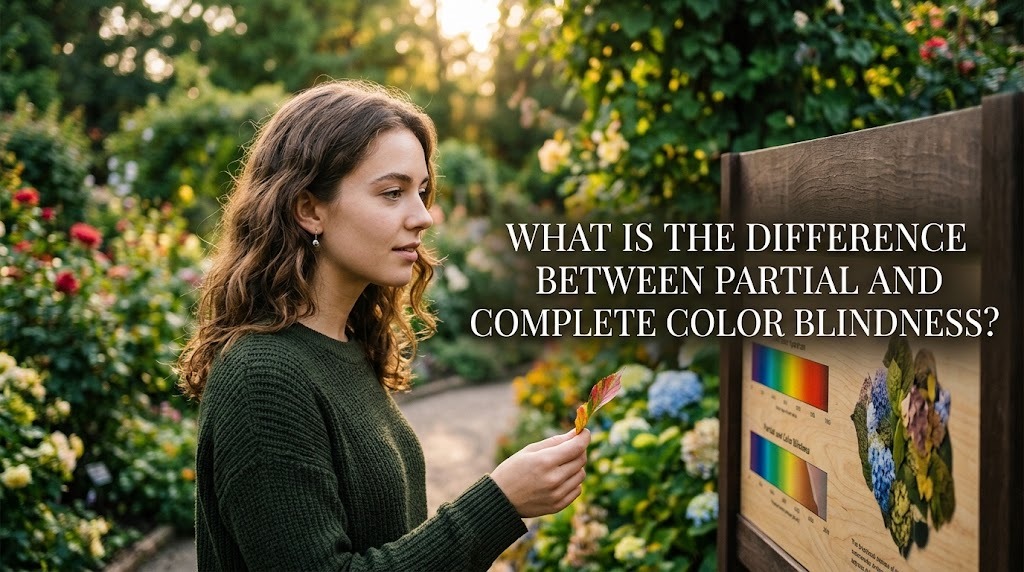
Color blindness is a vision condition that affects a person's ability to distinguish certain colors. Although many people use the term color blindness to describe all difficulties in seeing colors, the condition can vary in severity. Some individuals have difficulty distinguishing only specific colors, while others may have significant difficulty recognizing almost all colors.
Understanding the difference between partial and complete color blindness is important because both conditions affect color perception in different ways. They also have different causes, symptoms, and effects on everyday activities. By recognizing these differences, individuals can better understand their vision condition and determine whether they need further eye examinations.
WHAT IS PARTIAL COLOR BLINDNESS?
Partial color blindness is a vision condition in which someone has difficulty distinguishing certain colors but can still see other colors relatively normally. This condition is the most common form of color vision deficiency. People with partial color blindness usually have difficulty distinguishing shades of red and green, although some individuals may also experience problems with blue and yellow.
This condition occurs when certain cone cells in the retina do not function properly. Cone cells are responsible for detecting different wavelengths of light and helping the brain recognize colors. When one type of cone cell is missing or does not work normally, the ability to distinguish particular colors becomes limited. However, people with partial color blindness can generally recognize many colors and perform most daily activities independently.
WHAT IS COMPLETE COLOR BLINDNESS?
Complete color blindness is a rare vision condition in which a person has extremely limited or no ability to distinguish colors. In many cases, individuals with this condition see the world mainly in shades of gray, black, and white. This condition is medically known as achromatopsia when it involves the complete or near-complete absence of normal color vision.
Complete color blindness is commonly associated with problems affecting the cone cells in the retina. Unlike partial color blindness, which usually affects the perception of specific color groups, complete color blindness significantly reduces the ability to perceive colors overall. People with this condition may also experience additional vision problems, such as sensitivity to bright light, reduced visual sharpness, and involuntary eye movements called nystagmus. These symptoms can make certain activities, particularly those involving bright environments, more challenging.
KEY DIFFERENCES BETWEEN PARTIAL AND COMPLETE COLOR BLINDNESS
The main difference between partial and complete color blindness lies in how much color a person can recognize. Individuals with partial color blindness can still see many colors but may confuse certain shades, especially red and green. Meanwhile, people with complete color blindness have a much more limited ability to perceive colors and may see their surroundings primarily in grayscale.
Another difference involves the condition of the cone cells in the retina. Partial color blindness generally occurs because one or more types of cone cells have reduced or abnormal function. Complete color blindness involves a more significant disruption of the cone cells responsible for normal color vision. The severity of visual difficulties can also vary between individuals, depending on the underlying condition.
In everyday life, people with partial color blindness may have difficulty identifying colored charts, traffic signals, clothing combinations, or color-coded information. People with complete color blindness may rely more heavily on differences in brightness, contrast, patterns, and shapes to recognize objects. Therefore, the impact of each condition depends on the individual's remaining visual abilities and the environment around them.
CAUSES AND SYMPTOMS OF BOTH CONDITIONS
Partial color blindness is often inherited and associated with genetic changes that affect the development or function of cone cells. Red-green color vision deficiency is commonly linked to genes located on the X chromosome, which explains why it occurs more frequently in men. However, color vision problems can also develop later in life due to eye diseases, certain medications, or damage to the visual system.
Complete color blindness is often associated with inherited conditions that affect the function of cone cells. Achromatopsia is generally present from birth and can cause severe color vision difficulties. Common symptoms include poor color discrimination, sensitivity to light, reduced visual acuity, and involuntary eye movements. Some acquired conditions can also cause severe color vision loss, although their symptoms and underlying causes may differ from inherited achromatopsia.
Both conditions require appropriate evaluation to identify the type and severity of the vision problem. An eye specialist can assess color perception and examine whether other visual functions are affected. Early identification is particularly useful for children because color vision difficulties may influence learning activities and the ability to interpret educational materials.
HOW ARE PARTIAL AND COMPLETE COLOR BLINDNESS DIAGNOSED?
Color blindness can be identified through several eye examinations designed to evaluate a person's ability to recognize and distinguish colors. One commonly used method is the Ishihara test, which consists of colored dot patterns containing numbers or shapes. This test is particularly useful for identifying common red-green color vision deficiencies, although it is not sufficient to diagnose every type of color blindness.
Other examinations may include color arrangement tests, in which individuals organize colored objects according to their shades. More specialized examinations can measure how the eyes respond to different wavelengths of light and help identify more complex color vision problems. These tests are useful when an individual has unusual symptoms or suspected complete color blindness.
For suspected achromatopsia, an eye specialist may also recommend additional examinations to evaluate retinal function and visual responses. These examinations help distinguish complete color blindness from other conditions that affect color perception. Accurate diagnosis is important because the appropriate management depends on the underlying cause and the severity of the condition.
CONCLUSION
Partial and complete color blindness are different conditions that affect a person's ability to recognize colors. Partial color blindness usually causes difficulty distinguishing certain color groups while preserving the ability to see many other colors. In contrast, complete color blindness involves a much more severe loss of color perception and may cause individuals to see the world mainly in grayscale.
Although both conditions can influence daily activities, their effects vary depending on the individual's visual abilities. Understanding their differences, recognizing the symptoms, and undergoing appropriate eye examinations can help individuals manage their vision needs. If someone experiences difficulty distinguishing colors, consulting an eye specialist is an important step toward obtaining an accurate diagnosis.
Recent Posts

Bagaimana Sistem SKS pada Program Kuliah... 22.11.2026/42 View

How Does Technology Make Daily Evaluation... 21.11.2026/72 View

Apa Strategi Menghadapi Kesenjangan antara Kompetensi... 21.11.2026/74 View

Mengapa Inventaris Aset Penting bagi Kelancaran... 21.11.2026/70 View

When Should Musicians Join a Record... 21.11.2026/73 View
