

What Is the Difference Between Political Literacy and Political Education?
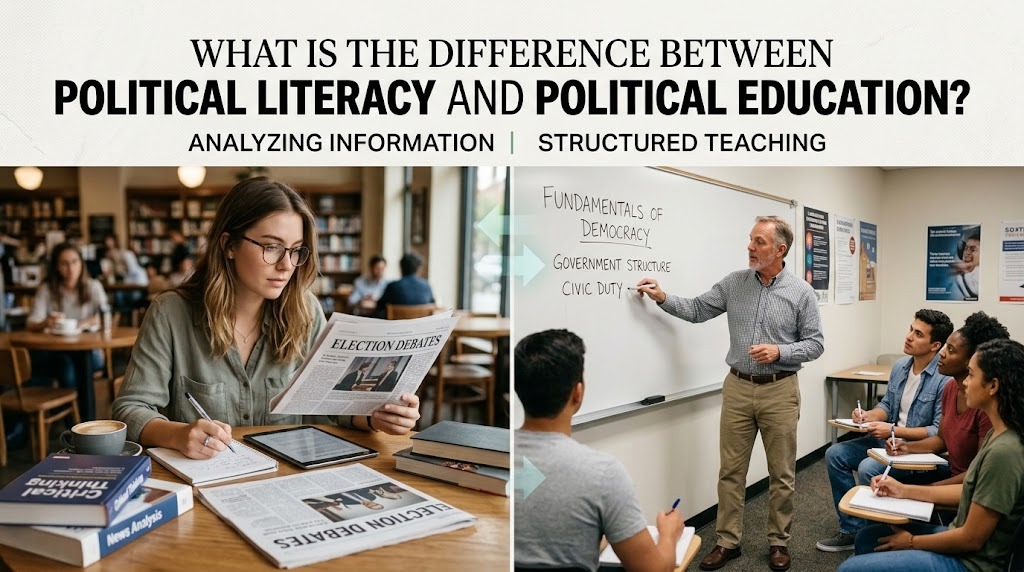
Political literacy and political education are closely related concepts, but they do not have exactly the same meaning. Political literacy generally refers to the knowledge and skills people use to understand political issues, public institutions, rights, responsibilities, and civic participation. Political education refers more broadly to the process of providing learning and experiences that help people develop this knowledge and understanding.
Understanding the difference between political literacy and political education can help clarify how people learn about politics and how they apply that knowledge in everyday life. Both can contribute to informed civic participation while allowing individuals to develop their own political views.
UNDERSTANDING POLITICAL LITERACY
Political literacy refers to a person's ability to understand and evaluate political information and public issues. It can include knowledge of government institutions, laws, elections, public policies, civic rights, and responsibilities.
Political literacy also involves practical skills. A politically literate person can examine information, consider evidence, understand different perspectives, and communicate about public issues more carefully.
Therefore, political literacy is not simply about memorizing political terms or names. It involves applying knowledge to understand political situations and make informed judgments.
UNDERSTANDING POLITICAL EDUCATION
Political education is the process through which people learn about political systems, civic life, public institutions, rights, responsibilities, and democratic processes. It can take place in schools, universities, families, communities, organizations, and other educational environments.
Political education may involve lessons, discussions, projects, civic activities, and other learning experiences. The content and approach can vary depending on the educational setting and the age or circumstances of the learners.
The broader purpose of political education can be to provide people with knowledge and opportunities to understand how society and public institutions function. Civic and democratic education frameworks also emphasize knowledge, skills, attitudes, and participation in democratic life.
COMPARING THEIR MAIN DIFFERENCES
The simplest way to understand the difference is to view political education as a learning process and political literacy as a set of knowledge and skills that can result from learning and experience.
For example, a student may receive political education by studying how government institutions work. The ability to use that knowledge to understand a public issue, evaluate information, and discuss the issue based on evidence represents aspects of political literacy.
The two concepts therefore support each other. Political education can provide opportunities to develop political literacy, while political literacy can help people apply what they have learned in real situations.
HOW THEY WORK TOGETHER IN DAILY LIFE
Both political literacy and political education can be developed through everyday experiences. Reading reliable news, learning about public policies, discussing community issues, and participating in appropriate civic activities can provide opportunities for learning.
Schools and universities can provide structured political education, while individuals can continue developing political literacy through independent learning and experience. Media and information literacy can also support this process by helping people evaluate information encountered online.
UNESCO emphasizes the importance of media and information literacy in helping people access, evaluate, and use information effectively. These skills are particularly useful when people encounter political content through digital platforms.
SUPPORTING INFORMED CIVIC PARTICIPATION
The relationship between political literacy and political education becomes especially relevant in democratic societies. People need opportunities to understand public institutions and civic processes while developing the skills to evaluate political information independently.
Political education can introduce concepts such as rights, responsibilities, democracy, and public institutions. Political literacy can then help individuals apply these concepts when interpreting political information and participating in civic life.
Neither concept requires people to have identical political opinions. The goal is to provide knowledge, skills, and learning opportunities that allow individuals to understand public affairs and form their own informed judgments.
CONCLUSION
The main difference between political literacy and political education is that political literacy focuses on the knowledge and skills used to understand political issues, while political education refers to the process of learning about politics, civic life, and democratic institutions.
Both concepts are connected and can complement each other. Through political education, people can gain knowledge and learning experiences, while political literacy helps them apply that knowledge when evaluating information, understanding public issues, and participating responsibly in society.
Recent Posts

Bagaimana Sistem SKS pada Program Kuliah... 22.11.2026/33 View

How Does Technology Make Daily Evaluation... 21.11.2026/67 View

Apa Strategi Menghadapi Kesenjangan antara Kompetensi... 21.11.2026/67 View

Mengapa Inventaris Aset Penting bagi Kelancaran... 21.11.2026/65 View

When Should Musicians Join a Record... 21.11.2026/66 View
