

What Is the Difference Between Regional Government Owned Enterprises and State Owned Enterprises?
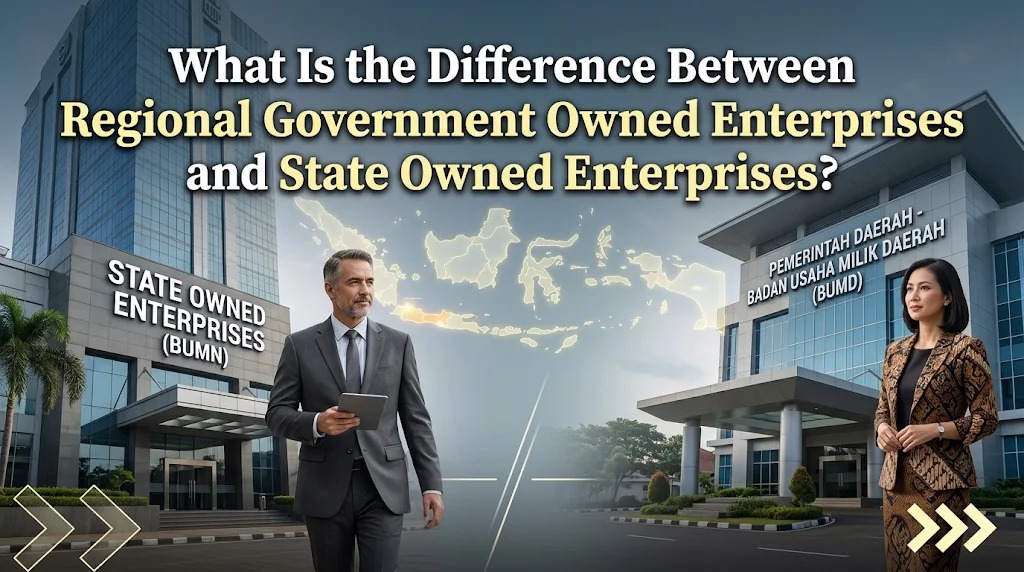
Regional Government Owned Enterprises (BUMD) and State Owned Enterprises (BUMN) are business entities established with government ownership in Indonesia. Both play important roles in supporting economic development, providing public services, and generating government revenue. However, they differ in terms of ownership, management authority, business objectives, and the level of government responsible for supervising their activities. BUMD are owned by regional governments, while BUMN are owned by the central government through state capital participation. These differences determine how each enterprise operates and contributes to the national and regional economies.
Although both types of enterprises operate as business organizations, they have different areas of responsibility. BUMN generally manage businesses with national importance, including energy, transportation, telecommunications, and banking. Meanwhile, BUMD focus more on regional economic needs, such as drinking water services, local banking, regional transportation, and other public facilities. Both are expected to operate professionally while considering the interests of the community. Understanding their differences helps people recognize how government-owned businesses contribute to economic development at different levels.
DIFFERENCES IN OWNERSHIP AND GOVERNMENT AUTHORITY
The main difference between BUMD and BUMN is the government institution that owns and controls their capital. BUMN are business entities whose capital is wholly or mostly owned by the central government through direct state investment. Their ownership is managed under the authority of the central government, with the Ministry of State Owned Enterprises and other relevant government institutions playing roles according to the applicable legal framework. In contrast, BUMD are established and owned by regional governments, including provincial governments and regency or municipal governments. Their capital comes from regional assets separated from the regional budget.
Regional governments have authority over BUMD ownership and supervision in accordance with applicable regulations. The regional head, such as a governor, regent, or mayor, represents the regional government in exercising ownership rights, depending on the enterprise structure. This arrangement allows BUMD to focus on regional priorities and local economic conditions. BUMN, on the other hand, generally operate within broader national economic policies and strategic business interests. Therefore, the level of government ownership influences how each enterprise makes decisions and determines its business direction.
DIFFERENCES IN BUSINESS OBJECTIVES AND RESPONSIBILITIES
BUMN and BUMD share several objectives, including generating profits and supporting public welfare. However, their business priorities are often different because they serve different levels of government and communities. BUMN generally operate in sectors considered important to national economic development, such as electricity, energy, telecommunications, transportation, and financial services. Their activities can influence economic stability, national infrastructure, and access to essential services across Indonesia. In addition to generating profits, BUMN may also receive public service assignments from the government.
BUMD primarily focus on supporting regional development and meeting the needs of local communities. For example, regional drinking water companies provide clean water services, while regional development banks support financial activities in their respective areas. These enterprises can also help increase regional revenue through business profits and dividends. Their operations are expected to support local economic growth, create employment opportunities, and improve public services. This makes BUMD particularly important for strengthening regional economic independence.
DIFFERENCES IN BUSINESS SCOPE AND OPERATIONAL AREAS
Another difference can be seen in the geographical scope of their business activities. BUMN generally have a wider operational reach because many of them provide products and services across multiple regions or throughout Indonesia. Some BUMN also operate internationally through subsidiaries, partnerships, or overseas business activities. Their large operational networks allow them to support national infrastructure and connect different parts of the country. For this reason, BUMN often manage businesses that require substantial investment and extensive operational resources.
BUMD usually concentrate their activities within the regions that own them, although their business operations are not necessarily limited to a single local area. Some BUMD may expand their services or establish cooperation with other regions when permitted by applicable regulations. Their main focus remains addressing local economic challenges and providing services that match regional priorities. For example, a regional bank may serve customers within its province while also expanding its branch network. Their operational scope is therefore generally more closely connected to regional development needs.
EXAMPLES OF BUMN AND BUMD IN INDONESIA
Indonesia has many BUMN operating in different economic sectors. Examples include PT Pertamina (Persero), which operates in the energy sector, and PT PLN (Persero), which provides electricity services. Other examples include PT Kereta Api Indonesia (Persero) in railway transportation and PT Bank Mandiri (Persero) Tbk in financial services. These companies contribute to national economic activities and provide services used by communities across Indonesia. Their operations demonstrate the important role of state-owned enterprises in strategic industries.
BUMD also operate in various sectors that support regional needs. Examples include Bank DKI, which is owned by the Jakarta regional government, and Bank Jateng, which supports financial activities in Central Java. Regional drinking water companies, commonly known as Perumda Air Minum, are also examples of BUMD that provide essential public services. These enterprises help regional governments improve local services and strengthen their economic resources. Their activities show how regional businesses can contribute directly to community welfare.
CONCLUSION
The main difference between Regional Government Owned Enterprises and State Owned Enterprises lies in their ownership, government authority, business objectives, and operational scope. BUMN are owned by the central government and generally support national economic development, while BUMD are owned by regional governments and focus on local economic growth and public services. Despite these differences, both have important responsibilities in generating revenue, creating employment, and improving community welfare. Understanding the roles of BUMN and BUMD provides a clearer picture of how government-owned enterprises support Indonesia's economy at both national and regional levels.
Recent Posts

Bagaimana Sistem SKS pada Program Kuliah... 22.11.2026/35 View

How Does Technology Make Daily Evaluation... 21.11.2026/69 View

Apa Strategi Menghadapi Kesenjangan antara Kompetensi... 21.11.2026/70 View

Mengapa Inventaris Aset Penting bagi Kelancaran... 21.11.2026/67 View

When Should Musicians Join a Record... 21.11.2026/69 View
