

What Is the Difference Between Trans Pelajar and a Regular School Bus?
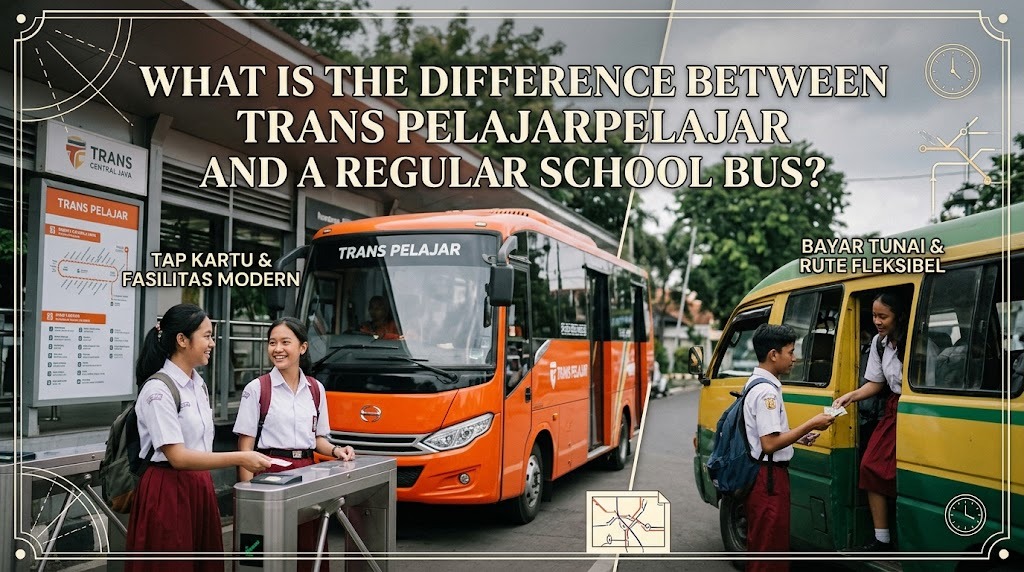
The main difference is who the bus is built for. A regular school bus (bus sekolah) is usually a dedicated service for students, often free and run by a local government or school. Trans Pelajar is a common name for public city buses, such as BRT services, that offer a free or cheaper fare for students.
This means a school bus is mostly for students, while a Trans Pelajar bus is open to everyone, with special rules for students. Exact details depend on the city, because there is no single national definition. This guide compares the two options using examples from Semarang and other regions.
WHO CAN RIDE
A regular school bus usually carries students only. In Bandung, for example, the free school bus program was meant for students who wear a school uniform. This keeps the bus focused on school trips.
Trans Pelajar buses, like Trans Semarang, serve the general public. Workers, shoppers, and families ride the same bus. Students receive a special fare after they register, such as the free card for Semarang residents introduced in May 2025.
FARES AND PAYMENT
School buses are often free for students, as in the program in Bandung and in Nganjuk. There is usually no card to buy, but students may need to show a school ID or wear a uniform. The government pays for the service to support students.
On Trans Semarang, general passengers pay Rp 4,000 in cash or Rp 3,500 cashless. Registered students with a Semarang ID ride for Rp 0 by using a subscription card. On Trans Jateng, students pay a reduced Rp 2,000 fare.
ROUTES AND STOPS
Regular school buses are built around school routes. In Nganjuk, for instance, the free school transport runs on eight routes from district areas into the town and passes 15 schools. This design makes it easy for students to reach their classes.
Trans Pelajar services use public corridors that connect many parts of the city, including stops near schools. Trans Semarang has eight main corridors, one special corridor, and feeder lines. These routes serve many people, so a stop may be near your school but not always right at the gate.
SCHEDULES AND OPERATING HOURS
School buses often follow school hours. The Nganjuk service, for example, ran from about 05:00 to 13:00 and 15:00, with times adjusted as needed. Pontianak's free student BRT buses left at 05:30 and 05:35 in the morning.
Public Trans Pelajar services run on a wider timetable. Most regular Trans Semarang corridors operate from around 05:30 to 17:30, with some night and airport services running later. This can be helpful for after-school activities, but buses can be more crowded.
COMFORT, CROWDS, AND RULES
A student-only bus can feel more predictable, because the passengers are mostly classmates. The rules are usually clear, such as wearing a uniform and following school schedules. Capacity is limited, so some programs have only a few buses.
On a public Trans Pelajar bus, you share space with all passengers, so crowds can be bigger at rush hour. Students must follow general rules, such as using their own card and giving priority seats to those who need them. In return, the bus network is larger and more flexible.
WHICH ONE SHOULD YOU CHOOSE
Choose a school bus if your area has one that passes your home and school, and its schedule fits your day. It is often free and easy to use. Check which schools and routes are covered, because coverage can be limited.
Choose Trans Pelajar if you need a wider network or a longer service time. It can connect you to places beyond school, such as libraries and relatives' homes. Check your eligibility, such as the local ID rule for the free card in Semarang.
CONCLUSION
The key difference is that a regular school bus is a student-focused service, while Trans Pelajar is a public bus with student fare benefits. They also differ in fares, routes, schedules, and rules. The best choice depends on where you live and what your city offers.
Ask your school or local transport office which services are available and what documents you need. Always check the newest routes, fares, and operating hours before you start. With the right information, you can pick the bus that is cheapest, safest, and most convenient for your daily trip.
Recent Posts

Bagaimana Sistem SKS pada Program Kuliah... 22.11.2026/54 View

How Does Technology Make Daily Evaluation... 21.11.2026/83 View

Apa Strategi Menghadapi Kesenjangan antara Kompetensi... 21.11.2026/82 View

Mengapa Inventaris Aset Penting bagi Kelancaran... 21.11.2026/78 View

When Should Musicians Join a Record... 21.11.2026/84 View
