

What Is the Difference Between Verbal and Nonverbal Communication?
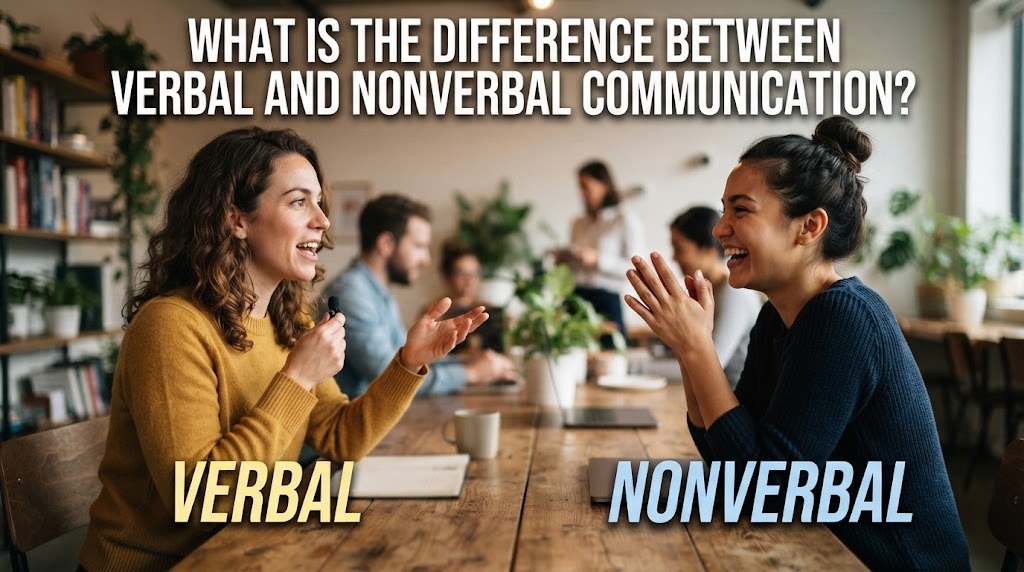
Communication is an important part of everyday life because people use it to share information, express feelings, and build relationships. Communication can happen through spoken or written words, but people also communicate through facial expressions, gestures, body movements, and tone of voice. These two forms are generally known as verbal and nonverbal communication. Understanding the difference between them can help people choose the right way to express messages and understand others more effectively.
Verbal and nonverbal communication often work together during an interaction. A person may say that they are happy while also smiling and using an enthusiastic tone. In this situation, the words provide the direct message, while the nonverbal signals provide additional emotional information. Although both forms are connected, they have different characteristics and functions.
WHAT IS VERBAL COMMUNICATION?
Verbal communication is the process of sharing messages through words and language. It can occur through speaking, conversations, presentations, discussions, telephone calls, or other forms of spoken interaction. Verbal communication can also be written, such as in messages, emails, reports, books, and social media posts. Because it uses language, people can communicate detailed information, instructions, opinions, and explanations more directly.
One advantage of verbal communication is that messages can be organized and explained clearly. A speaker can choose specific words to describe an idea, while a writer can revise a message before sending it. However, verbal communication can still cause misunderstandings when people use unclear words, inappropriate expressions, or different interpretations of the same message. The effectiveness of verbal communication therefore depends on language choice, clarity, context, and the ability of the receiver to understand the message.
WHAT IS NONVERBAL COMMUNICATION?
Nonverbal communication refers to messages communicated without relying primarily on words. It includes facial expressions, eye contact, gestures, body posture, physical distance, appearance, and other behavioral signals. Tone of voice, pitch, volume, and speaking speed are also often considered nonverbal or paralinguistic elements because they influence how spoken words are interpreted.
Nonverbal communication can provide information about emotions, attitudes, reactions, and relationships. For example, a smile may communicate friendliness, while avoiding eye contact may sometimes suggest discomfort or nervousness. However, nonverbal signals can have different meanings depending on the person and situation. Therefore, they should not be interpreted alone without considering the surrounding context.
KEY DIFFERENCES BETWEEN VERBAL AND NONVERBAL COMMUNICATION
The main difference is the way the message is expressed. Verbal communication uses words, while nonverbal communication mainly uses behaviors, movements, expressions, and vocal characteristics. Verbal communication is generally more direct when people need to explain specific information, while nonverbal communication can provide emotional or contextual information that words may not fully express.
Another difference is how messages are interpreted. Words can often be understood through their literal or agreed meaning, while nonverbal signals may require observation and interpretation. For example, the statement "I am fine" provides a verbal message, but the speaker's facial expression and tone may provide additional clues about how they actually feel. This shows why nonverbal communication can influence the meaning of verbal communication.
HOW VERBAL AND NONVERBAL COMMUNICATION WORK TOGETHER
In most everyday interactions, verbal and nonverbal communication do not operate separately. People naturally combine words with facial expressions, gestures, eye contact, posture, and tone of voice. These signals can reinforce one another and make a message clearer. For example, a person saying "Congratulations!" while smiling and offering a handshake communicates both the words and a positive emotional response.
Nonverbal communication can also contradict verbal communication. Someone may say that they are comfortable while repeatedly moving away or showing a tense facial expression. In such cases, the listener may become uncertain about which message to believe. Paying attention to both forms of communication can therefore help people understand the complete meaning of an interaction more accurately.
WHY ARE BOTH FORMS IMPORTANT?
Verbal communication is essential when people need to exchange detailed information, explain ideas, give instructions, or discuss specific topics. Nonverbal communication is equally important because it can communicate emotions, reactions, confidence, attention, and social attitudes. In school, both forms help students participate in discussions, give presentations, and interact with teachers and classmates. In professional environments, they can influence interviews, teamwork, meetings, presentations, and relationships with customers or colleagues.
Developing both verbal and nonverbal communication skills can make interactions more effective. People should learn to choose clear words while also paying attention to their facial expressions, gestures, tone, and body language. They should also observe how others respond rather than focusing only on what is being said. This combination can reduce misunderstandings and create more positive interactions.
CONCLUSION
The main difference between verbal and nonverbal communication is that verbal communication uses words, while nonverbal communication uses signals such as facial expressions, gestures, eye contact, posture, and tone. Verbal communication is useful for delivering specific information, while nonverbal communication often adds emotional and contextual meaning. Both forms are important because they frequently work together during everyday interactions.
Understanding these differences can help people become more effective communicators. By choosing clear words and using appropriate nonverbal signals, people can express their ideas more accurately and understand others more easily. Strong communication happens when verbal and nonverbal messages support each other.
Recent Posts

Bagaimana Sistem SKS pada Program Kuliah... 22.11.2026/38 View

How Does Technology Make Daily Evaluation... 21.11.2026/71 View

Apa Strategi Menghadapi Kesenjangan antara Kompetensi... 21.11.2026/73 View

Mengapa Inventaris Aset Penting bagi Kelancaran... 21.11.2026/69 View

When Should Musicians Join a Record... 21.11.2026/73 View
