

What Is the Difference Between Verbal Reasoning and Numerical Reasoning Tests?
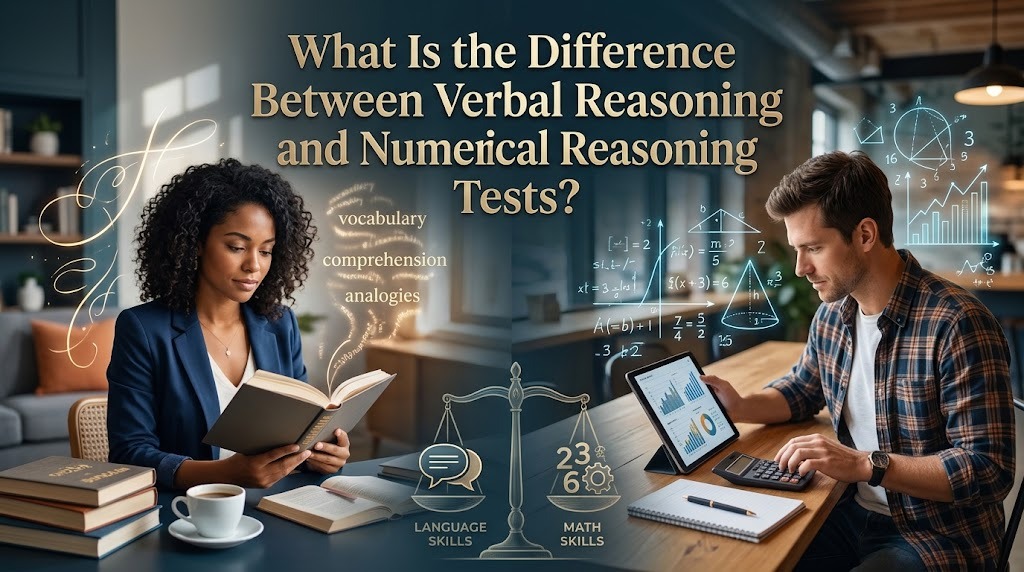
Verbal reasoning and numerical reasoning tests are two common types of assessments used in job recruitment, university admissions, scholarship selections, and professional evaluations. Both tests are designed to measure a person's ability to understand information, analyze problems, and make logical decisions. However, they focus on different types of information and require different approaches to solving questions.
Verbal reasoning tests focus on language comprehension, word relationships, and the ability to interpret written information. Meanwhile, numerical reasoning tests evaluate the ability to understand numerical data, perform calculations, and interpret mathematical information. Understanding the differences between these two assessments can help candidates prepare more effectively and identify the skills they need to improve before taking selection tests.
UNDERSTANDING VERBAL REASONING TESTS
A verbal reasoning test is an assessment that measures a person's ability to understand, interpret, and analyze information presented through words or written passages. Candidates are usually given paragraphs, sentences, or groups of words followed by questions that require logical thinking. The main purpose is to evaluate how accurately someone understands written information and draws conclusions based on the available evidence.
Common verbal reasoning questions include reading comprehension, synonyms, antonyms, word analogies, sentence completion, and logical deduction. For example, candidates may be asked to identify the main idea of a passage, determine the relationship between two words, or decide whether a statement is supported by specific information.
This type of assessment is particularly useful for evaluating language comprehension, vocabulary knowledge, critical thinking, and analytical abilities. These skills are important in academic activities and professional responsibilities that involve reading instructions, understanding reports, and communicating information clearly.
UNDERSTANDING NUMERICAL REASONING TESTS
A numerical reasoning test is an assessment designed to measure a person's ability to understand and analyze numerical information. Unlike verbal reasoning, which focuses on words and written passages, numerical reasoning involves numbers, mathematical relationships, and statistical data. Candidates must interpret the information provided and use appropriate calculations to reach accurate conclusions.
Common questions may involve percentages, ratios, averages, fractions, proportions, and basic arithmetic operations. Some assessments also present information through tables, graphs, charts, or financial reports. Candidates must understand the data, identify relevant figures, and determine the correct answer based on mathematical relationships.
For example, a candidate may receive a table showing a company's sales performance over several months and be asked to calculate the percentage increase in revenue. Solving this question requires understanding the figures, selecting the correct formula, and performing the calculation accurately.
Numerical reasoning tests evaluate mathematical understanding, data interpretation, problem-solving, and numerical accuracy. These abilities are particularly valuable in occupations involving finance, administration, business analysis, accounting, and data management.
THE MAIN DIFFERENCES BETWEEN VERBAL AND NUMERICAL REASONING
Although both assessments measure logical thinking and problem-solving abilities, verbal and numerical reasoning tests differ in the types of information they use and the skills they evaluate. Understanding these differences can help candidates recognize the specific challenges associated with each assessment.
The main differences include:
- Type of Information: Verbal reasoning uses words, sentences, and written passages, while numerical reasoning uses numbers, mathematical expressions, tables, and graphs.
- Main Skills Measured: Verbal reasoning evaluates reading comprehension, vocabulary, and language interpretation, whereas numerical reasoning measures mathematical understanding and numerical analysis.
- Question Formats: Verbal tests commonly include synonyms, antonyms, analogies, and reading comprehension. Numerical tests usually contain percentages, ratios, averages, calculations, and data interpretation.
- Problem-Solving Methods: Verbal reasoning requires candidates to interpret language and identify logical connections, while numerical reasoning involves mathematical formulas and calculations.
- Common Challenges: Verbal reasoning can be difficult when passages contain unfamiliar vocabulary or complex statements. Numerical reasoning may be challenging when calculations involve several steps or limited time.
- Practical Applications: Verbal reasoning is useful for understanding documents and communicating information, while numerical reasoning supports financial analysis, budgeting, and interpreting statistical data.
- These differences show that each assessment measures a distinct set of abilities. However, both require concentration, accuracy, logical thinking, and effective time management.
THE IMPORTANCE OF VERBAL AND NUMERICAL REASONING IN JOB SELECTION
Employers frequently use verbal and numerical reasoning tests as part of their recruitment processes to evaluate candidates' abilities beyond academic qualifications and work experience. These assessments provide additional information about how applicants process information, solve problems, and respond to different challenges.
Verbal reasoning skills are valuable in positions that involve communication, administration, customer service, management, education, and document analysis. Employees in these roles often need to understand instructions, interpret written information, prepare reports, and communicate ideas effectively.
On the other hand, numerical reasoning skills are important for jobs that involve calculations, financial information, data analysis, and business performance evaluation. Employees working in accounting, banking, finance, logistics, and business management may regularly use numerical information to support their decisions.
However, strong performance in one assessment does not automatically mean someone will perform equally well in the other. A candidate may have excellent language comprehension but need more practice with mathematical calculations. Employers therefore consider test results alongside other qualifications, technical abilities, experience, and personal competencies.
HOW TO PREPARE FOR VERBAL AND NUMERICAL REASONING TESTS
Preparing for both assessments requires different learning strategies because each test focuses on specific abilities. Candidates should understand the question formats, identify their weaknesses, and practice regularly to improve accuracy and confidence.
For verbal reasoning tests, candidates can improve their performance through regular reading and vocabulary development. Reading articles, identifying main ideas, studying synonyms and antonyms, and practicing word analogies can strengthen language comprehension. It is also important to practice drawing conclusions based only on the information provided in a passage.
For numerical reasoning tests, candidates should review basic mathematical concepts such as percentages, fractions, ratios, averages, and proportions. Practicing questions involving tables, graphs, and statistical information can improve their ability to interpret numerical data. Understanding the calculation process is more useful than simply memorizing formulas.
The following strategies can help candidates prepare for both assessments:
- Create a Study Schedule: Allocate regular study time for verbal and numerical reasoning practice.
- Understand Question Formats: Learn the common types of questions before attempting full practice tests.
- Improve Reading Skills: Read different types of written materials to strengthen vocabulary and comprehension.
- Review Mathematical Concepts: Practice basic calculations and understand how mathematical formulas work.
- Take Practice Tests: Complete sample assessments to become familiar with question patterns and time limitations.
- Evaluate Incorrect Answers: Identify mistakes and understand the correct reasoning behind each answer.
- Develop Time Management: Practice answering questions efficiently without sacrificing accuracy.
Combining these strategies can help candidates develop balanced reasoning abilities. Consistent preparation also makes it easier to recognize difficult questions and choose suitable methods to solve them.
WHICH REASONING TEST SHOULD YOU PRIORITIZE?
The reasoning test that candidates should prioritize depends on their abilities, educational background, career interests, and the requirements of the selection process. Some positions place greater emphasis on communication and language comprehension, while others require strong numerical and analytical abilities.
Candidates applying for administrative, communication, education, or customer service positions may benefit from giving additional attention to verbal reasoning. These occupations often involve understanding documents, interpreting instructions, and communicating information clearly.
Meanwhile, candidates interested in accounting, banking, finance, business analysis, or data-related positions may need to strengthen their numerical reasoning abilities. Understanding mathematical concepts and interpreting numerical information can be particularly important in these fields.
Nevertheless, candidates should not completely ignore either assessment. Many employers use both types of tests to obtain a broader understanding of applicants' abilities. Developing both verbal and numerical reasoning skills can provide greater flexibility when facing different selection requirements and professional challenges.
CONCLUSION
Verbal reasoning and numerical reasoning tests are assessments that measure different but equally important abilities. Verbal reasoning focuses on understanding written information, interpreting language, recognizing word relationships, and drawing logical conclusions. In contrast, numerical reasoning evaluates mathematical understanding, numerical analysis, and the ability to interpret data accurately.
Both assessments are widely used in academic and professional selection because they help evaluate candidates' problem-solving and analytical abilities. By understanding their differences and practicing the appropriate question types, candidates can improve their performance and prepare more confidently for selection tests.
Recent Posts

Bagaimana Sistem SKS pada Program Kuliah... 22.11.2026/45 View

How Does Technology Make Daily Evaluation... 21.11.2026/73 View

Apa Strategi Menghadapi Kesenjangan antara Kompetensi... 21.11.2026/75 View

Mengapa Inventaris Aset Penting bagi Kelancaran... 21.11.2026/71 View

When Should Musicians Join a Record... 21.11.2026/75 View
