

What Is the Difference Between Visual Intelligence and Verbal Intelligence?
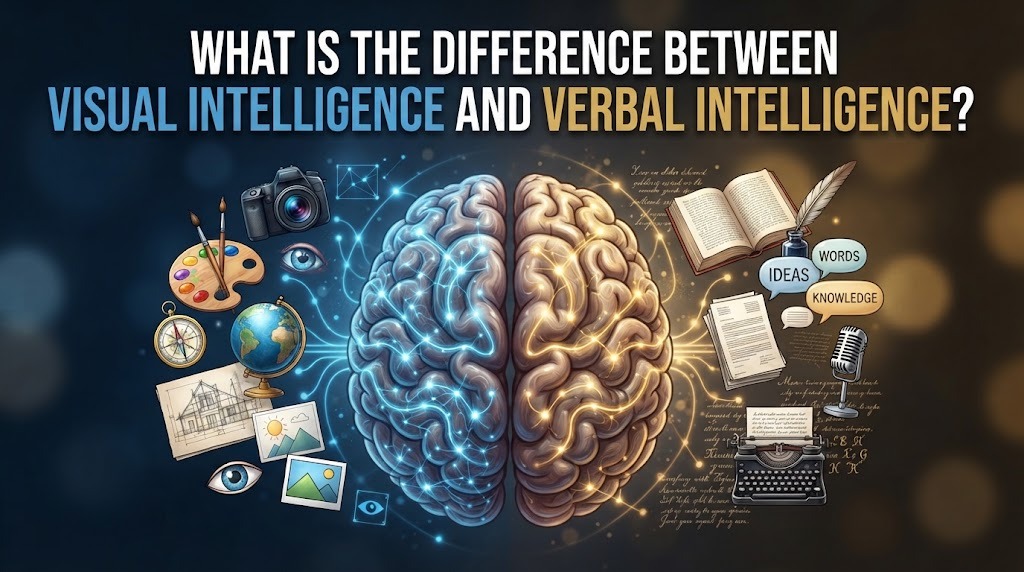
Intelligence can appear in different forms, and people may have different ways of understanding and processing information. Visual intelligence focuses on images, shapes, patterns, colors, and spatial relationships, while verbal intelligence focuses more on words, language, reading, speaking, and communication. Both abilities can support learning, problem solving, and everyday activities.
Understanding the difference between visual intelligence and verbal intelligence can help people recognize how they process information. Some people may understand a concept more easily through diagrams or images, while others may prefer explanations through words. However, these abilities can also work together when people learn or communicate.
WHAT IS VISUAL INTELLIGENCE?
Visual intelligence is the ability to understand, process, and remember information through visual elements. It involves recognizing shapes, patterns, colors, positions, distances, and relationships between objects. Spatial awareness and mental visualization are important parts of visual intelligence.
People use visual intelligence in many everyday situations. Reading maps, understanding charts, arranging furniture, recognizing faces, drawing, and interpreting diagrams are examples of activities that involve visual thinking. This ability is also useful in fields such as design, architecture, photography, engineering, and animation.
WHAT IS VERBAL INTELLIGENCE?
Verbal intelligence refers to the ability to understand and use language effectively. It includes skills related to reading, writing, speaking, listening, vocabulary, and expressing ideas. People with strong verbal skills may find it easier to explain concepts, understand written information, and communicate through language.
Verbal intelligence is useful in education and many professional environments. Students use it when reading textbooks, writing assignments, and participating in discussions. Communication, storytelling, writing, teaching, and language-based problem solving all involve verbal intelligence.
KEY DIFFERENCES BETWEEN VISUAL AND VERBAL INTELLIGENCE
The main difference is the type of information each ability emphasizes. Visual intelligence focuses on information that can be represented through images, shapes, patterns, and space, while verbal intelligence focuses on words and language. The two abilities may therefore lead people to use different approaches when understanding the same topic.
For example, a person using visual intelligence may understand a process more easily through a diagram. Someone relying more on verbal intelligence may prefer a written explanation or spoken instructions. Neither approach is automatically better because their usefulness depends on the task, information, and individual preferences.
HOW VISUAL AND VERBAL INTELLIGENCE WORK TOGETHER
Visual and verbal intelligence do not always operate separately. Many learning and communication activities require both abilities at the same time. A presentation, for example, may combine written explanations, spoken information, images, charts, and diagrams.
Using both forms of intelligence can make information more complete and easier to communicate. A student may read an explanation and then use a diagram to understand the relationships between different concepts. Combining visual and verbal information can provide multiple ways to understand and remember an idea.
EXAMPLES IN LEARNING AND EVERYDAY LIFE
Students use visual intelligence when interpreting graphs, maps, illustrations, charts, and diagrams. They use verbal intelligence when reading books, writing essays, answering questions, or participating in classroom discussions. Many school subjects require a combination of both skills.
In everyday life, visual intelligence can help someone follow a map or assemble furniture from a diagram. Verbal intelligence can help the same person understand written instructions or ask for additional information. Different situations require different ways of processing information, which is why developing both abilities can be useful.
HOW TO DEVELOP BOTH TYPES OF INTELLIGENCE
Visual intelligence can be practiced through drawing, puzzles, photography, mind mapping, building activities, and pattern recognition. These activities encourage observation, spatial awareness, visual memory, and mental visualization. Regular practice can make visual information easier to understand.
Verbal intelligence can be developed through reading, writing, storytelling, discussions, vocabulary exercises, and explaining ideas clearly. Practicing both visual and verbal skills can create a more flexible approach to learning and communication. People can also combine the two by creating written summaries with diagrams or explaining visual information in their own words.
CONCLUSION
Visual intelligence and verbal intelligence differ mainly in how information is processed. Visual intelligence emphasizes images, patterns, shapes, and spatial relationships, while verbal intelligence emphasizes language, words, reading, writing, and communication.
Both abilities have important roles in learning, problem solving, creativity, and everyday life. Instead of viewing them as competing abilities, people can develop and combine them according to their needs. Using both visual and verbal approaches can help individuals understand information from different perspectives and communicate ideas more effectively.
Recent Posts

Bagaimana Sistem SKS pada Program Kuliah... 22.11.2026/21 View

How Does Technology Make Daily Evaluation... 21.11.2026/64 View

Apa Strategi Menghadapi Kesenjangan antara Kompetensi... 21.11.2026/65 View

Mengapa Inventaris Aset Penting bagi Kelancaran... 21.11.2026/62 View

When Should Musicians Join a Record... 21.11.2026/60 View
