

What Is the Future of Radio Announcing in the Age of Podcasts?
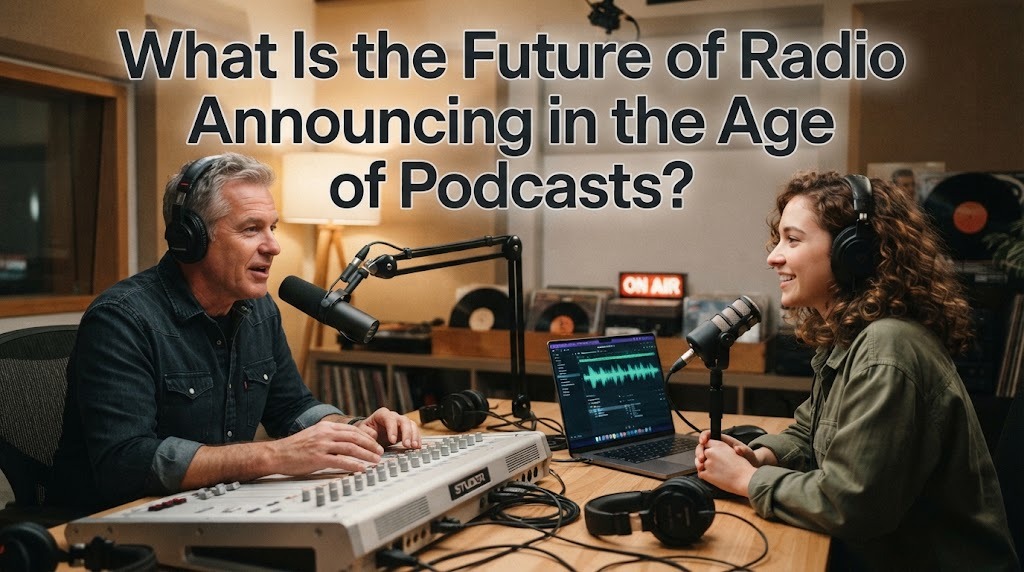
he growth of podcasts has changed how people listen to audio content. Listeners can now choose programs based on their interests and listen whenever they want. This development has created new challenges for traditional radio while also opening opportunities for radio announcers. Instead of disappearing, radio announcing is adapting to a broader digital audio environment. The future of the profession will likely depend on how well announcers combine traditional broadcasting skills with digital communication abilities.
RADIO AND PODCASTS CAN EXIST TOGETHER
Podcasts and radio have different characteristics, but they can serve similar audience needs. Radio usually provides scheduled programming, live interaction, music, news, entertainment, and local information. Podcasts generally allow listeners to choose specific topics and listen to episodes at a convenient time. Because of these differences, the growth of podcasts does not necessarily mean that traditional radio has no future. Both formats can attract audiences with different listening habits.
Radio stations can also use podcasting as an extension of their existing content. Interviews, discussions, educational segments, and selected programs can be adapted into podcast episodes. This allows announcers to reach listeners who may not be available during the original broadcast. Combining live radio with on-demand audio can give broadcasters more opportunities to build long-term audiences.
RADIO ANNOUNCERS ARE BECOMING MULTIMEDIA COMMUNICATORS
The role of a radio announcer is becoming broader as digital media develops. In addition to speaking on air, announcers may host podcasts, create short videos, manage social media content, and participate in online broadcasts. These responsibilities require skills beyond traditional voice presentation. Announcers need to understand how audiences interact with different digital platforms. They also need to adapt their communication style to different content formats.
This transformation does not make traditional broadcasting skills less important. Clear pronunciation, voice control, interviewing ability, storytelling, and audience engagement remain essential. Digital skills simply provide additional ways for announcers to use those abilities. A professional who can work across several audio and digital formats may have more opportunities in the changing media industry.
PODCASTS CREATE NEW OPPORTUNITIES FOR ANNOUNCERS
Podcasting can provide radio announcers with opportunities to explore specialized subjects. An announcer can develop a podcast focused on education, business, culture, entertainment, technology, sports, or other areas of interest. Unlike a general radio schedule, podcast content can target a specific audience with particular interests. This makes it possible for announcers to develop a more focused communication style. It can also help them build a recognizable professional identity.
Podcasting also provides greater flexibility in program development. Announcers can record episodes in advance, edit audio, invite guests, and structure discussions according to the intended audience. They can experiment with storytelling techniques that may not fit traditional radio schedules. This creative freedom can encourage announcers to develop new presentation skills. It can also create additional career paths within the wider audio industry.
LIVE BROADCASTING REMAINS AN IMPORTANT STRENGTH
One advantage of traditional radio is its ability to provide live communication. Live broadcasts can respond quickly to current events, traffic conditions, weather developments, community activities, and breaking information. Listeners can also interact with announcers while a program is happening. This sense of immediacy can create a different experience from prerecorded podcast episodes. Radio announcers who are skilled at live communication can therefore offer something distinctive.
Live broadcasting also requires quick thinking and adaptability. Announcers need to respond to unexpected developments, technical problems, guest responses, or changes in the program schedule. These abilities are valuable because they create a sense of spontaneity and human connection. Podcasts can include conversational content, but scheduled live radio offers a unique relationship between announcers and listeners. This can remain an important part of radio's future.
DIGITAL PLATFORMS WILL EXPAND AUDIENCE REACH
The future of radio announcing will increasingly involve digital distribution. Radio programs can be delivered through online streaming, station websites, mobile applications, and other connected platforms. This allows audiences to access radio content without depending entirely on traditional broadcasting methods. Announcers can therefore reach listeners who live outside the station's usual terrestrial coverage area. Digital distribution can make radio more accessible to audiences with different listening habits.
Social media can strengthen this connection by allowing announcers to communicate before, during, and after a broadcast. They can promote upcoming programs, share short clips, answer audience questions, and encourage discussions. This creates a continuous relationship rather than limiting communication to the time when a program is on air. However, announcers need to maintain professional standards across every platform they use.
AUDIO CONTENT WILL BECOME MORE PERSONALIZED
Digital audio platforms make it easier for audiences to select content based on personal interests. This trend may encourage radio announcers to develop more specialized programs and podcast series. Instead of creating content only for a broad demographic, announcers can explore specific communities and interests. Personalization can help audiences discover content that feels more relevant to their needs. It may also encourage announcers to develop deeper knowledge of particular subjects.
Audience data can support this process by showing which programs, topics, or episodes receive attention. However, popularity should not become the only measure of quality. Professional announcers still need to prioritize accurate information, responsible communication, and meaningful content. Data can help guide content decisions, but human judgment remains essential. A balance between audience preferences and editorial responsibility will be important for future audio professionals.
TECHNOLOGY WILL SUPPORT BUT NOT REPLACE HUMAN COMMUNICATION
Automation and artificial intelligence may increasingly be used in audio production. Technology can assist with tasks such as editing, scheduling, transcription, content organization, and other parts of production. These tools may help broadcasters work more efficiently. However, radio announcing involves spontaneous interaction, emotional expression, humor, empathy, and an understanding of audience context. These human qualities remain important when creating meaningful communication.
Future announcers will therefore need to learn how to work effectively with new technologies. They may use digital tools to improve production while maintaining their own voice and personality. The goal is not simply to use as much technology as possible, but to use it in ways that improve the listener experience. Human creativity and professional judgment will continue to play an important role.
NEW SKILLS WILL SHAPE THE RADIO ANNOUNCER PROFESSION
Future radio announcers will need a combination of communication, technical, and digital skills. Voice presentation and public speaking will remain fundamental. At the same time, knowledge of podcast production, audio editing, social media, digital storytelling, and online audience engagement can provide additional advantages. Announcers may also need to understand basic analytics to evaluate how audiences interact with their content. Continuous learning will therefore become increasingly important.
Adaptability will be one of the most valuable professional qualities. Media technology changes quickly, and audience behavior can change with it. Announcers who are willing to learn new tools and experiment with new formats can respond more effectively to these changes. They can preserve the strengths of traditional radio while exploring opportunities in digital audio. This combination can help the profession remain relevant in the future.
CONCLUSION
The future of radio announcing in the age of podcasts is likely to involve transformation rather than disappearance. Radio announcers can continue to play an important role by combining live broadcasting with podcasts, streaming, social media, and other digital formats. Their ability to communicate naturally, respond to current situations, and build relationships with listeners remains valuable. At the same time, they need to develop digital skills and understand changing audience expectations.
Podcasts have expanded the audio industry and created additional opportunities for radio professionals. Future announcers may work across several platforms while maintaining the communication qualities that make radio engaging. Technology can support their work, but authentic human interaction will remain important. By adapting to digital developments while preserving strong broadcasting skills, radio announcers can continue to have a meaningful role in the future of audio media.
Recent Posts

Bagaimana Sistem SKS pada Program Kuliah... 22.11.2026/35 View

How Does Technology Make Daily Evaluation... 21.11.2026/69 View

Apa Strategi Menghadapi Kesenjangan antara Kompetensi... 21.11.2026/69 View

Mengapa Inventaris Aset Penting bagi Kelancaran... 21.11.2026/67 View

When Should Musicians Join a Record... 21.11.2026/68 View
