

What Is the Industrial Revolution and How Has It Evolved Over Time?
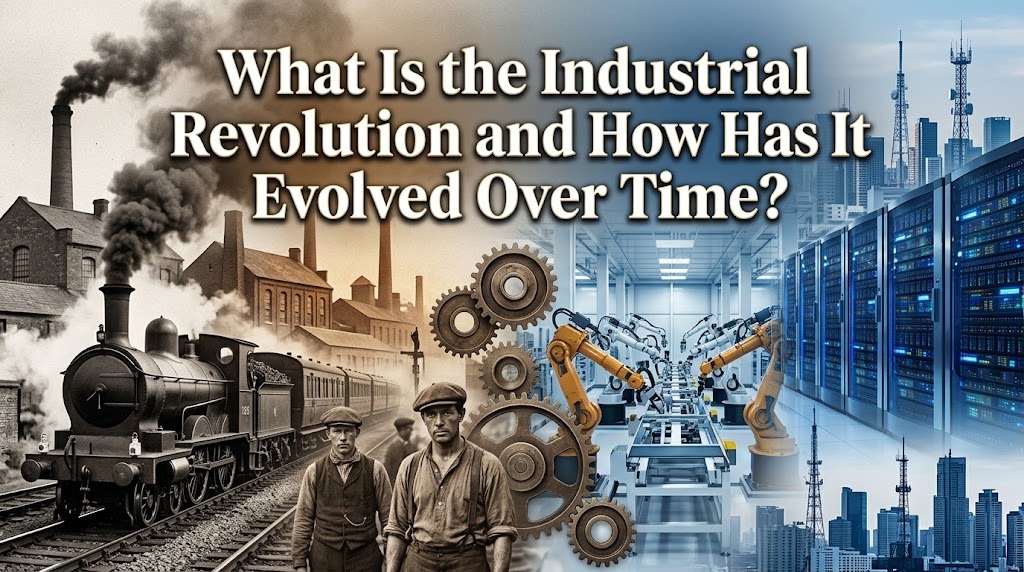
The Industrial Revolution was a major period of change in human history that transformed how people produced goods, worked, traveled, and communicated. It began in Great Britain in the late 18th century and gradually spread to other parts of the world. Before this period, most products were made manually using simple tools, and many people worked in agriculture or small workshops. The development of machines, factories, and new energy sources changed these traditional activities into more efficient production systems.
Over time, the Industrial Revolution continued to develop alongside scientific discoveries and technological innovations. It progressed from steam-powered machinery to electricity, computers, automation, and artificial intelligence. These changes have influenced modern economies, education, transportation, and everyday life. Understanding the history of the Industrial Revolution helps us recognize how technology shapes society and prepares us for future developments.
THE FIRST INDUSTRIAL REVOLUTION
The First Industrial Revolution began in Great Britain around the late 1700s and continued into the early 1800s. This period marked the transition from manual production to machine-based manufacturing. One of its most important innovations was the steam engine, which provided power for factories, mines, and transportation. Improvements in textile machinery also enabled manufacturers to produce cloth more quickly and in larger quantities than traditional hand production.
The development of factories changed how people organized their work. Instead of producing goods at home or in small workshops, many workers moved to industrial towns to find employment in factories. The expansion of the railway system and steam-powered ships made transporting goods and people faster and more efficient. However, this transformation also created problems, including long working hours, unsafe working conditions, and crowded urban settlements. Despite these challenges, the First Industrial Revolution established the foundations of modern industrial production.
THE SECOND INDUSTRIAL REVOLUTION
The Second Industrial Revolution developed during the late 19th century and continued into the early 20th century. It was characterized by the widespread use of electricity, advances in steel production, and the development of new chemical processes. Electricity provided factories with more flexible and reliable power than many earlier energy systems. Meanwhile, innovations in transportation and communication, including automobiles, telephones, and improved railways, helped connect businesses and communities.
Another important development was mass production, which allowed companies to manufacture large quantities of standardized products at lower costs. The introduction of the assembly line, famously adopted and developed by Henry Ford in automobile manufacturing, improved production speed and efficiency. These changes contributed to the growth of large companies, international trade, and modern urban economies. Nevertheless, industrial expansion also increased the demand for natural resources and contributed to pollution. The Second Industrial Revolution helped create the economic and technological systems that continue to influence modern manufacturing.
THE THIRD INDUSTRIAL REVOLUTION
The Third Industrial Revolution, often called the Digital Revolution, began to take shape during the second half of the 20th century. It was driven by the development of computers, electronics, telecommunications, and information technology. Unlike earlier industrial periods that focused mainly on mechanical power and mass production, this revolution introduced digital systems into factories, offices, and everyday activities. Computers made it possible to process information more quickly, while electronic devices improved the accuracy and control of industrial operations.
The growth of the internet further accelerated this transformation by connecting people, businesses, and institutions across the world. Companies began using computer-controlled machines and industrial robots to improve productivity and reduce repetitive manual work. Digital communication also changed how people learned, worked, shopped, and exchanged information. However, the expansion of digital technology created new challenges, including cybersecurity risks, privacy concerns, and unequal access to technological resources. The Third Industrial Revolution laid the groundwork for today's highly connected digital economy.
THE FOURTH INDUSTRIAL REVOLUTION AND INDUSTRY 4.0
The Fourth Industrial Revolution, commonly known as Industry 4.0, builds on digital technology by connecting physical machines, software, data, and intelligent systems. It combines technologies such as artificial intelligence (AI), the Internet of Things (IoT), cloud computing, big data, and advanced robotics. These technologies allow machines and computer systems to exchange information, monitor production processes, and support faster decision-making. As a result, factories can become more connected, flexible, and responsive to changing customer demands.
For example, a smart factory can use sensors to detect unusual machine conditions before serious equipment failures occur. AI systems can analyze production data to identify inefficiencies, while connected devices help companies monitor inventory and supply chains in real time. These innovations can reduce waste, improve product quality, and increase operational efficiency. However, Industry 4.0 also requires significant investment, reliable digital infrastructure, and workers with appropriate technical skills. It may reduce demand for certain repetitive tasks while increasing opportunities in software development, data analysis, cybersecurity, and robotics maintenance.
THE FUTURE OF THE INDUSTRIAL REVOLUTION
The future of the Industrial Revolution will involve further integration between advanced technology and human capabilities. One emerging concept is Industry 5.0, which emphasizes cooperation between humans and machines while placing greater attention on sustainability, resilience, and human well-being. Rather than focusing only on productivity and automation, this approach encourages industries to use technology in ways that support workers, customers, and the environment. For example, collaborative robots can assist employees with physically demanding tasks while allowing humans to contribute judgment, creativity, and problem-solving skills.
Future industrial development will also be influenced by renewable energy, smart manufacturing, artificial intelligence, and sustainable production methods. Businesses will increasingly need to balance technological progress with environmental responsibility and social needs. At the same time, education and professional training will become more important because workers must adapt to changing job requirements. Skills such as digital literacy, critical thinking, communication, and lifelong learning can help individuals remain competitive. Although technological progress may create uncertainty, responsible innovation can provide new opportunities for economic growth and improved quality of life.
CONCLUSION
The Industrial Revolution has evolved through several major stages, each introducing technologies that transformed production and society. The First Industrial Revolution introduced steam-powered machinery, the Second expanded electricity and mass production, and the Third brought computers and digital communication. The Fourth Industrial Revolution connects intelligent technologies through automation, artificial intelligence, and the Internet of Things. Meanwhile, Industry 5.0 highlights the importance of combining technological innovation with human creativity and sustainability.
Understanding these developments is essential for individuals, businesses, and governments preparing for the future. Although industrial progress offers opportunities to improve productivity, communication, and living standards, it also presents challenges related to employment, inequality, and environmental protection. By investing in education, developing relevant skills, and using technology responsibly, society can benefit from industrial innovation while reducing its potential negative effects.
Recent Posts

Bagaimana Sistem SKS pada Program Kuliah... 22.11.2026/49 View

How Does Technology Make Daily Evaluation... 21.11.2026/79 View

Apa Strategi Menghadapi Kesenjangan antara Kompetensi... 21.11.2026/79 View

Mengapa Inventaris Aset Penting bagi Kelancaran... 21.11.2026/75 View

When Should Musicians Join a Record... 21.11.2026/80 View
