

What Is the Link Between Radiation and Human Cell DNA Damage?
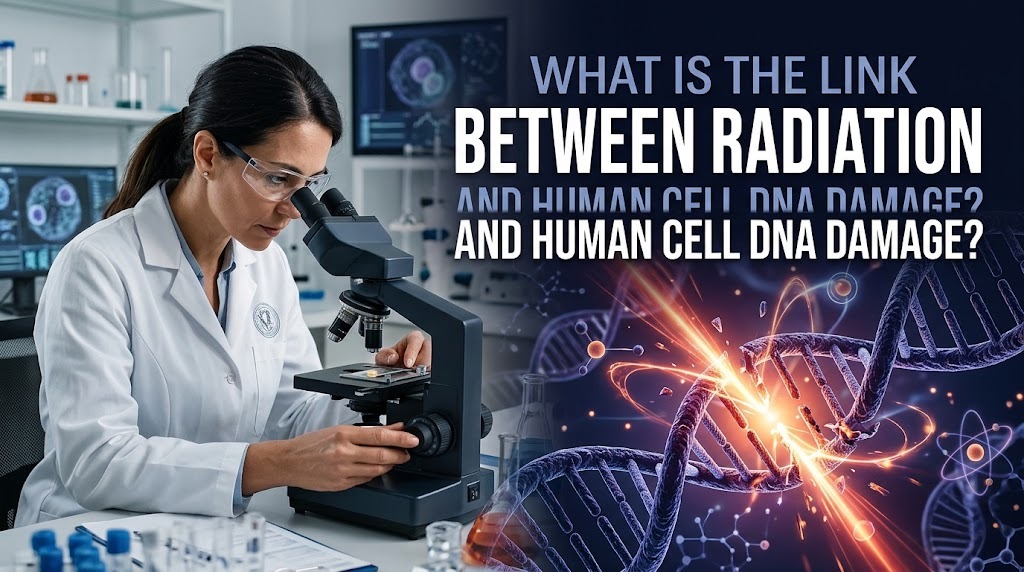
Radiation is energy that travels in waves or particles. While non-ionizing radiation (like radio waves and microwaves) lacks the energy to alter chemical bonds, ionizing radiation (such as X-rays, gamma rays, and cosmic rays) carries immense energy.
When ionizing radiation passes through human tissue, it has enough energy to knock electrons out of atoms. If this energy strikes a DNA molecule inside a human cell, it can break the chemical bonds that hold the genetic code together, leading to structural damage.
DIRECT VS. INDIRECT DNA DAMAGE
Radiation interacts with cellular components through two primary mechanisms:
- Direct Action: High-energy photons or particles collide directly with the DNA strand, breaking the sugar-phosphate backbone or altering the nitrogenous bases (adenine, thymine, cytosine, guanine).
- Indirect Action: Because human cells are mostly made of water, radiation often strikes water molecules instead. This creates unstable, highly reactive chemicals called free radicals, which quickly attack and damage nearby DNA molecules.
TYPES OF DNA BREAKS
The severity of radiation-induced DNA damage depends heavily on the type of break sustained:
- Single-Strand Breaks: Radiation breaks only one side of the DNA double helix. These are relatively easy for the cell to repair because the opposite strand acts as an exact template for reconstruction.
- Double-Strand Breaks: Radiation breaks both strands of the DNA helix close to each other. These are much more serious and complex, as the cell lacks a direct adjacent template to fix the error accurately.
CELLULAR REPAIR AND CONSEQUENCES
Human cells possess remarkable built-in DNA repair mechanisms that constantly scan and fix genetic errors. Following low-level radiation exposure, cellular enzymes quickly mend most single-strand and even double-strand breaks.
However, if exposure is extremely high or if repair mechanisms fail, uncorrected damage can lead to three main outcomes:
- Cell Death: The cell is so severely damaged that it self-destructs through programmed cell death (apoptosis).
- Mutation: The cell survives, but with altered genetic instructions, which can occasionally lead to abnormal cell growth or long-term health risks like cancer.
- Loss of Function: The cell continues to live but loses its ability to replicate or perform its normal physiological duties properly.
CONCLUSION
In summary, the link between radiation and human cell DNA damage lies in the ability of ionizing energy to break chemical bonds either directly or through reactive free radicals. While cells possess advanced repair systems to handle everyday background exposure, high doses of radiation can overwhelm these defenses, leading to mutations or cell destruction.
Understanding this biological interaction is essential for setting safe medical imaging limits and occupational radiation standards.
Recent Posts

Bagaimana Sistem SKS pada Program Kuliah... 22.11.2026/53 View

How Does Technology Make Daily Evaluation... 21.11.2026/82 View

Apa Strategi Menghadapi Kesenjangan antara Kompetensi... 21.11.2026/81 View

Mengapa Inventaris Aset Penting bagi Kelancaran... 21.11.2026/77 View

When Should Musicians Join a Record... 21.11.2026/82 View
