

What Is the Relationship Between Basic Research and Modern Technology?
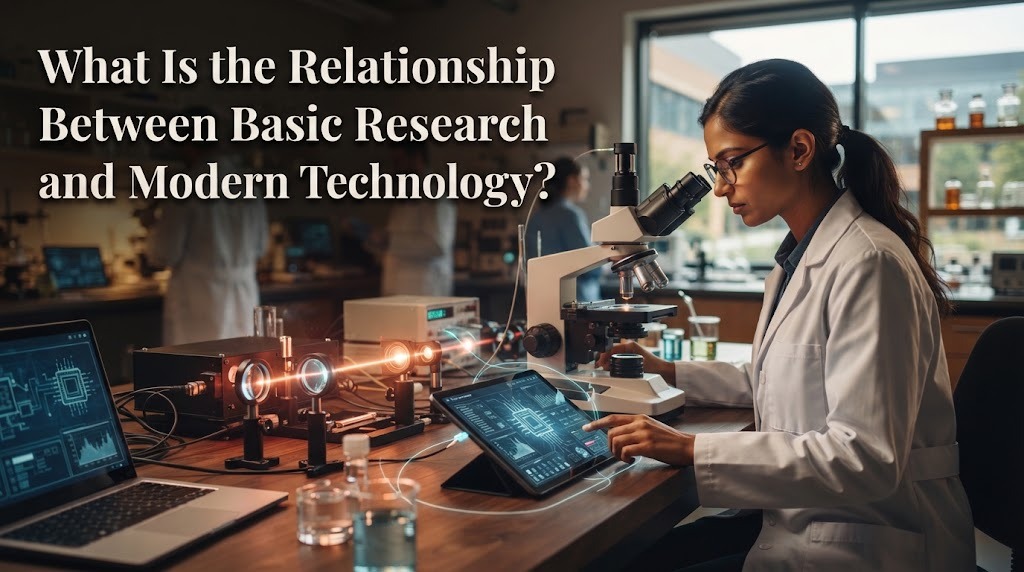
Basic research and modern technology are closely connected because scientific discoveries provide the knowledge needed to develop new technologies. Basic research focuses on understanding fundamental principles, natural phenomena, and scientific processes. Although it does not always aim to create an immediate practical product, its findings can become the foundation for technological innovation. Modern devices, communication systems, medical equipment, and energy technologies often depend on scientific knowledge developed through years of fundamental investigation.
The relationship between basic research and technology is also a continuous process. Scientific discoveries help engineers design new tools, while technological advancements provide researchers with better instruments to investigate complex questions. This connection allows science and technology to develop together, creating opportunities for further discoveries and practical improvements.
UNDERSTANDING BASIC RESEARCH AND MODERN TECHNOLOGY
Basic research is conducted to expand knowledge and improve understanding of fundamental scientific concepts. Researchers investigate questions about matter, energy, living organisms, and other phenomena without necessarily expecting immediate commercial applications. Their findings help explain how different systems work and establish principles that other researchers can use in future investigations. Modern technology, on the other hand, applies scientific knowledge to create tools, machines, software, and systems that address particular needs. Although these activities have different primary objectives, they frequently support one another.
For example, research into the electrical properties of materials has helped scientists understand how electronic components function. This knowledge contributes to the development of computers, smartphones, and other digital devices. Similarly, fundamental research into light has supported technologies used in lasers, optical communication, and scientific instruments. These examples demonstrate that modern technology often depends on scientific knowledge developed long before a particular product becomes available. Basic research therefore provides an important foundation for technological progress.
HOW BASIC RESEARCH DRIVES TECHNOLOGICAL INNOVATION
Basic research drives technological innovation by revealing scientific principles that can be applied to new engineering challenges. When researchers discover previously unknown properties of materials or identify new relationships between physical processes, they create opportunities for developing improved technologies. Engineers can use these findings to design devices that are more efficient, accurate, or reliable. However, transforming a scientific discovery into a practical application often requires additional experiments, engineering development, and testing. The process may take years or even decades.
For instance, fundamental investigations into semiconductor physics helped establish the principles behind modern electronic components. These principles later contributed to the development of increasingly powerful computers and communication devices. Research into magnetic materials has also supported advances in data storage and electronic systems. Such developments show that technological innovation frequently begins with scientific questions rather than a specific product idea. By expanding scientific understanding, basic research makes new technological possibilities achievable.
THE ROLE OF BASIC RESEARCH IN COMPUTER AND DIGITAL TECHNOLOGY
Modern computers and digital technologies rely on scientific discoveries in physics, mathematics, materials science, and information theory. Basic research helps explain how electrons behave in materials, how information can be represented mathematically, and how signals can be transmitted and processed. These principles support the design of processors, memory systems, communication networks, and other digital components. Without a strong understanding of these fundamental concepts, developing advanced computing systems would be considerably more difficult.
Research into quantum mechanics, for example, has contributed to the scientific foundations of semiconductor devices and continues to inform investigations into quantum computing. Mathematical research also provides algorithms and theoretical tools that support data processing, encryption, and artificial intelligence. Although practical digital technologies require extensive engineering and software development, their underlying principles often originate in fundamental scientific work. Continued basic research can therefore help researchers explore new computing methods and improve the capabilities of future digital systems.
THE CONNECTION BETWEEN BASIC RESEARCH AND MEDICAL TECHNOLOGY
Basic research contributes to medical technology by improving scientific understanding of the human body, biological processes, and disease mechanisms. Investigations into cells, genes, proteins, and microorganisms help researchers identify how biological systems function. This knowledge can guide the development of diagnostic instruments, medical imaging systems, laboratory tests, and other healthcare technologies. Before many medical devices can be developed, scientists must understand the physical or biological processes that make those devices work.
For example, fundamental research into nuclear magnetic resonance helped establish principles that later contributed to magnetic resonance imaging, commonly known as MRI. MRI technology allows healthcare professionals to examine internal structures of the body without using ionizing radiation to produce the images. Similarly, research in molecular biology has supported the development of advanced diagnostic methods that detect specific biological substances. However, turning scientific findings into safe and effective medical technologies requires further development, testing, and regulatory evaluation. Basic research remains an important starting point for many advances in modern healthcare.
HOW BASIC RESEARCH SUPPORTS ARTIFICIAL INTELLIGENCE
Artificial intelligence is another area where basic research and modern technology interact closely. Progress in AI depends on developments in mathematics, statistics, computer science, neuroscience, and other scientific disciplines. Basic research helps scientists investigate how learning algorithms work, how information can be represented, and how computational systems can identify patterns in data. These investigations can lead to new theoretical approaches that improve the design and understanding of AI systems. They also help researchers identify the limitations of existing methods.
For example, advances in statistical learning theory and neural network research have contributed to modern machine learning techniques. These techniques are now used in language processing, image recognition, scientific analysis, and many other applications. At the same time, AI tools can help researchers analyze large datasets, simulate complex systems, and identify patterns that may be difficult to detect manually. Nevertheless, AI-generated findings still require careful verification, and technological performance depends on data quality, research methods, and appropriate evaluation. This relationship demonstrates how basic research can advance AI while AI can also support scientific discovery.
THE IMPORTANCE OF BASIC RESEARCH IN ENERGY AND ENVIRONMENTAL TECHNOLOGY
Basic research helps improve energy and environmental technologies by expanding knowledge about chemical reactions, materials, climate systems, and energy transfer. Scientists investigate how different materials store energy, how sunlight can be converted into electricity, and how environmental processes affect natural resources. These findings can guide the development of solar cells, batteries, fuel technologies, and systems for monitoring pollution. Fundamental knowledge is particularly important when researchers need to understand why existing technologies have limitations.
For example, research into the properties of photovoltaic materials has contributed to improvements in solar energy conversion. Investigations into electrochemistry have also helped researchers understand how batteries store and release energy. These scientific foundations support efforts to improve energy storage, renewable electricity, and the efficiency of electronic devices. However, practical applications also depend on engineering design, manufacturing costs, material availability, and environmental considerations. By investigating these fundamental challenges, basic research creates opportunities for more sustainable technological development.
WHY COLLABORATION BETWEEN SCIENTISTS AND ENGINEERS MATTERS
The relationship between basic research and modern technology becomes stronger when scientists and engineers work together. Scientists investigate fundamental questions and develop explanations, while engineers often use scientific findings to design and improve practical systems. Collaboration allows researchers to identify which discoveries may support technological development and which scientific questions require further investigation. It can also help ensure that new technologies are based on reliable evidence rather than untested assumptions.
Universities, laboratories, technology companies, and government research institutions can support this collaboration by sharing expertise, facilities, and research resources. For example, materials scientists may work with electrical engineers to investigate substances suitable for more efficient electronic devices. Computer scientists may collaborate with mathematicians to develop new algorithms or improve computational models. These partnerships can shorten the distance between scientific discovery and practical application, although successful development still requires testing and refinement. Strong collaboration helps transform scientific knowledge into technologies that benefit society.
CHALLENGES IN TURNING BASIC RESEARCH INTO TECHNOLOGY
Although basic research provides valuable foundations for technological progress, not every discovery leads directly to a useful product. Some findings remain theoretical because practical applications are technically difficult, expensive, or currently unavailable. Other discoveries require additional research before scientists fully understand their potential uses. This uncertainty is a normal part of scientific investigation because the main purpose of basic research is to expand knowledge, not guarantee a specific technological outcome.
Funding and time are also important challenges. Fundamental research may require specialized equipment, skilled researchers, and long periods of investigation before producing results that can support technological development. In addition, promising discoveries must often undergo engineering development, safety testing, and performance evaluation before they can be used widely. Cooperation between universities, governments, and industry can help address these challenges through sustained investment and knowledge sharing. Supporting basic research remains important because discoveries without immediate applications may become essential to technologies developed in the future.
CONCLUSION
Basic research and modern technology have a strong and mutually beneficial relationship. Basic research expands scientific knowledge, reveals fundamental principles, and creates the foundation for innovations in computing, artificial intelligence, healthcare, energy, and communication. Modern technology, in turn, provides researchers with advanced tools that improve experiments, data analysis, and scientific investigation.
Although the journey from discovery to practical application can be long and uncertain, continued investment in basic research creates opportunities for future technological breakthroughs. Collaboration between scientists, engineers, universities, and industries helps turn scientific understanding into useful applications. Ultimately, basic research is essential to modern technological progress because it expands what humanity understands and what future generations can develop.
Recent Posts

Bagaimana Sistem SKS pada Program Kuliah... 22.11.2026/44 View

How Does Technology Make Daily Evaluation... 21.11.2026/73 View

Apa Strategi Menghadapi Kesenjangan antara Kompetensi... 21.11.2026/75 View

Mengapa Inventaris Aset Penting bagi Kelancaran... 21.11.2026/70 View

When Should Musicians Join a Record... 21.11.2026/74 View
