

What Is the Relationship Between Deforestation and Rising Global Temperatures?
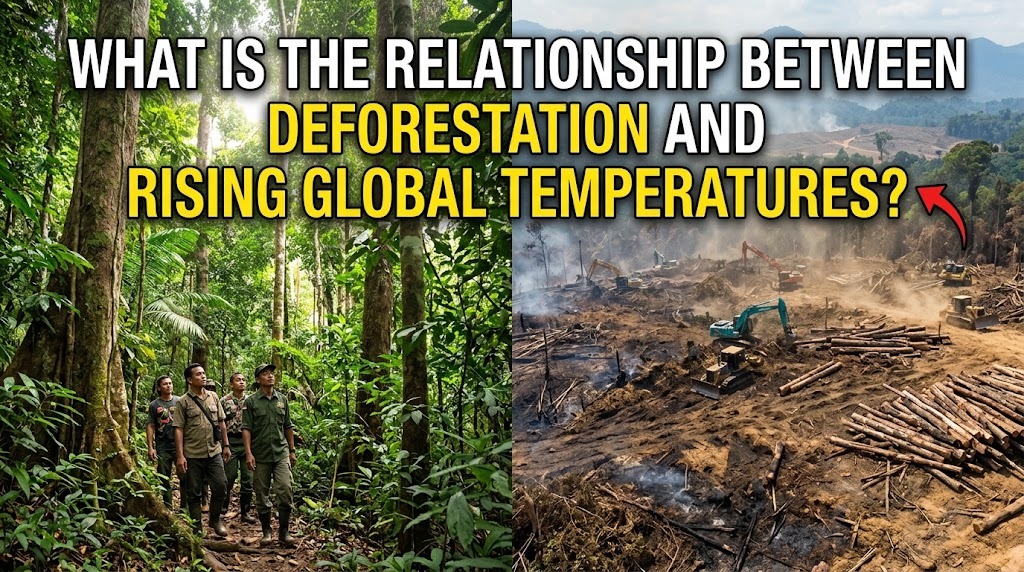
Deforestation is the large-scale removal of trees and forest vegetation, often to make way for agriculture, plantations, settlements, mining, or infrastructure. Forests play an important role in regulating the Earth's climate because trees absorb carbon dioxide from the atmosphere and store carbon in their trunks, branches, roots, and surrounding soil. When forests are cleared or damaged, this natural ability to store carbon can be reduced.
The relationship between deforestation and rising global temperatures is closely connected to greenhouse gas emissions and the loss of natural carbon storage. Forest clearing can release stored carbon, reduce future carbon absorption, and change how land interacts with sunlight and water. Understanding this relationship is important for developing effective strategies to reduce global warming and protect the environment.
DEFORESTATION RELEASES STORED CARBON INTO THE ATMOSPHERE
One of the main ways deforestation contributes to global warming is through the release of carbon stored in trees and forest soils. When trees are burned, much of their carbon is released into the atmosphere as carbon dioxide. When felled trees decompose, they can also release carbon over time, depending on how the wood and other organic materials are managed.
Forest clearing can therefore increase greenhouse gas emissions, especially when large areas are affected. The amount released depends on the type of forest, the amount of vegetation removed, soil conditions, and the method used to clear the land. Peatland forests are particularly important because their soils can contain substantial quantities of stored carbon. When peatlands are drained or burned, significant emissions may occur. Reducing forest destruction helps limit these emissions and supports climate change mitigation.
LOSING TREES REDUCES NATURAL CARBON ABSORPTION
Healthy forests help remove carbon dioxide from the atmosphere through photosynthesis. Trees absorb carbon dioxide and use it to produce the sugars needed for growth, storing some of the carbon in their tissues. Forest ecosystems also store carbon in roots, dead organic matter, and soil.
When forests are removed, the landscape generally loses some of its capacity to absorb and store carbon. Newly planted trees may gradually restore part of that capacity, but recovery can take many years or decades, depending on local conditions. Young forests also do not necessarily store as much carbon as mature, healthy forests. For this reason, forest conservation is important not only because it prevents emissions from clearing but also because it preserves existing carbon stores and ongoing carbon absorption.
FOREST CLEARING CAN CHANGE LOCAL TEMPERATURES AND RAINFALL
Forests influence more than carbon storage. Trees provide shade and release water vapor through transpiration, helping regulate local temperatures and the movement of water through the environment. Removing forest cover can change how much sunlight the ground absorbs, how quickly water evaporates, and how moisture moves through the landscape.
In some areas, deforestation can increase local surface temperatures and reduce the moisture available for rainfall. Changes in forest cover may also affect regional weather patterns, particularly when large areas are cleared. However, the exact effects vary by location, vegetation type, and climate. These local and regional changes are different from the global warming caused by increasing greenhouse gas concentrations, although both can interact. Protecting forests helps maintain ecosystem stability and important natural climate processes.
AGRICULTURE, MINING, AND INFRASTRUCTURE CAN DRIVE FOREST LOSS
Deforestation often occurs when land is converted for human activities. Agricultural expansion, commercial plantations, logging, mining, road construction, and urban development can all contribute to forest loss. These activities may provide economic benefits, but poorly managed expansion can create significant environmental costs.
The climate impact depends partly on what happens after a forest is cleared. Land used for crops, grazing, or buildings may store less carbon than the original forest, while burning vegetation can produce immediate emissions. Roads and settlements can also make previously inaccessible forests easier to clear. Better land-use planning, sustainable agricultural practices, responsible sourcing, and stronger enforcement of forest protection rules can help reduce deforestation and carbon emissions while supporting local livelihoods.
FOREST CONSERVATION CAN HELP LIMIT GLOBAL WARMING
Protecting existing forests is a key part of reducing the climate impacts of deforestation. Governments, businesses, communities, and individuals can contribute by supporting responsible land management, preventing illegal clearing, restoring degraded forests, and choosing products that are produced with lower environmental impacts. Conservation efforts can also protect biodiversity, soil, and water resources.
Reforestation and forest restoration can help rebuild carbon storage when trees and vegetation recover. However, planting trees should be appropriate to the natural ecosystem, and seedlings need long-term care to survive. Tree planting cannot fully compensate for continued forest destruction or replace the need to reduce emissions from fossil fuels. Combining forest conservation, suitable restoration, and reductions in greenhouse gas emissions provides a more comprehensive approach to limiting rising global temperatures.
CONCLUSION
The relationship between deforestation and rising global temperatures is mainly linked to the release of stored carbon and the loss of trees that absorb carbon dioxide. Forest clearing can also alter local temperatures, water cycles, and regional environmental conditions. These effects make deforestation an important factor in climate change, particularly when forests are cleared or burned on a large scale.
Reducing forest loss, protecting peatlands, restoring degraded areas, and improving land management can help limit emissions and preserve natural carbon storage. However, forest protection must be combined with broader efforts to reduce greenhouse gas emissions from energy, transportation, industry, and other sources. Through consistent forest conservation and climate action, societies can protect valuable ecosystems while helping slow global warming.
Recent Posts

Bagaimana Sistem SKS pada Program Kuliah... 22.11.2026/49 View

How Does Technology Make Daily Evaluation... 21.11.2026/76 View

Apa Strategi Menghadapi Kesenjangan antara Kompetensi... 21.11.2026/78 View

Mengapa Inventaris Aset Penting bagi Kelancaran... 21.11.2026/74 View

When Should Musicians Join a Record... 21.11.2026/78 View
