

What Is the Relationship Between Logical Intelligence and Creative Problem Solving?
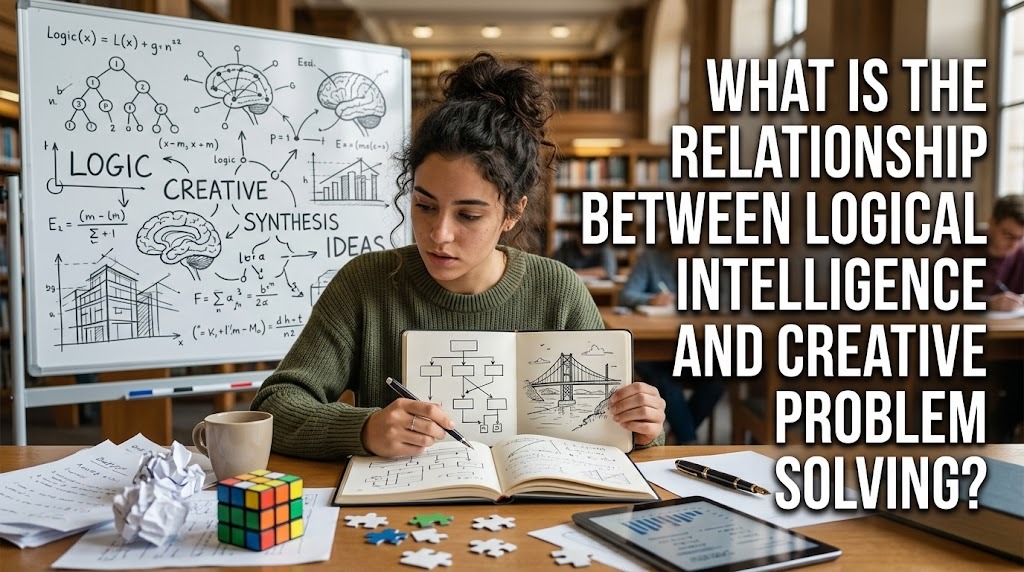
Logical intelligence and creative problem solving are two abilities that can work together when people face challenges. Logical intelligence helps a person organize information, identify relationships, and evaluate possible solutions. Creative problem solving allows them to generate new ideas and explore different approaches. Combining these abilities can help students handle problems that do not always have one simple answer.
UNDERSTANDING LOGICAL INTELLIGENCE
Logical intelligence is the ability to use reasoning, recognize patterns, analyze information, and understand cause-and-effect relationships. People use this ability when they need to examine a situation carefully before reaching a conclusion. Logical thinking provides a structured way to understand what is happening and what information may be important. It can therefore become a useful foundation for solving different types of problems.
Logical intelligence does not mean following only one fixed method. A person can use reasoning to compare several approaches and determine which one may be suitable. This process involves analysis, organization, evaluation, and decision making. These skills can help students understand complicated problems before attempting to create a solution.
UNDERSTANDING CREATIVE PROBLEM SOLVING
Creative problem solving is the process of finding new or different ways to address a challenge. It encourages people to look beyond familiar methods and consider alternative possibilities. Creativity can be useful when a problem has several possible solutions or when an ordinary approach does not work. The goal is not simply to produce an unusual idea but to develop an idea that can address the problem.
Creative problem solving often begins with understanding the problem clearly. After identifying the main challenge, a person can generate several ideas without immediately rejecting them. The ideas can then be examined based on their usefulness, practicality, and possible consequences. This shows why creativity can benefit from logical thinking during the solution process.
HOW LOGICAL THINKING SUPPORTS CREATIVE IDEAS
Logical intelligence can help creativity become more focused and structured. When people generate many ideas, logical reasoning can help them organize those ideas and identify connections between them. They can examine whether an idea addresses the actual problem and whether it can realistically be developed. This prevents creativity from becoming disconnected from the purpose of solving the problem.
Logical thinking can also help people combine different ideas into a more useful solution. For example, a student working on a project may develop several possible approaches and then compare their strengths and limitations. By examining the available information, the student can modify an idea until it becomes more practical. In this way, logic can guide creativity without replacing it.
USING BOTH ABILITIES TO SOLVE COMPLEX PROBLEMS
Complex problems often require more than one type of thinking. Logical intelligence helps a person understand the structure of a problem, while creative thinking helps generate possible ways to address it. The two abilities can be used in different stages of the problem-solving process. This can make the overall approach both organized and flexible.
For example, a student may discover that a traditional method does not solve a particular assignment effectively. The student can first analyze why the method is unsuccessful and then consider alternative approaches. After generating several ideas, the student can use logical reasoning to compare the options and select an appropriate one. This process combines analysis, creativity, evaluation, and adaptation.
DEVELOPING LOGICAL AND CREATIVE THINKING
Students can strengthen both abilities through activities that require them to think, experiment, and explain their reasoning. Puzzles, research projects, coding, design activities, writing tasks, experiments, and strategy games can provide useful opportunities. Some activities can focus on finding logical patterns, while others can encourage students to develop multiple solutions. Combining different types of activities can provide broader thinking practice.
Teachers and parents can also encourage students to avoid immediately assuming that there is only one possible answer. Asking questions such as why a solution works or whether another approach could work can encourage deeper thinking. Students can review unsuccessful attempts and use what they learn to develop new ideas. This creates an environment where mistakes become opportunities for learning and innovation.
CONCLUSION
The relationship between logical intelligence and creative problem solving is complementary because each ability contributes something different. Logical intelligence helps people analyze information, organize ideas, and evaluate possible solutions, while creative thinking helps them generate alternative approaches. When used together, these abilities can support flexible and structured problem solving. Students can develop them through puzzles, projects, experiments, coding, design activities, and other challenges that require reasoning and creativity. Strengthening both abilities can help students approach unfamiliar problems with greater flexibility, organization, and confidence.
Recent Posts

Bagaimana Sistem SKS pada Program Kuliah... 22.11.2026/21 View

How Does Technology Make Daily Evaluation... 21.11.2026/64 View

Apa Strategi Menghadapi Kesenjangan antara Kompetensi... 21.11.2026/65 View

Mengapa Inventaris Aset Penting bagi Kelancaran... 21.11.2026/62 View

When Should Musicians Join a Record... 21.11.2026/60 View
