

What Is the Relationship Between Logical Intelligence and Problem Solving?
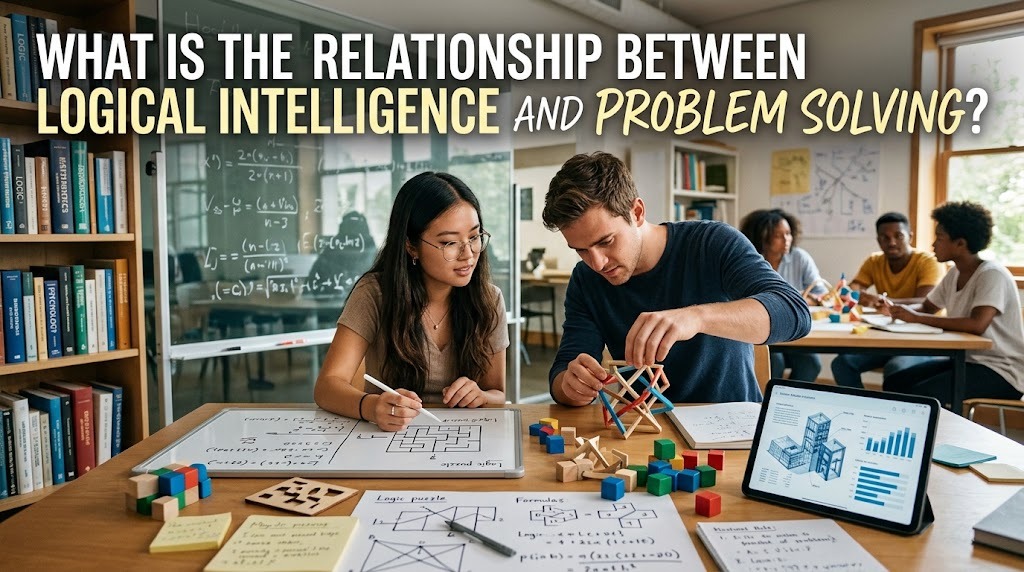
Logical intelligence and problem solving are closely connected because both involve the ability to understand information, identify relationships, and find appropriate solutions. Logical intelligence provides a way of thinking that helps people approach problems in an organized and reasonable manner. Students can use this ability when completing assignments, analyzing situations, or dealing with challenges in everyday life. By developing logical intelligence, students can gradually improve the way they approach different problems.
UNDERSTANDING LOGICAL INTELLIGENCE
Logical intelligence is the ability to use reasoning, recognize patterns, compare information, and understand relationships between different elements. A person with developed logical intelligence can examine information carefully before reaching a conclusion. This ability is useful in subjects such as mathematics and science, but it can also support learning in many other areas. Logical intelligence is not simply about getting the correct answer but also about understanding how the answer is reached.
Logical thinking involves several skills, including analysis, classification, sequencing, and cause-and-effect reasoning. These skills allow a person to organize information and determine which details are important. When facing a difficult situation, logical thinking can help separate the problem into smaller parts. This makes the situation easier to understand and provides a clearer path toward a possible solution.
UNDERSTANDING PROBLEM SOLVING
Problem solving is the process of identifying a problem, understanding its causes, considering possible solutions, and selecting an appropriate action. Problems can occur in academic activities, work, relationships, technology, and daily life. Effective problem solving requires more than immediately choosing the first available answer. A person needs to understand the situation before deciding what action should be taken.
The problem-solving process can include identifying the problem, gathering information, generating solutions, evaluating options, and checking the result. Each stage requires a certain level of reasoning. For example, students may need to determine which information is relevant before choosing a method to answer a difficult question. This structured approach can reduce confusion and help them make more informed decisions.
HOW LOGICAL INTELLIGENCE SUPPORTS PROBLEM SOLVING
Logical intelligence provides the reasoning skills needed to approach problems systematically. When students encounter a complicated problem, they can use logical thinking to break it into smaller and more manageable parts. They can identify what is known, what is unknown, and what information may be useful. This allows them to focus on the actual problem instead of becoming overwhelmed by its complexity.
Logical intelligence also helps students compare different solutions and predict possible consequences. Instead of choosing an answer randomly, they can consider whether a solution is reasonable based on the available information. If the first solution does not work, they can examine the result and try another approach. This process encourages students to become more flexible and persistent problem solvers.
THE ROLE OF ANALYSIS AND REASONING
Analysis and reasoning are important connections between logical intelligence and problem solving. Analysis allows students to examine individual parts of a problem and understand how those parts are related. Reasoning then helps them connect the information and determine a logical conclusion. Together, these abilities can make the problem-solving process more organized.
For example, when working on a complex assignment, a student can first identify the main question and separate it into several smaller tasks. The student can then determine which information is relevant and decide which method may be most suitable. This demonstrates how logical reasoning turns complicated information into a structured process. Such habits can also be applied outside the classroom.
DEVELOPING BOTH SKILLS THROUGH PRACTICE
Logical intelligence and problem-solving skills can be strengthened through regular practice and challenging activities. Students can work on puzzles, mathematics exercises, strategy games, coding tasks, experiments, and research projects. These activities encourage them to identify patterns, test ideas, and evaluate results. Different types of challenges can provide opportunities to practice different aspects of logical thinking.
Mistakes can also become part of the learning process. When a solution does not produce the expected result, students can examine what happened and identify which step needs to be changed. This encourages reflection, adaptability, and independent thinking. With consistent practice, students can become more comfortable approaching unfamiliar problems instead of immediately giving up.
CONCLUSION
The relationship between logical intelligence and problem solving is strong because logical thinking provides important skills for understanding and addressing problems. Logical intelligence helps people analyze information, recognize patterns, evaluate alternatives, and develop structured solutions. Problem solving then applies these reasoning skills to real situations and challenges. Students can strengthen both abilities through puzzles, academic exercises, experiments, technology, and everyday problem-solving activities. Developing these skills can support critical thinking, decision making, and independent learning.
Recent Posts

Bagaimana Sistem SKS pada Program Kuliah... 22.11.2026/12 View

How Does Technology Make Daily Evaluation... 21.11.2026/63 View

Apa Strategi Menghadapi Kesenjangan antara Kompetensi... 21.11.2026/64 View

Mengapa Inventaris Aset Penting bagi Kelancaran... 21.11.2026/61 View

When Should Musicians Join a Record... 21.11.2026/59 View
