

What Is the Relationship Between Mind Mapping and Information Retention?
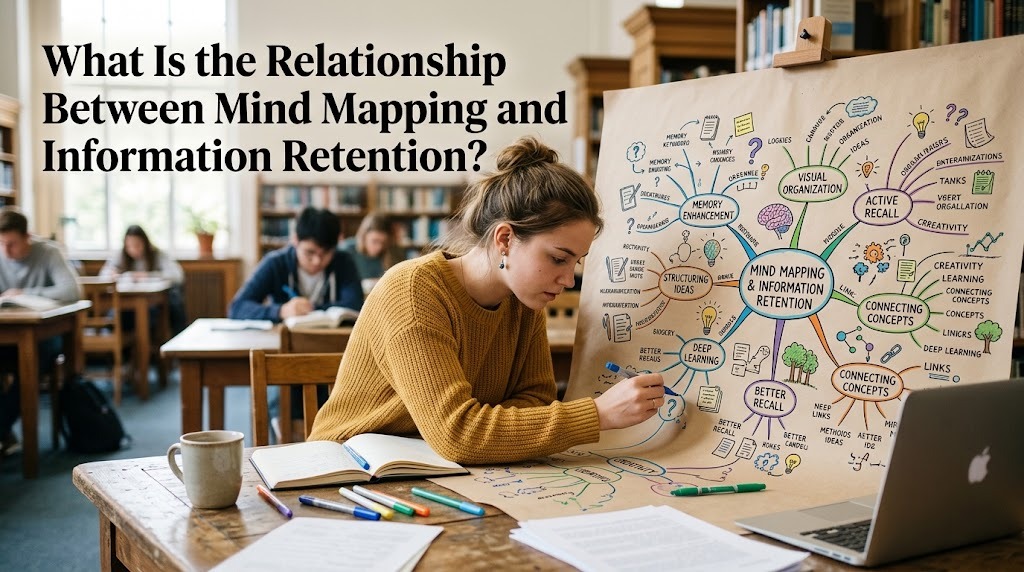
Information retention refers to the ability to keep and recall information after learning it. Students often need strong retention skills because they encounter many concepts, facts, and explanations during their studies. Mind mapping is one learning technique that can help students organize information in a visual and connected format. By placing a main topic at the center and adding related ideas through branches, students can create a clearer structure for the material. This structure may support the process of understanding, reviewing, and remembering information.
HOW MIND MAPPING ORGANIZES INFORMATION
Mind mapping organizes information by connecting a central topic with related concepts. Students can divide a lesson into several main branches and then add smaller branches for supporting details. This allows information to be arranged according to relationships rather than presented only as a long sequence of sentences. When ideas are grouped logically, students can more easily recognize how different concepts relate to one another.
The structure of a mind map can also help students identify main ideas and supporting information. Instead of treating every piece of information as equally important, students can place major concepts closer to the center and details farther along the branches. This creates a visual hierarchy that can make the learning material easier to review. A clear structure can provide useful cues when students try to recall the information later.
CONNECTIONS CAN SUPPORT INFORMATION RETENTION
One important relationship between mind mapping and information retention is the creation of connections between ideas. When students connect related concepts, they are not simply recording information but also thinking about how the information fits together. These relationships can provide additional cues for remembering a topic. For example, a student studying history can connect an event with its causes, important figures, effects, and related events.
These connections can make information more meaningful because students see the relationship between individual concepts. However, creating a mind map does not automatically guarantee that information will be remembered for a long period. Retention is influenced by several factors, including attention, understanding, practice, and review. Mind mapping can therefore be considered a supporting learning technique rather than a complete solution by itself.
KEYWORDS AND VISUAL CUES HELP RECALL
Mind maps usually use short keywords instead of long paragraphs. Selecting a keyword requires students to identify the most important part of an explanation. These keywords can later act as cues that help students remember the broader information connected to them. For example, a single keyword on a branch may remind students of a definition, example, or explanation discussed during a lesson.
Visual cues such as symbols, arrows, shapes, or simple drawings can also support the organization of information. Students should use these elements when they add meaning to the material rather than using them only for decoration. A clear visual system can make certain concepts easier to locate during review. As a result, students can quickly recognize important information without having to read an entire page of notes.
REVIEWING A MIND MAP CAN STRENGTHEN RECALL
Creating a mind map is only the first part of using it for information retention. Students should review their maps regularly and actively try to recall the information represented by each branch. For example, they can look at a keyword and explain the related concept without reading the textbook. This practice requires students to retrieve information from memory rather than simply recognize it.
Students can also gradually increase the time between review sessions. This approach, commonly known as spaced practice, can support long-term learning when used appropriately. Mind maps provide a convenient structure for these review sessions because the main concepts are organized in one place. Combining mind mapping with active recall and spaced review can make the technique more useful for long-term retention.
MIND MAPPING SHOULD SUPPORT UNDERSTANDING
Information retention is closely related to understanding the material. Students may have difficulty remembering information that they have copied without understanding its meaning. When creating a mind map, students should therefore think about why concepts are connected and explain them using their own words. This makes the activity more than simply rewriting notes in a different format.
Students should also check their mind maps against reliable learning materials to make sure the information is accurate. A visually attractive map is not useful if it contains incorrect or incomplete concepts. The goal should be to create a map that represents the important relationships within the subject. In this way, mind mapping can support both understanding and later recall.
CONCLUSION
The relationship between mind mapping and information retention can be seen through the way mind maps organize concepts, create connections, and provide visual cues for review. By selecting keywords and arranging related ideas into branches, students can build a structured representation of what they have learned. Regularly reviewing the map and practicing active recall can make it more useful for remembering information over time. However, mind mapping should be combined with other effective learning methods rather than treated as a guaranteed method for improving memory. When used thoughtfully, it can become a practical learning strategy for understanding and retaining information.
Recent Posts

Bagaimana Sistem SKS pada Program Kuliah... 22.11.2026/27 View

How Does Technology Make Daily Evaluation... 21.11.2026/65 View

Apa Strategi Menghadapi Kesenjangan antara Kompetensi... 21.11.2026/65 View

Mengapa Inventaris Aset Penting bagi Kelancaran... 21.11.2026/62 View

When Should Musicians Join a Record... 21.11.2026/63 View
