

What Is the Relationship Between Scientific Literacy and Problem Solving Skills?
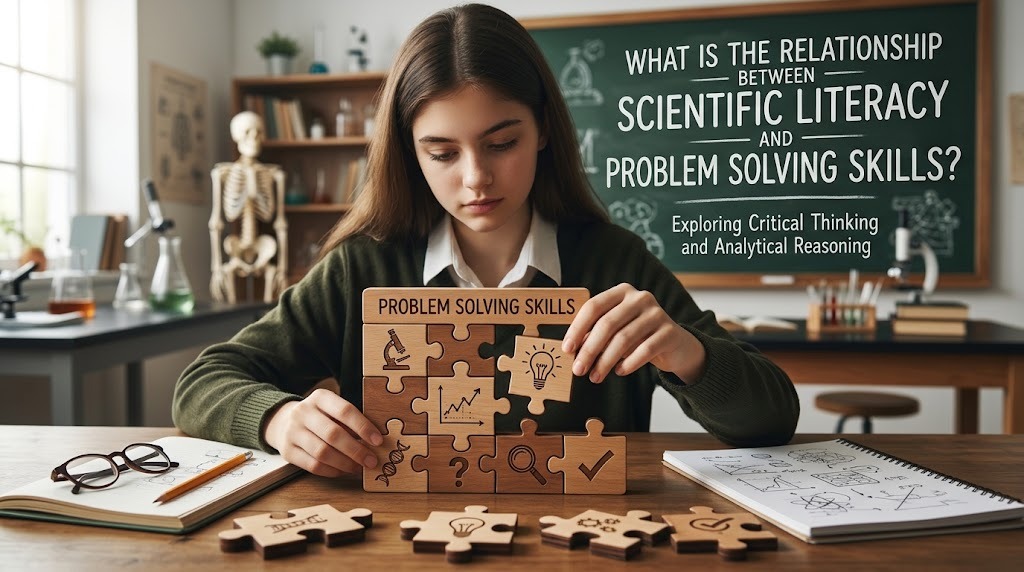
Scientific literacy and problem solving skills are closely connected because both involve understanding information, analyzing evidence, and finding reasonable solutions. In everyday life, people often face problems that require more than simple memorization. They need to understand the situation, identify relevant information, and consider possible solutions. Scientific literacy provides knowledge and reasoning skills that can support this process. Therefore, developing scientific literacy can also help students strengthen their problem solving abilities.
UNDERSTANDING SCIENTIFIC LITERACY
Scientific literacy is the ability to understand scientific knowledge, evaluate evidence, and use scientific information in real-life situations. It involves more than remembering scientific facts because individuals also need to understand how information can be used to explain problems. Students with scientific literacy can ask questions, examine evidence, and develop conclusions based on logical reasoning. These abilities are useful when dealing with both academic and everyday problems. Scientific literacy therefore provides an important foundation for effective problem solving.
Scientific literacy also encourages people to understand the relationship between science, technology, society, and the environment. For example, students can use scientific knowledge to understand problems related to pollution, energy, health, or climate. They can examine possible causes and consider solutions supported by evidence. This process allows scientific knowledge to be applied beyond the classroom. As a result, students can develop a more practical understanding of scientific concepts.
SCIENTIFIC LITERACY HELPS IDENTIFY PROBLEMS
The first step in solving a problem is understanding what the actual problem is. Scientific literacy encourages students to ask questions and identify relevant information before attempting to find a solution. They can examine the conditions surrounding a problem and distinguish important facts from assumptions. This prevents them from immediately choosing a solution without understanding the situation. Careful problem identification can therefore improve the overall problem solving process.
For example, if students investigate why waste is increasing in their school, they can begin by observing the situation and collecting relevant information. They might examine the types of waste, disposal habits, and available waste facilities. By gathering this information, students can identify possible factors contributing to the problem. This approach is more systematic than simply guessing the cause. It demonstrates how scientific literacy can support structured problem analysis.
SCIENTIFIC LITERACY SUPPORTS EVIDENCE BASED SOLUTIONS
After identifying a problem, people need to consider possible solutions. Scientific literacy helps students evaluate solutions using evidence and logical reasoning. They can compare different options and examine the potential advantages and limitations of each one. Instead of choosing a solution only because it seems attractive, students can consider whether available evidence supports it. This process can lead to more informed problem solving.
For instance, when investigating waste management, students could compare several approaches to reducing waste. They might examine whether recycling programs, waste separation, or educational campaigns could address the problem. The students can then consider information about the effectiveness of each approach. This process encourages them to connect scientific knowledge with practical action. It also strengthens their ability to make decisions based on evidence.
SCIENTIFIC LITERACY DEVELOPS CRITICAL THINKING
Critical thinking is an important part of both scientific literacy and problem solving. Students need to examine information carefully and determine whether a proposed explanation makes sense. They can compare evidence, identify assumptions, and consider alternative explanations before reaching a conclusion. These activities help students avoid making decisions based only on incomplete information. Scientific learning can therefore provide regular opportunities to practice critical thinking.
Critical thinking is especially important when problems are complex and have more than one possible solution. Students may need to consider different factors before deciding which approach is appropriate. They can also recognize that a solution may need to be changed when new evidence becomes available. This flexibility is an important part of effective problem solving. It teaches students that solving a problem can involve investigation, evaluation, and revision.
SCIENTIFIC LITERACY SUPPORTS REAL LIFE PROBLEM SOLVING
The relationship between scientific literacy and problem solving extends beyond school activities. People encounter problems involving health, technology, transportation, energy, food, and the environment in their daily lives. Scientific literacy can help individuals understand relevant information and evaluate possible solutions. These abilities can support informed decision making in practical situations. Therefore, scientific literacy has value in many areas of everyday life.
Students can develop these abilities through activities such as experiments, investigations, projects, and discussions about real-world issues. Such activities allow them to apply concepts instead of simply memorizing information. They learn to identify problems, gather evidence, evaluate options, and reflect on the results. These steps can strengthen both scientific understanding and problem solving skills. Over time, students can become more confident in approaching unfamiliar challenges.
CONCLUSION
Scientific literacy and problem solving skills have a strong relationship because both require people to understand information, evaluate evidence, and use logical reasoning. Scientific literacy helps students identify problems, investigate possible causes, compare solutions, and make evidence based decisions. It also strengthens critical thinking, analytical skills, and practical reasoning. These abilities can be applied to academic tasks as well as everyday challenges. By developing scientific literacy, students can become better prepared to approach problems systematically and responsibly.
Recent Posts

Bagaimana Sistem SKS pada Program Kuliah... 22.11.2026/33 View

How Does Technology Make Daily Evaluation... 21.11.2026/67 View

Apa Strategi Menghadapi Kesenjangan antara Kompetensi... 21.11.2026/67 View

Mengapa Inventaris Aset Penting bagi Kelancaran... 21.11.2026/65 View

When Should Musicians Join a Record... 21.11.2026/66 View
