

What Is the Role of Logical Intelligence in Improving Analytical Skills?
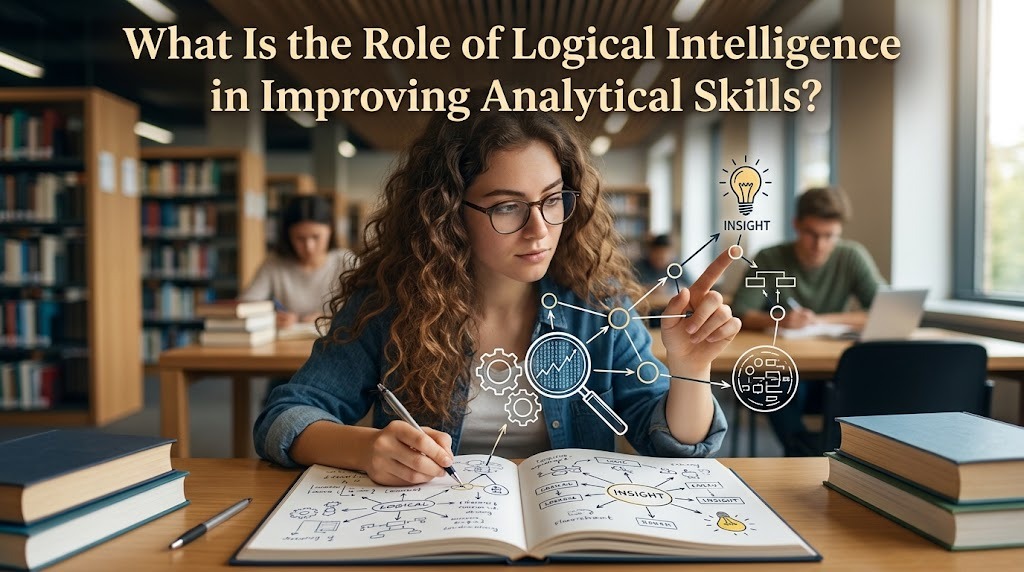
Logical intelligence plays an important role in developing analytical skills because it helps people understand information, recognize relationships, identify patterns, and reach conclusions through reasoning. Analytical skills are useful when students need to examine a problem, compare information, or determine the best way to complete a task. These abilities are not limited to mathematics or science but can also support learning, communication, and everyday decision making. With regular practice, logical intelligence can become a strong foundation for better analytical thinking.
UNDERSTANDING LOGICAL INTELLIGENCE AND ANALYTICAL SKILLS
Logical intelligence refers to the ability to use reasoning and understand relationships between different pieces of information. It allows a person to organize facts, recognize patterns, and determine how one situation may be connected to another. Analytical skills, meanwhile, involve examining information carefully to understand its meaning and importance. Both abilities work together when someone needs to understand a complex situation.
For example, a student working on an assignment may need to identify the main question, collect relevant information, and determine how different facts are connected. Logical intelligence provides the reasoning needed to organize these details, while analytical skills help the student examine them more deeply. This combination can support clearer thinking and more structured conclusions. It can also reduce the tendency to make decisions without considering sufficient information.
HELPING PEOPLE BREAK DOWN COMPLEX INFORMATION
One important role of logical intelligence is helping people divide complicated information into smaller parts. A large amount of information can be difficult to understand when viewed as a whole. By separating the information into categories, sequences, or key points, students can identify what is most relevant. This makes analytical tasks easier to manage.
Logical thinking can also help students recognize connections between individual pieces of information. For instance, they may identify a cause-and-effect relationship or notice that several facts support the same idea. These connections help create a clearer understanding of the topic. As a result, logical intelligence can make information analysis more organized and effective.
STRENGTHENING PATTERN AND RELATIONSHIP RECOGNITION
Pattern recognition is an important part of analytical thinking. Logical intelligence helps people notice repeated structures, similarities, differences, and relationships within information. This ability can be useful when analyzing numbers, written information, data, or everyday situations. Recognizing a pattern can provide clues that help someone understand a problem more quickly.
For example, students may notice that certain results repeatedly appear under similar conditions during a learning activity. They can then examine why the pattern occurs and whether the same relationship applies to another situation. This process combines observation, comparison, and reasoning. These skills can strengthen the way students analyze unfamiliar information.
SUPPORTING EVIDENCE BASED REASONING
Analytical skills require people to evaluate information before reaching conclusions. Logical intelligence supports this process by encouraging individuals to consider evidence and examine whether a conclusion follows from the available information. Students can use this approach when reading articles, conducting research, or evaluating different explanations. It encourages them to think beyond assumptions.
Evidence-based reasoning also helps students identify weaknesses in an argument. They can ask whether a statement has enough support and whether the information used is relevant to the conclusion. This does not mean that every situation has one simple answer. Instead, it encourages students to develop conclusions that are supported by relevant information and logical connections.
IMPROVING PROBLEM SOLVING AND DECISION MAKING
Logical intelligence and analytical skills are particularly useful when solving problems. Students can identify the main problem, examine possible causes, consider different solutions, and predict potential outcomes. This structured process can make problem solving more manageable. It also encourages students to evaluate their approach rather than immediately accepting the first solution.
The same skills can support better decision making. When several choices are available, students can compare the advantages, limitations, and possible consequences of each option. They can then select an approach based on the information available at that time. If new information appears, they can reassess the decision and adjust their approach when necessary.
DEVELOPING ANALYTICAL SKILLS THROUGH PRACTICE
Analytical skills can be strengthened through activities that require reasoning, comparison, evaluation, and problem solving. Students can practice with puzzles, research projects, mathematics exercises, coding, strategy games, experiments, and data interpretation. These activities encourage them to examine information rather than simply memorize it. Repeated practice can gradually make analytical thinking more natural.
Teachers and parents can also encourage students to explain how they reached an answer. Discussing different solutions allows students to compare reasoning methods and identify possible mistakes. Learning from mistakes is valuable because it helps students understand which part of their reasoning needs improvement. With consistent practice, students can develop stronger logical intelligence and analytical abilities that can support learning and everyday challenges.
CONCLUSION
Logical intelligence plays a significant role in improving analytical skills by helping people organize information, recognize patterns, evaluate evidence, and understand relationships. These abilities allow students to approach complex information in a more structured way. Logical intelligence also supports problem solving and decision making because students can compare alternatives and consider possible consequences. Activities such as puzzles, research, coding, experiments, and data analysis can provide opportunities to strengthen these abilities. Developing logical and analytical thinking can help students become more independent, careful, and effective learners.
Recent Posts

Bagaimana Sistem SKS pada Program Kuliah... 22.11.2026/21 View

How Does Technology Make Daily Evaluation... 21.11.2026/63 View

Apa Strategi Menghadapi Kesenjangan antara Kompetensi... 21.11.2026/65 View

Mengapa Inventaris Aset Penting bagi Kelancaran... 21.11.2026/62 View

When Should Musicians Join a Record... 21.11.2026/60 View
