

What Is the Role of Scientific Literacy in Improving Critical Thinking Skills?
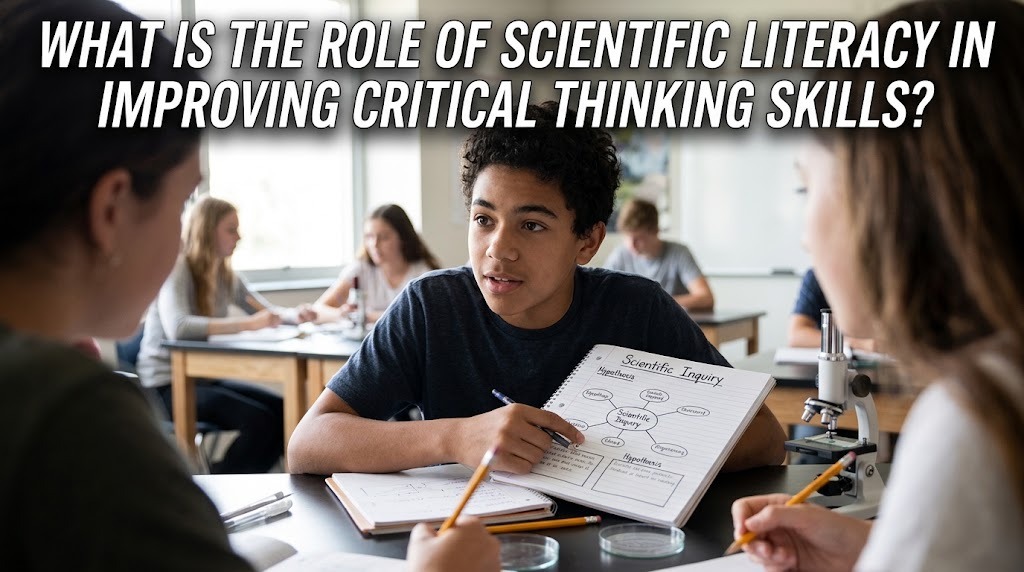
Scientific literacy plays an important role in helping people develop critical thinking skills. In everyday life, people encounter scientific information through education, news, social media, and digital platforms. Not all information can be accepted immediately because some claims may lack reliable evidence. Scientific literacy teaches individuals to examine information, ask questions, and consider evidence before reaching conclusions. Therefore, scientific literacy can support students in becoming more careful and logical thinkers.
UNDERSTANDING SCIENTIFIC LITERACY
Scientific literacy is the ability to understand scientific concepts, evaluate evidence, and apply scientific knowledge to real-life situations. It is not limited to memorizing facts from textbooks or completing science assignments. People with scientific literacy can connect scientific knowledge with problems and situations around them. They can also examine whether a statement is supported by appropriate evidence. These abilities provide an important foundation for developing critical thinking.
Scientific literacy encourages individuals to become curious about information rather than accepting every claim immediately. When students encounter a scientific statement, they can ask where the information comes from and what evidence supports it. They can also compare different explanations before deciding which conclusion is reasonable. This process develops a habit of careful information analysis. As a result, scientific literacy and critical thinking can develop together through meaningful learning experiences.
SCIENTIFIC LITERACY ENCOURAGES QUESTIONING
One important part of critical thinking is the ability to ask relevant questions. Scientific literacy encourages students to question how and why something happens instead of simply memorizing an answer. They can investigate possible causes, examine available evidence, and consider different explanations. This process encourages curiosity and logical reasoning. Asking questions can also help students identify information that requires further investigation.
For example, when students learn about environmental changes, they can ask what causes those changes and what evidence supports the explanation. They may compare information from different reliable sources and examine whether the evidence leads to the same conclusion. Through this activity, students learn that conclusions should be based on evidence rather than assumptions. This creates a stronger foundation for critical thinking skills. The habit of questioning can also be useful outside the classroom.
SCIENTIFIC LITERACY HELPS EVALUATE EVIDENCE
Critical thinking requires the ability to determine whether information is supported by reliable evidence. Scientific literacy teaches students how evidence can be used to support or challenge a claim. Students can examine the source of information, the quality of available evidence, and whether the conclusion is consistent with the findings. These skills are particularly important when students encounter information online. Digital platforms can provide useful resources, but they can also contain inaccurate or misleading information.
By learning to evaluate evidence, students become less likely to accept claims simply because they are popular or frequently shared. They can compare information from trustworthy sources and identify differences between scientific evidence, personal opinions, and unsupported assumptions. This process helps students develop more independent judgments. It also encourages them to recognize that some scientific questions may involve uncertainty or require additional research.
SCIENTIFIC LITERACY IMPROVES PROBLEM SOLVING
Scientific literacy is also connected to problem solving because scientific learning often requires people to investigate problems and identify possible solutions. Students can learn to define a problem, collect relevant information, analyze evidence, and consider possible explanations. These steps encourage them to approach problems systematically rather than relying only on guesses. The process can strengthen both analytical and reasoning abilities.
For instance, students may investigate why a particular environmental problem occurs in their community. They can gather information, identify possible causes, and consider solutions based on scientific knowledge. During this process, they need to examine whether their proposed solution is supported by evidence. Such activities help students understand how logical problem solving works in real situations. These skills can later be applied to academic, professional, and everyday challenges.
SCIENTIFIC LITERACY SUPPORTS BETTER DECISIONS
Strong critical thinking allows people to make decisions after considering relevant information and evidence. Scientific literacy supports this process by helping students understand how evidence can influence a conclusion. Instead of deciding based only on emotions, assumptions, or popular opinions, students can examine the available information first. They can also recognize when additional evidence is needed before making a decision. This approach promotes informed decision making.
These skills are especially useful in the digital era, when information can spread rapidly. Students may encounter health claims, environmental information, technology news, or scientific statements on social media. Scientific literacy encourages them to verify information before believing or sharing it. By developing this habit, students can become more responsible users of information. Critical thinking therefore becomes a practical skill that supports everyday decision making.
CONCLUSION
Scientific literacy plays an important role in improving critical thinking skills by teaching students to ask questions, evaluate evidence, solve problems, and make informed decisions. It encourages learners to examine information carefully instead of accepting claims without sufficient evidence. Scientific literacy also develops logical reasoning, curiosity, problem solving, and information evaluation. These abilities are valuable both in education and in everyday life. By strengthening scientific literacy, students can become more thoughtful and responsible thinkers in an increasingly information-rich world.
Recent Posts

Bagaimana Sistem SKS pada Program Kuliah... 22.11.2026/33 View

How Does Technology Make Daily Evaluation... 21.11.2026/67 View

Apa Strategi Menghadapi Kesenjangan antara Kompetensi... 21.11.2026/67 View

Mengapa Inventaris Aset Penting bagi Kelancaran... 21.11.2026/65 View

When Should Musicians Join a Record... 21.11.2026/66 View
