

What Learning Methods Help Students Master Olympiad Science Topics?
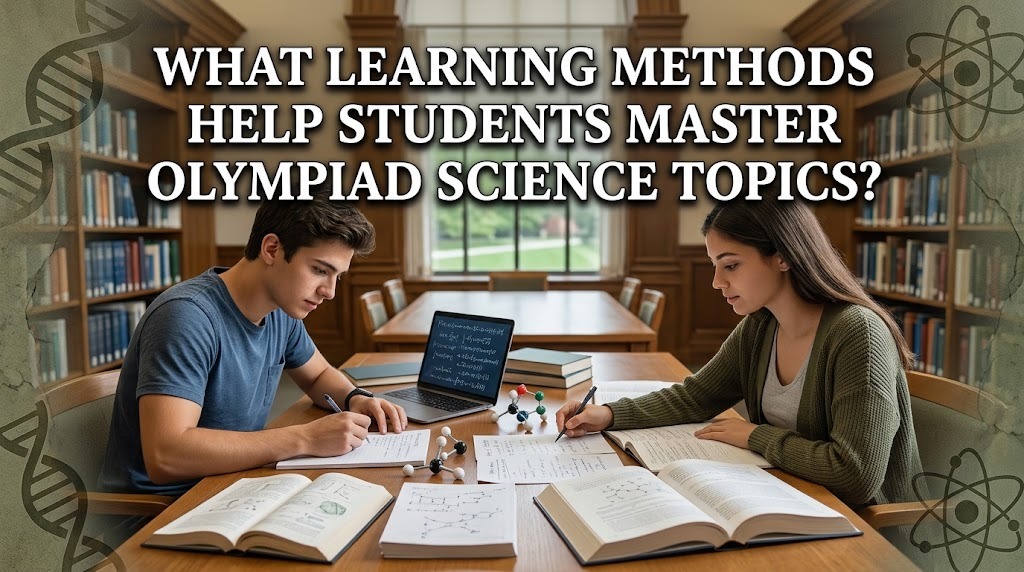
Mastering Science Olympiad topics requires more than memorizing scientific definitions and formulas. Students need to understand complex concepts, interpret information, solve challenging problems, and apply scientific knowledge to unfamiliar situations. These abilities develop through consistent practice and effective learning methods.
Every student has a different learning style and level of understanding. Some learn more effectively through visual explanations, while others benefit from experiments, discussions, or independent exercises. Choosing appropriate learning methods can help students understand difficult topics, improve their academic performance, and prepare more systematically for Science Olympiad competitions.
BUILDING STRONG FUNDAMENTAL KNOWLEDGE
Understanding fundamental concepts is the first step toward mastering advanced Science Olympiad topics. Students should begin by studying basic principles before moving on to complicated theories and applications.
For example, students preparing for physics competitions should understand fundamental concepts such as motion, force, energy, and electricity. Chemistry participants need a strong foundation in atomic structure, chemical bonding, and chemical reactions.
A solid understanding of basic principles makes advanced materials easier to follow. It also helps students recognize relationships between different topics and avoid relying entirely on memorized formulas.
USING ACTIVE RECALL TO STRENGTHEN MEMORY
Active recall is a learning method that encourages students to retrieve information from memory without immediately looking at their notes. Instead of repeatedly reading the same material, students test themselves by answering questions or explaining concepts independently.
For example, after studying the human circulatory system, students can close their textbooks and describe how blood moves through the heart and body. They can then compare their explanations with the original material to identify missing information.
This method encourages deeper engagement with learning materials. Regular active recall can also help students recognize which concepts they understand and which ones require additional practice.
APPLYING SPACED REPETITION
Spaced repetition involves reviewing information at gradually increasing intervals rather than studying everything in one session. This method helps students revisit important concepts before they become difficult to remember.
Science Olympiad preparation often covers extensive materials from several scientific disciplines. Without regular review, students may forget previously studied topics while focusing on new information.
Students can create a weekly revision schedule that includes short reviews after the initial lesson, followed by additional reviews over the following days or weeks. Flashcards, digital learning applications, and personal study notes can support this process.
PRACTICING WITH OLYMPIAD QUESTIONS
Solving practice questions is one of the most useful methods for preparing for Science Olympiad competitions. These exercises allow students to apply theoretical knowledge and become familiar with different question formats.
Students should practice questions with varying levels of difficulty, beginning with fundamental exercises before progressing to more advanced problems. Previous competition questions can also help them understand the types of reasoning and scientific applications commonly tested.
After completing each exercise, students should review their answers carefully. Understanding why an answer is incorrect is just as important as knowing the correct solution because it helps prevent similar mistakes in future practice.
CONDUCTING EXPERIMENTS AND PRACTICAL ACTIVITIES
Practical learning helps students connect scientific theories with observable phenomena. Through experiments, they can investigate how scientific principles work and understand the processes behind different results.
For example, chemistry students can observe simple chemical reactions, while biology students can examine plant structures or investigate biological processes. Physics students can conduct activities involving motion, temperature, or electrical circuits.
During these activities, students should record observations, identify variables, and analyze experimental outcomes. Practical experience develops scientific reasoning and helps participants understand concepts that may be difficult to learn through textbooks alone.
USING VISUAL LEARNING MATERIALS
Some scientific concepts involve processes and structures that are difficult to imagine through written explanations. Visual learning materials such as diagrams, animations, charts, and concept maps can make these topics easier to understand.
For instance, biology students can use diagrams to study cell structures and organ systems. Chemistry participants may benefit from molecular models, while physics students can use motion diagrams to understand relationships between forces and movement.
Visual materials help organize complex information into clearer representations. Students can also create their own diagrams to summarize important topics and identify connections between scientific concepts.
APPLYING THE FEYNMAN TECHNIQUE
The Feynman Technique is a learning approach that involves explaining a concept using simple language, as if teaching it to someone who has no previous understanding of the topic.
Students can begin by selecting a scientific concept and writing an explanation without relying heavily on technical terminology. If they struggle to explain a particular part, this may indicate that their understanding is incomplete.
They can then review the relevant material and improve their explanation. This process encourages deeper comprehension and helps students identify gaps in their knowledge.
JOINING STUDY GROUPS AND DISCUSSION SESSIONS
Studying with other students can provide opportunities to exchange knowledge and understand scientific concepts from different perspectives. Participants may have different strengths in mathematics, physics, chemistry, or biology.
During group discussions, students can explain solutions, ask questions, and compare problem-solving methods. Teaching a concept to another person can also strengthen their own understanding.
However, group study should remain focused on specific learning objectives. Students should prepare discussion topics and ensure that every member has an opportunity to participate actively.
USING DIGITAL LEARNING PLATFORMS
Technology provides additional learning opportunities for students preparing for Science Olympiad competitions. Digital platforms offer educational videos, interactive simulations, electronic textbooks, and online practice questions.
Students can use these resources to explore complicated topics at their own pace. Virtual laboratories can also help them understand experimental procedures when physical laboratory facilities are unavailable.
However, students should select reliable learning platforms and verify important scientific information through trusted references. Digital tools should support active learning rather than replace independent thinking and practical experience.
FOLLOWING A CONSISTENT STUDY SCHEDULE
A structured study schedule helps students organize extensive Science Olympiad materials and maintain consistent preparation. Without proper planning, students may focus too much on familiar subjects while neglecting topics that require additional attention.
Students can divide their study time among different scientific disciplines and allocate additional sessions for difficult concepts. They should also include regular revision, practice questions, and sufficient breaks.
Consistency is more important than studying for extremely long periods without a clear objective. A realistic schedule helps students maintain motivation and make gradual progress throughout the preparation process.
EVALUATING LEARNING PROGRESS REGULARLY
Regular evaluation allows students to understand whether their learning methods are effective. They can use practice tests, quizzes, and mock examinations to measure their understanding of different scientific topics.
After completing an assessment, students should examine their incorrect answers and identify the reasons behind their mistakes. These may include misunderstood concepts, calculation errors, insufficient practice, or difficulty interpreting questions.
The results can guide their next study sessions. By focusing on specific weaknesses, students can improve their preparation more efficiently and monitor their development over time.
CONCLUSION
Mastering Science Olympiad topics requires a combination of effective learning methods and consistent practice. Building fundamental knowledge, using active recall, applying spaced repetition, solving competition questions, and conducting experiments can help students develop a deeper understanding of science.
Visual learning, group discussions, digital resources, and regular progress evaluations also support academic development. By selecting methods that match their learning needs and following a structured study routine, students can strengthen their scientific knowledge and become better prepared for Science Olympiad competitions.
Recent Posts

Bagaimana Sistem SKS pada Program Kuliah... 22.11.2026/48 View

How Does Technology Make Daily Evaluation... 21.11.2026/76 View

Apa Strategi Menghadapi Kesenjangan antara Kompetensi... 21.11.2026/78 View

Mengapa Inventaris Aset Penting bagi Kelancaran... 21.11.2026/73 View

When Should Musicians Join a Record... 21.11.2026/78 View
