

What Makes Haptic Feedback Valuable in Remote Robot Control?
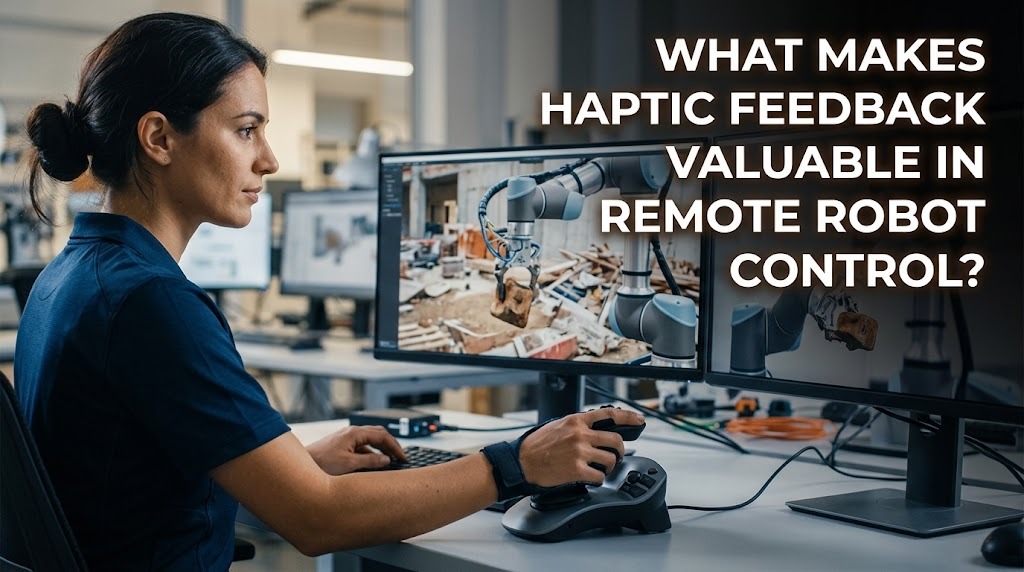
Remote robot control allows operators to perform tasks in locations that may be dangerous, distant, or difficult to access. However, controlling a robot from another location can be challenging because operators cannot directly feel the objects the robot touches. Haptic feedback helps address this limitation by providing tactile sensations or force information through a control device. This technology makes remote interaction more intuitive and helps operators perform delicate tasks with greater precision.
UNDERSTANDING HAPTIC FEEDBACK IN ROBOTICS
Haptic feedback is a technology that communicates information through the sense of touch. In remote robot control, sensors measure forces, pressure, vibration, or contact between the robot and its surroundings. The system then converts this information into tactile sensations or resistance that the operator can feel through a specialized controller, glove, or robotic interface. This creates a stronger connection between the operator's movements and the robot's physical interactions.
IMPROVING CONTROL PRECISION
Haptic feedback helps operators control robotic movements more accurately by providing information about physical contact. When a robot arm touches an object, the operator can receive force signals that indicate how much pressure is being applied. This information is especially valuable when handling fragile materials, inserting small components, or manipulating delicate instruments. By feeling resistance through the control interface, operators can adjust their movements before excessive force causes damage.
PREVENTING DAMAGE TO OBJECTS AND EQUIPMENT
Applying too much force can break fragile objects, damage robotic grippers, or harm surrounding equipment. Haptic systems help reduce these risks by warning operators when contact pressure becomes excessive. For example, a remotely controlled robot handling glassware can communicate resistance as its gripper closes around an object. The operator can then stop or adjust the movement to maintain a safer grip. Although haptic feedback cannot eliminate every accident, it provides an additional source of information for safer manipulation.
SUPPORTING SURGERY AND MEDICAL ROBOTICS
Medical robotics is an important application of haptic feedback because many procedures require delicate and controlled movements. During remote or robot-assisted procedures, tactile information can help clinicians understand the forces applied by robotic instruments. This may be useful when manipulating soft tissue or handling small medical devices. However, not all surgical robots provide force feedback, and the effectiveness of haptic systems depends on their design, calibration, and clinical validation. Reliable feedback must also be integrated with appropriate training and safety procedures.
ENHANCING HUMAN-ROBOT INTERACTION
Haptic feedback makes remote robot control feel more natural by allowing operators to receive information through touch instead of relying entirely on visual displays. Visual information can show where a robot is moving, but it may not clearly communicate the force required to move an object or the resistance encountered during contact. Combining visual, auditory, and haptic signals gives operators a more complete understanding of the robot's actions. This multisensory approach can improve situational awareness and make complex tasks easier to manage.
REDUCING OPERATOR ERRORS AND FATIGUE
Operators who control robots remotely often depend on cameras, sensor readings, and control interfaces to understand their surroundings. Without tactile information, they may need to make repeated visual adjustments to estimate contact forces. Haptic feedback can reduce this uncertainty by communicating resistance and contact events directly through the controller. This may help prevent mistakes and reduce the mental effort required for certain tasks. Nevertheless, poorly designed feedback can become distracting or uncomfortable, so interfaces must be carefully tested for usability.
CHALLENGES OF HAPTIC FEEDBACK SYSTEMS
Despite its benefits, haptic feedback introduces technical challenges. Communication delays can cause force sensations to arrive too late, making remote manipulation less stable or less intuitive. Sensors may also produce inaccurate readings, while actuators and specialized controllers can increase system costs and complexity. Engineers must design feedback mechanisms that remain responsive, comfortable, and safe under different operating conditions. In long-distance or unstable networks, additional control strategies may be needed to manage latency and prevent unintended movements.
FUTURE DEVELOPMENTS IN HAPTIC ROBOT CONTROL
Advances in wearable devices, force sensors, artificial intelligence, and communication networks may improve haptic feedback in remote robotics. Lightweight gloves and compact controllers could make tactile interaction more accessible across industrial, medical, and research applications. Intelligent systems may also adjust feedback intensity according to the task, helping operators distinguish between gentle contact and potentially dangerous force. As these technologies develop, reliable calibration, low-latency communication, and human-centered design will remain essential for effective remote control.
CONCLUSION
Haptic feedback is valuable in remote robot control because it provides tactile information that visual displays alone cannot fully communicate. It improves precision, supports safer object handling, and can enhance operator awareness during delicate tasks. Although challenges such as communication delays, equipment costs, and system complexity remain, well-designed haptic interfaces can make remote robotic operations more intuitive and reliable.
Recent Posts

Bagaimana Sistem SKS pada Program Kuliah... 22.11.2026/49 View

How Does Technology Make Daily Evaluation... 21.11.2026/76 View

Apa Strategi Menghadapi Kesenjangan antara Kompetensi... 21.11.2026/78 View

Mengapa Inventaris Aset Penting bagi Kelancaran... 21.11.2026/74 View

When Should Musicians Join a Record... 21.11.2026/78 View
