

What Makes Homo Sapiens Different From Other Human Species?
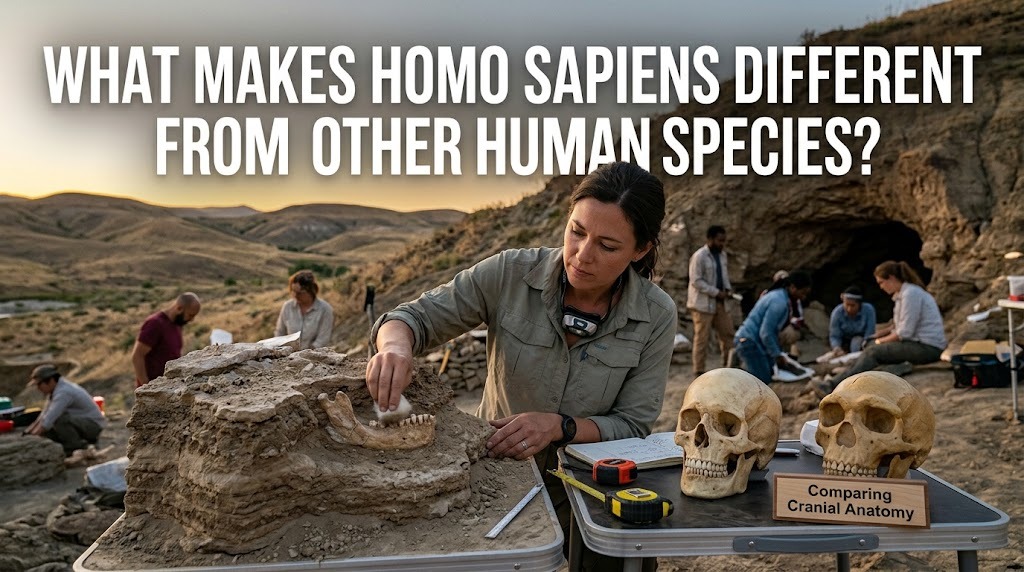
Homo sapiens, the scientific name for modern humans, is the only surviving human species today. Throughout human evolution, several other human species existed, including Neanderthals, Denisovans, and Homo erectus. These species shared certain characteristics with modern humans, such as upright walking, tool use, and social cooperation, but they also had important differences in anatomy, behavior, and adaptation.
Understanding what makes Homo sapiens different from other human species helps explain how modern humans developed and spread across the world. Scientists study fossils, archaeological discoveries, and ancient DNA to investigate these differences. Although some details remain uncertain, the evidence shows that modern humans evolved through a complex process involving biological changes, cultural development, and interactions with other human populations.
PHYSICAL CHARACTERISTICS OF HOMO SAPIENS
One noticeable difference between Homo sapiens and many other human species is their physical structure. Modern humans generally have rounded skulls, relatively flat faces, smaller brow ridges, and a prominent chin. Their skeletons are also typically more slender than those of Neanderthals, who had robust bodies adapted to physically demanding environments. Modern human bodies vary considerably in height, build, and other characteristics, reflecting genetic diversity and adaptation to different environments.
Other human species possessed distinctive physical features that helped them survive in their habitats. Neanderthals, for example, generally had broad bodies, large noses, and strong limbs, while Homo erectus had body proportions suited to walking long distances. These differences developed over many generations as populations adapted to different ecological conditions. However, physical appearance alone does not determine intelligence, behavior, or evolutionary success. Comparing skeletal remains allows scientists to understand how different human species responded to their environments.
BRAIN DEVELOPMENT AND COGNITIVE ABILITIES
The brains of Homo sapiens support complex thinking, planning, learning, and communication. Modern humans can develop abstract ideas, create symbolic systems, and combine existing knowledge to solve unfamiliar problems. They can also imagine future possibilities and pass complicated information to others through language and education. These abilities have contributed to developments in science, mathematics, art, and technology. Nevertheless, intelligence cannot be measured simply by comparing brain size.
Other human species also demonstrated considerable cognitive abilities. Neanderthals made sophisticated tools, used fire, adapted to difficult environments, and may have engaged in symbolic activities. Some Neanderthal remains also provide evidence of care for injured individuals, suggesting forms of social cooperation. Although modern humans developed extensive cultural and technological systems, scientists cannot confidently claim that every cognitive ability was exclusive to Homo sapiens. The differences likely involved several interacting factors, including brain organization, social learning, communication, and cultural development.
LANGUAGE AND COMMUNICATION
Language is an important part of modern human life because it allows people to communicate detailed information, share experiences, and express abstract ideas. Through spoken and signed languages, humans can coordinate complex activities and transmit knowledge between generations. Writing systems later made it possible to preserve information for long periods, supporting the development of education, science, and large-scale societies. Modern digital communication has expanded these abilities by allowing people to exchange information across the world almost instantly.
The communication abilities of other human species are more difficult to establish. Fossils and genetic evidence can provide clues about their hearing, vocal anatomy, and biological capacity for speech, but they cannot reveal exactly what their languages sounded like or how complex they were. Neanderthals possessed some anatomical and genetic characteristics associated with speech, although the precise nature of their communication remains uncertain. It is therefore inaccurate to assume that other human species communicated only through simple sounds or gestures. Modern humans are distinctive in the scale and complexity of their documented language systems and cultural transmission.
TOOLS AND TECHNOLOGICAL INNOVATION
Toolmaking played an important role in the survival of many human species. Early humans created stone tools for cutting, processing food, and performing other essential tasks. Homo erectus used stone tools and adapted to a variety of environments, while Neanderthals developed sophisticated tool traditions suited to their needs. These examples demonstrate that technological ability existed long before modern humans appeared. Different human species developed different techniques depending on their environments, available materials, and cultural practices.
Modern humans developed increasingly diverse technologies and systems for sharing technical knowledge. They produced specialized tools, ornaments, artworks, and eventually complex technologies involving agriculture, metalworking, writing, and engineering. One important characteristic of modern human societies is their ability to accumulate knowledge across generations and combine ideas from different communities. This process allows innovations to spread, improve, and become more sophisticated over time. However, the development of technology was gradual, and some earlier human populations also demonstrated impressive innovation.
CULTURE, ART, AND SYMBOLIC THINKING
Culture is another important area for understanding Homo sapiens. Modern humans create art, develop traditions, establish social rules, and use symbols to communicate meanings that extend beyond immediate practical needs. Archaeological discoveries include personal ornaments, cave paintings, engraved objects, and other evidence of symbolic behavior. These activities provide insights into how people expressed ideas, maintained social identities, and shared cultural knowledge. Cultural practices also vary widely across societies and historical periods.
Evidence of symbolic behavior is not limited to modern humans. Some Neanderthal archaeological sites contain pigments, ornaments, and other objects that may indicate symbolic activities, although interpretations of particular findings can be debated. This evidence suggests that cultural behavior may have developed in several human populations rather than appearing exclusively in Homo sapiens. Modern humans became especially successful at transmitting and expanding complex cultural traditions across large populations. Their cultural diversity and cumulative knowledge have strongly influenced the development of societies throughout history.
SOCIAL COOPERATION AND ADAPTABILITY
Social cooperation helped different human species survive by allowing individuals to share resources, care for group members, and respond to environmental challenges. Neanderthals and other ancient humans lived in social groups and used knowledge of their surroundings to obtain food and shelter. Their survival in challenging climates demonstrates that they possessed effective strategies for adapting to difficult conditions. However, the exact size, organization, and relationships within these groups varied and are not always easy to reconstruct from archaeological evidence.
Modern humans have developed social networks that can connect people across enormous distances. Language, shared cultural practices, trade, and institutions allow individuals to cooperate with people they have never met. This capacity supports large communities, specialized occupations, and international systems of knowledge exchange. Modern humans have also adapted to many different environments through a combination of biological variation, technology, and cultural practices. Their success reflects not a single superior characteristic but the interaction of many abilities and historical circumstances.
WHY HOMO SAPIENS SURVIVED WHILE OTHER HUMAN SPECIES DISAPPEARED
Several human species once lived across Africa, Europe, and Asia, but Homo sapiens is the only surviving human species today. Scientists believe that the disappearance of other human species resulted from multiple interacting factors rather than one simple cause. Climate fluctuations, changes in food availability, small population sizes, competition for resources, and demographic challenges may all have contributed. The relative importance of these factors likely differed between species and regions.
Interactions between human populations also played an important role. Genetic research shows that Homo sapiens interbred with Neanderthals and Denisovans, meaning that some of their genetic material survives in many people today. This evidence demonstrates that the history of human evolution involved contact and reproduction between different groups, not just competition. Modern humans may have benefited from extensive social connections, cultural exchange, and adaptable technologies, but researchers continue to investigate why some populations survived while others disappeared. There is no single explanation that accounts for every extinct human species.
HOW SCIENTISTS COMPARE DIFFERENT HUMAN SPECIES
Scientists use several types of evidence to distinguish Homo sapiens from other human species. Fossils reveal differences in skull shape, teeth, body proportions, and other anatomical characteristics. Archaeological discoveries, including tools, ornaments, and ancient settlements, help researchers investigate behavior and cultural development. These findings can reveal how different populations lived, obtained food, and adapted to changing environments.
Ancient DNA has also transformed the study of human evolution. By comparing genetic material from ancient remains with DNA from modern populations, scientists can investigate ancestry, migration, and interbreeding between human groups. However, DNA does not survive equally well in every environment, and many fossils do not preserve usable genetic material. Researchers therefore combine genetic evidence with fossil analysis and archaeological findings to build a more complete picture. As new discoveries emerge, scientific understanding of the relationships between human species continues to develop.
CONCLUSION
Homo sapiens differs from other human species through a combination of physical characteristics, cognitive abilities, communication systems, technological development, and cultural practices. Modern humans generally have distinctive skull and skeletal features, while their societies demonstrate extensive language use and the accumulation of knowledge across generations. However, many other human species also developed sophisticated tools, adapted to challenging environments, and demonstrated social cooperation.
The survival of Homo sapiens cannot be explained by intelligence or physical superiority alone. Environmental changes, population dynamics, cultural adaptation, and interactions with other human species all contributed to the history of human evolution. Fossils, archaeological discoveries, and genetic research continue to reveal how closely related these populations were. Studying these differences helps us understand both the distinctive characteristics of modern humans and the shared evolutionary history of our species.
Recent Posts

Bagaimana Sistem SKS pada Program Kuliah... 22.11.2026/51 View

How Does Technology Make Daily Evaluation... 21.11.2026/81 View

Apa Strategi Menghadapi Kesenjangan antara Kompetensi... 21.11.2026/81 View

Mengapa Inventaris Aset Penting bagi Kelancaran... 21.11.2026/77 View

When Should Musicians Join a Record... 21.11.2026/82 View
