

What Makes Mobile Samsat Different from Regular Samsat?
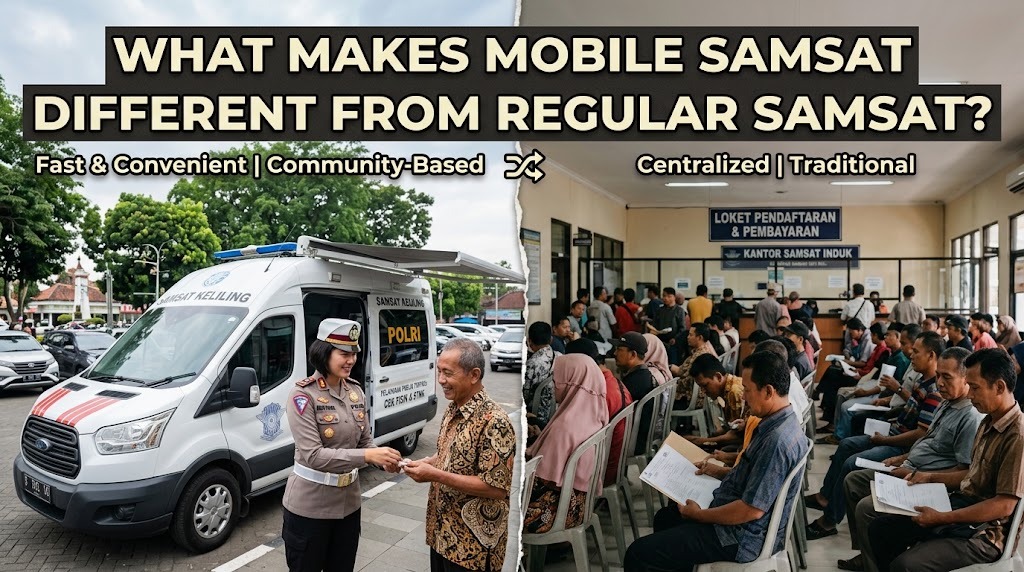
Mobile Samsat and regular Samsat services help vehicle owners in Indonesia fulfill their vehicle tax obligations and manage certain vehicle administration procedures. The main difference lies in their service locations, accessibility, and the types of transactions they can handle. Mobile Samsat brings selected services closer to communities through mobile service units, while regular Samsat operates from permanent offices that generally provide a broader range of administrative services. Understanding these differences helps vehicle owners choose the most suitable option for their needs.
DIFFERENCES IN SERVICE LOCATIONS
The most noticeable difference between Mobile Samsat and regular Samsat is where the services are provided. Mobile Samsat operates at designated locations according to a schedule established by the relevant local authorities. These locations may include public parking areas, community centers, or other accessible places where residents can complete eligible transactions.
Regular Samsat operates from a permanent service office. Vehicle owners usually visit this office when they need services that require specific facilities, more extensive administrative processing, or direct coordination between relevant agencies. Because its location remains fixed, people can plan their visits around the office's operating hours.
DIFFERENCES IN SERVICE ACCESSIBILITY
Mobile Samsat is designed to bring selected services closer to residents. This can be especially useful for people who live far from a permanent Samsat office or have limited time to travel. By operating in different locations, mobile units can make routine vehicle tax services more accessible to surrounding communities.
Regular Samsat requires customers to travel to the designated office. Although this may involve longer journeys for some residents, permanent offices generally provide access to more service counters and administrative facilities. The most convenient option depends on the distance, operating schedule, and type of service required.
DIFFERENCES IN TYPES OF SERVICES
Mobile Samsat generally focuses on specific routine transactions, particularly eligible annual vehicle tax payments and annual STNK validation. Its available services depend on the policies and facilities of the local Samsat authority. Therefore, vehicle owners should confirm the services offered at a particular mobile unit before visiting.
Regular Samsat generally handles a broader range of vehicle administration procedures. Depending on the office and local arrangements, these may include annual tax payments, five-year STNK renewal, license plate replacement, vehicle ownership transfers, and certain registration corrections. Some procedures require physical vehicle inspections or additional documents that mobile units may not be equipped to process.
DIFFERENCES IN WAITING TIMES
Mobile Samsat can reduce the need to travel to a central office and may provide a convenient alternative to regular service counters. However, the waiting time depends on the number of visitors, staff availability, and the popularity of the service location. A mobile unit can still experience long queues during busy periods.
Regular Samsat may have more counters and facilities to accommodate different administrative needs, but busy offices can also experience significant queues. Customers can improve their experience by checking service hours, preparing documents in advance, and visiting at a suitable time. Neither option guarantees an immediate transaction.
DIFFERENCES IN ADMINISTRATIVE REQUIREMENTS
Both Mobile Samsat and regular Samsat require vehicle owners to meet the applicable administrative conditions. For routine annual tax payments, commonly requested documents include the original vehicle registration certificate, known as STNK, and identification matching the registered owner, such as a KTP. Specific requirements can vary by region and service type.
Regular Samsat may require additional documents for more complex transactions. For example, five-year registration renewal generally involves a physical vehicle inspection and additional registration documentation. Vehicle owners should check the official requirements before visiting to avoid incomplete applications or unnecessary repeat trips.
DIFFERENCES IN COSTS AND TRANSPORTATION
The official vehicle tax and other applicable charges are determined by the relevant regulations and the type of transaction, rather than simply by whether the customer uses Mobile Samsat or regular Samsat. Using a mobile service does not automatically mean that the vehicle tax itself is cheaper.
The potential savings usually come from reduced transportation expenses. If a mobile unit operates near a person's home or workplace, the customer may spend less on fuel, public transportation, parking, and travel time. However, the actual savings depend on the distance to the available service locations.
DIFFERENCES IN FLEXIBILITY AND OPERATING HOURS
Mobile Samsat provides flexibility in terms of location because its service units can visit different areas. However, each unit follows a designated schedule and may only remain at a particular location for a limited period. Customers need to confirm the location and operating hours before traveling.
Regular Samsat has a permanent location and established operating hours. This can be more suitable for customers who need to plan complex administrative procedures or return for additional processing. Nevertheless, office hours and service availability may differ between regions, so checking official announcements remains important.
WHEN SHOULD VEHICLE OWNERS CHOOSE MOBILE SAMSAT?
Mobile Samsat is a practical option for vehicle owners who need to complete eligible annual tax payments and related routine services. It may be particularly suitable for residents who want to reduce travel time, avoid a longer journey to the main office, or complete a straightforward transaction near their neighborhood.
Before visiting, customers should confirm the service schedule, eligibility conditions, accepted payment methods, and required documents. If the transaction involves a five-year renewal, physical inspection, ownership transfer, or another complex administrative issue, they should first check whether a permanent Samsat office is necessary.
WHEN SHOULD VEHICLE OWNERS CHOOSE REGULAR SAMSAT?
Regular Samsat is generally more appropriate when a vehicle owner needs services beyond the limited scope of a mobile unit. Permanent offices usually provide facilities for more extensive registration and administrative procedures, including transactions that require additional verification or physical inspections.
Customers who are uncertain about their vehicle records or documentation can also contact the relevant Samsat office to determine the correct procedure. Choosing the appropriate service from the beginning can help prevent delays and reduce the possibility of making multiple visits.
CONCLUSION
Mobile Samsat differs from regular Samsat mainly in its location, accessibility, operating schedule, and range of available services. Mobile Samsat brings selected routine services closer to communities, while regular Samsat provides a permanent service location and generally handles a wider variety of vehicle administration procedures. Both options support vehicle owners in meeting their legal obligations. By checking the available services and preparing the required documents, residents can choose the option that best fits their needs.
Recent Posts

Bagaimana Sistem SKS pada Program Kuliah... 22.11.2026/56 View

How Does Technology Make Daily Evaluation... 21.11.2026/86 View

Apa Strategi Menghadapi Kesenjangan antara Kompetensi... 21.11.2026/84 View

Mengapa Inventaris Aset Penting bagi Kelancaran... 21.11.2026/82 View

When Should Musicians Join a Record... 21.11.2026/86 View
