

What Makes Numerical Reasoning Different from Mathematics Tests?
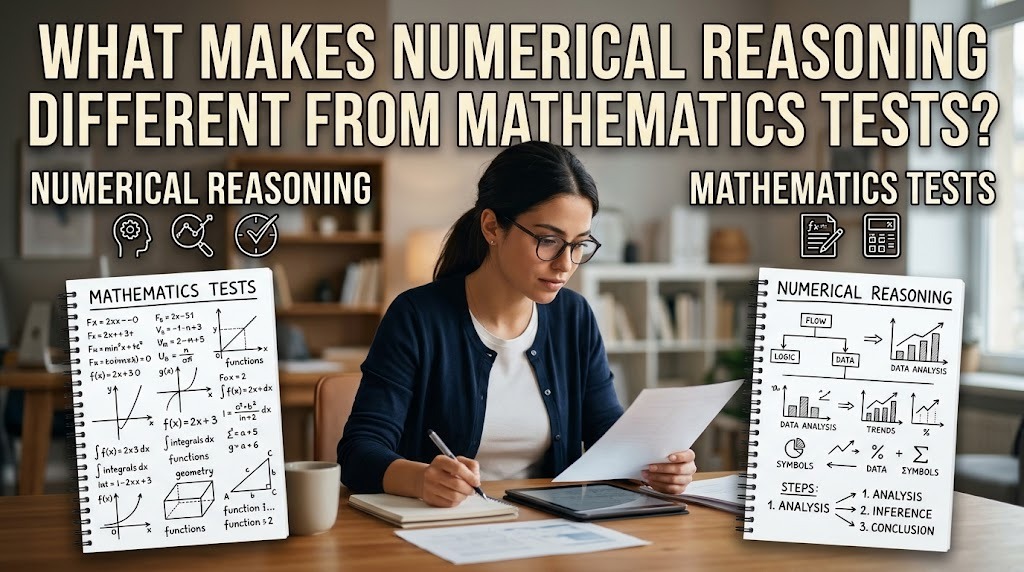
Numerical reasoning and mathematics tests both involve working with numbers, calculations, and mathematical concepts. However, they are designed to measure different abilities. Mathematics tests generally evaluate how well someone understands mathematical concepts, formulas, and procedures, while numerical reasoning tests focus on how effectively someone interprets numerical information and uses it to solve practical problems.
Understanding the difference between these assessments is useful for students, job applicants, and professionals. Although both require numerical skills, their questions, objectives, and problem-solving approaches can vary significantly. Knowing what each test measures can also help individuals prepare more effectively.
THE MAIN PURPOSE OF EACH TEST
Mathematics tests are designed to assess a person's understanding of mathematical knowledge. They commonly cover topics such as algebra, geometry, fractions, equations, statistics, and mathematical formulas. Students are expected to demonstrate that they understand specific concepts and can apply the correct procedures to solve problems.
Numerical reasoning tests have a different objective. They evaluate how well someone can interpret numerical data, recognize relationships, and draw logical conclusions. Instead of focusing mainly on mathematical theory, these tests often present information through tables, charts, graphs, percentages, and everyday business situations.
DIFFERENCES IN QUESTION FORMATS
The format of the questions is one of the clearest differences between numerical reasoning and mathematics tests. Mathematics assessments often provide direct problems that require a particular formula or calculation. For example, a question might ask someone to solve an algebraic equation or calculate the area of a triangle.
Numerical reasoning questions usually place numbers within a practical context. A candidate might receive a sales report and need to determine which product experienced the highest percentage increase. The challenge is not only calculating the result but also identifying the relevant information and understanding what the figures represent.
THE ROLE OF MATHEMATICAL KNOWLEDGE
Mathematical knowledge is an important foundation for both types of assessments. Mathematics tests generally examine whether individuals understand specific rules, formulas, and procedures. A strong understanding of these concepts can help students solve problems accurately and explain their working methods.
Numerical reasoning also requires mathematical knowledge, but it emphasizes how that knowledge is applied. Someone may understand how to calculate percentages but still struggle to interpret a business report. Therefore, numerical reasoning requires both basic calculation skills and the ability to connect numerical information with a meaningful conclusion.
DATA INTERPRETATION IN NUMERICAL REASONING
Data interpretation is a major component of numerical reasoning tests. Questions frequently present information through tables, bar charts, line graphs, pie charts, or financial reports. Test takers must identify relevant figures, compare values, and understand changes over time.
For example, a chart might show the monthly revenue of several businesses. Candidates may need to identify which business achieved the largest increase or calculate the difference between two periods. These tasks measure how effectively someone can understand and evaluate numerical information rather than simply perform calculations.
PRACTICAL APPLICATIONS OF EACH ASSESSMENT
Mathematics tests are commonly used in schools and educational institutions to measure academic progress. They help teachers determine whether students understand the material covered in lessons. The questions may involve theoretical concepts, structured calculations, and mathematical problem-solving.
Numerical reasoning tests are frequently used in recruitment and professional assessments. Employers may use them to evaluate whether candidates can work with figures, understand reports, and make decisions based on numerical evidence. These abilities can be relevant in areas such as finance, administration, marketing, management, and business operations.
LOGICAL THINKING AND PROBLEM-SOLVING SKILLS
Both assessments require problem-solving, but they emphasize different aspects of the process. Mathematics tests often focus on applying mathematical principles to reach an accurate answer. Depending on the question, test takers may need to follow a sequence of calculations or demonstrate a particular method.
Numerical reasoning places greater emphasis on interpreting information and deciding which approach is appropriate. Candidates must identify patterns, compare numerical relationships, recognize relevant details, and evaluate possible answers. This makes logical thinking an important part of completing numerical reasoning questions successfully.
TIME MANAGEMENT AND ACCURACY
Time management is important in both types of tests, especially when questions have a time limit. Mathematics assessments may allow students to demonstrate their working process, depending on the examination format. Accuracy and understanding are generally important evaluation criteria.
Numerical reasoning tests, particularly those used during recruitment, may place considerable emphasis on completing questions efficiently. Candidates often need to interpret data, select the appropriate calculation, and reach a conclusion within a limited period. Working too slowly or making careless calculation errors can affect the final result.
EXAMPLES OF HOW THE QUESTIONS DIFFER
The following examples illustrate how similar numerical concepts can be assessed in different ways.
Mathematics test example:
A product costs $80 and its price increases by 15%. Calculate the new price.
This question focuses on applying the percentage formula to find the correct value. The test taker needs to calculate the increase and add it to the original price.
Numerical reasoning test example:
A company records monthly sales of $80,000 in January and $92,000 in February. Determine the percentage increase in sales and explain what the figures indicate.
This question requires candidates to compare two values, calculate the percentage change, and interpret the result in a business context. It therefore combines mathematical calculation with data interpretation.
HOW TO PREPARE FOR BOTH TESTS
Preparation should match the skills measured by each assessment. For mathematics tests, individuals should review relevant topics, understand mathematical formulas, and practice solving different types of problems. Learning the reasoning behind each calculation can also help prevent mistakes.
For numerical reasoning tests, preparation should include interpreting tables and graphs, calculating percentages, comparing ratios, understanding averages, and identifying numerical patterns. Practicing under timed conditions can improve speed and accuracy. Reviewing incorrect answers is equally important because it helps identify weaknesses in calculation, interpretation, or logical thinking.
CONCLUSION
Numerical reasoning tests differ from mathematics tests in their main objectives and question formats. Mathematics tests primarily measure understanding of mathematical concepts and procedures, while numerical reasoning tests evaluate the ability to interpret numerical information, apply calculations, and make logical conclusions. Both require mathematical knowledge, but they assess how individuals use that knowledge in different situations. Understanding these distinctions can help students and job applicants choose appropriate preparation strategies and improve their performance.
Recent Posts

Bagaimana Sistem SKS pada Program Kuliah... 22.11.2026/42 View

How Does Technology Make Daily Evaluation... 21.11.2026/72 View

Apa Strategi Menghadapi Kesenjangan antara Kompetensi... 21.11.2026/74 View

Mengapa Inventaris Aset Penting bagi Kelancaran... 21.11.2026/70 View

When Should Musicians Join a Record... 21.11.2026/73 View
