

What Makes Primary Data Different From Secondary Data?
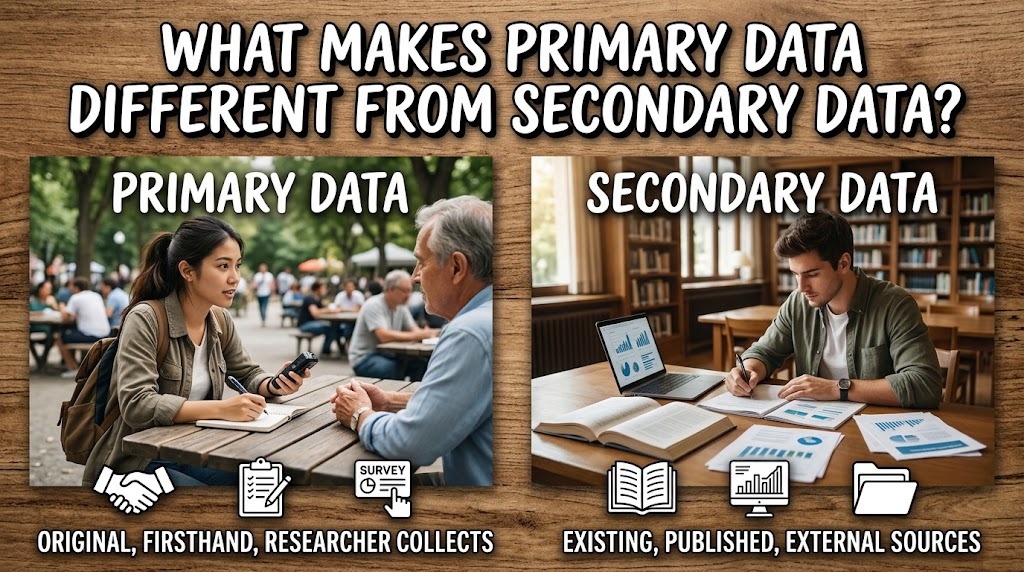
Data plays an important role in research because it provides the information needed to investigate questions, identify patterns, and develop conclusions. Researchers can obtain information directly from original sources or use data that has already been collected by other people. These approaches are known as primary data and secondary data. Although both are valuable for academic studies and business decisions, they differ in their sources, collection processes, and purposes. Understanding these differences helps researchers choose the most appropriate information for their research objectives.
UNDERSTANDING PRIMARY DATA
Primary data is original information collected directly by researchers for a specific investigation. It can come from surveys, interviews, experiments, observations, or direct measurements. For example, a student who distributes questionnaires to classmates about their study habits collects primary data. Because the information is gathered for a particular purpose, researchers can design questions and procedures that match their objectives. However, primary data collection may require considerable time, effort, and financial resources.
UNDERSTANDING SECONDARY DATA
Secondary data refers to information that has already been collected, processed, or published by another person or organization and is reused for a new research purpose. Common sources include academic journals, books, government statistics, company reports, and existing research datasets. For example, a student who uses published national education statistics to examine learning trends is working with secondary data. This approach can save time because the information is already available. Nevertheless, researchers must check whether the data is reliable, current, and relevant to their questions.
DIFFERENCES IN DATA SOURCES AND COLLECTION METHODS
The main difference between primary and secondary data lies in how the information is obtained. Primary data is gathered firsthand through a researcher's own collection activities, while secondary data comes from existing records or previously collected information. Primary data may involve conducting interviews or performing experiments, whereas secondary data may involve reviewing reports or analyzing published datasets. These different processes affect the researcher's level of control over the information. Researchers collecting primary data can design the process themselves, while those using secondary data must work within the limitations of the existing material.
COMPARING COST, TIME, AND RESOURCES
Primary data collection often requires more planning, personnel, equipment, and money. Researchers may need to recruit participants, prepare questionnaires, conduct fieldwork, and organize the resulting information. Secondary data is generally less expensive and faster to obtain because the information already exists. However, finding suitable secondary sources and checking their quality can still require substantial effort. Researchers should compare available resources with their research objectives before deciding which type of data to use.
DIFFERENCES IN ACCURACY AND RELEVANCE
Neither primary nor secondary data is automatically more accurate than the other. Primary data can be highly relevant because it is collected for a specific research question, but poorly designed surveys or unrepresentative samples may produce misleading results. Secondary data may come from reputable institutions and carefully conducted studies, yet it might not match the researcher's target population or current needs. Evaluating data quality requires examining the collection methods, definitions, sample characteristics, and possible sources of bias. Researchers should select information based on its suitability and reliability rather than its category alone.
WHEN SHOULD RESEARCHERS USE EACH TYPE?
Primary data is particularly useful when researchers need specific information that existing sources cannot adequately provide. Businesses may collect customer feedback to evaluate a new product, while scientists may conduct experiments to test a hypothesis. Secondary data is useful when researchers want to examine historical trends, compare published findings, or study large populations using existing statistics. In many projects, combining both types provides a broader understanding of the topic. Secondary data can establish background knowledge, while primary data can address questions that remain unanswered.
CONCLUSION
Primary data differs from secondary data mainly in its origin and collection process. Primary data is gathered firsthand for a specific research purpose, whereas secondary data uses information that already exists. Primary data offers greater control over collection, while secondary data can reduce the time and cost required to obtain information. Both types have advantages and limitations, so researchers should evaluate their quality, relevance, and availability before making a choice. Selecting the appropriate data helps produce more useful analysis and better-supported conclusions.
Recent Posts

Bagaimana Sistem SKS pada Program Kuliah... 22.11.2026/46 View

How Does Technology Make Daily Evaluation... 21.11.2026/74 View

Apa Strategi Menghadapi Kesenjangan antara Kompetensi... 21.11.2026/75 View

Mengapa Inventaris Aset Penting bagi Kelancaran... 21.11.2026/72 View

When Should Musicians Join a Record... 21.11.2026/75 View
