

What Makes Robotic Welding Suitable for Complex Metal Joints?
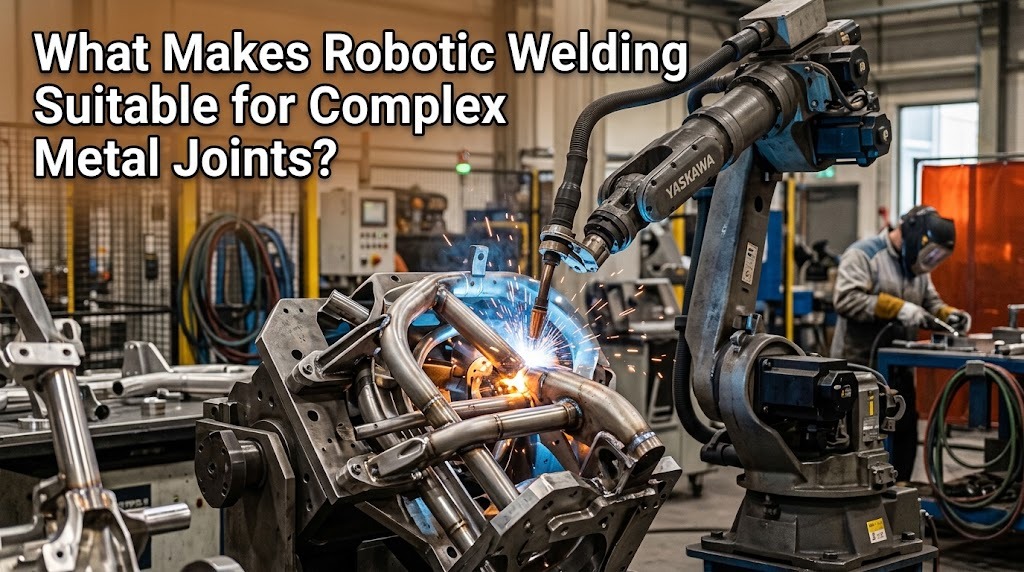
Robotic welding has become an important technology in modern manufacturing, especially when metal components require precise and complicated joints. Unlike manual welding, robotic systems can follow programmed paths, maintain consistent movements, and control welding parameters throughout the process. These capabilities make them useful for producing complex metal structures in industries such as automotive, aerospace, construction, and heavy equipment manufacturing.
PRECISE CONTROL OF WELDING MOVEMENTS
One major advantage of robotic welding is its ability to control the welding torch with high precision. Robots can follow programmed paths across different angles, curves, and joint configurations. This capability is particularly valuable when welding components with limited access or irregular geometries. Accurate torch positioning helps maintain consistent weld placement and reduces the likelihood of defects caused by incorrect movements. As a result, manufacturers can produce complex joints with greater repeatability.
FLEXIBILITY FOR DIFFERENT JOINT DESIGNS
Complex metal structures may contain butt joints, lap joints, T-joints, and other configurations that require different welding approaches. Robotic welding systems can be programmed to handle various joint designs by adjusting torch angles, travel paths, and welding sequences. Multi-axis robotic arms provide additional flexibility because they can approach workpieces from different directions. This makes them suitable for components with curved surfaces, intersecting sections, and difficult-to-reach welding areas. However, the workpiece design, robot configuration, and available clearance must still be considered.
CONSISTENT WELDING QUALITY
Maintaining consistent quality is essential when producing complicated metal joints. Robotic systems can repeat the same programmed movements and welding parameters across multiple components. Depending on the equipment, these parameters may include welding speed, current, voltage, and wire feed rate. Consistency helps reduce variations between welds and supports more predictable production results. Proper programming, fixture positioning, and regular equipment maintenance remain necessary to achieve reliable quality.
INTEGRATION WITH ADVANCED SENSORS
Modern robotic welding systems can use sensors and vision technology to improve accuracy during welding operations. Seam-tracking sensors help identify the location of a joint and detect deviations from its expected path. Vision systems may also assist with locating workpieces and checking their positions before welding begins. These technologies are useful when components have slight dimensional variations or are not perfectly aligned. Although sensors can improve adaptability, their effectiveness depends on the material, joint condition, lighting, and system configuration.
IMPROVED ACCESS TO DIFFICULT WELDING AREAS
Some metal assemblies contain narrow spaces, complex corners, or joints positioned at unusual angles. Robotic arms with multiple axes can rotate and reposition the welding torch to reach many of these locations. Specialized torch designs and carefully planned robot trajectories can further improve accessibility. This is particularly beneficial when manufacturing frames, vehicle structures, industrial machinery, and other assemblies with intricate geometries. Nevertheless, extremely confined spaces may still require alternative tooling, redesigned components, or manual welding.
GREATER PRODUCTIVITY IN COMPLEX MANUFACTURING
Robotic welding can improve productivity by performing repetitive welding operations with consistent speed and reduced interruptions. Once a suitable program has been developed, the robot can repeat complex welding sequences across many similar components. This reduces dependence on repetitive manual movements and can shorten production cycles. Automated systems can also be integrated with positioning equipment and production lines to coordinate several manufacturing steps. For small production batches or frequently changing designs, programming and setup time must be evaluated to determine whether automation is cost-effective.
SAFETY AND REDUCED OPERATOR EXPOSURE
Welding operations involve intense heat, ultraviolet radiation, fumes, sparks, and other workplace hazards. Robotic welding allows operators to remain outside the immediate welding area during automated production, especially when systems use protective enclosures and appropriate safety controls. This can reduce direct exposure to welding hazards and improve workplace organization. However, robots introduce their own risks, including unexpected movement and collision hazards. Proper guarding, interlocks, risk assessments, and operator training are essential for safe operation.
CONCLUSION
Robotic welding is suitable for complex metal joints because it combines precise movement control, flexible joint programming, consistent welding parameters, and potential integration with advanced sensors. These capabilities help manufacturers produce intricate metal assemblies with reliable quality and improved productivity. The best results depend on appropriate robot selection, joint preparation, programming, and quality inspection. By evaluating these factors, manufacturers can determine where robotic welding offers the greatest benefits.
Recent Posts

Bagaimana Sistem SKS pada Program Kuliah... 22.11.2026/48 View

How Does Technology Make Daily Evaluation... 21.11.2026/76 View

Apa Strategi Menghadapi Kesenjangan antara Kompetensi... 21.11.2026/78 View

Mengapa Inventaris Aset Penting bagi Kelancaran... 21.11.2026/73 View

When Should Musicians Join a Record... 21.11.2026/78 View
