

What Methods Are Used In Archaeological Research?
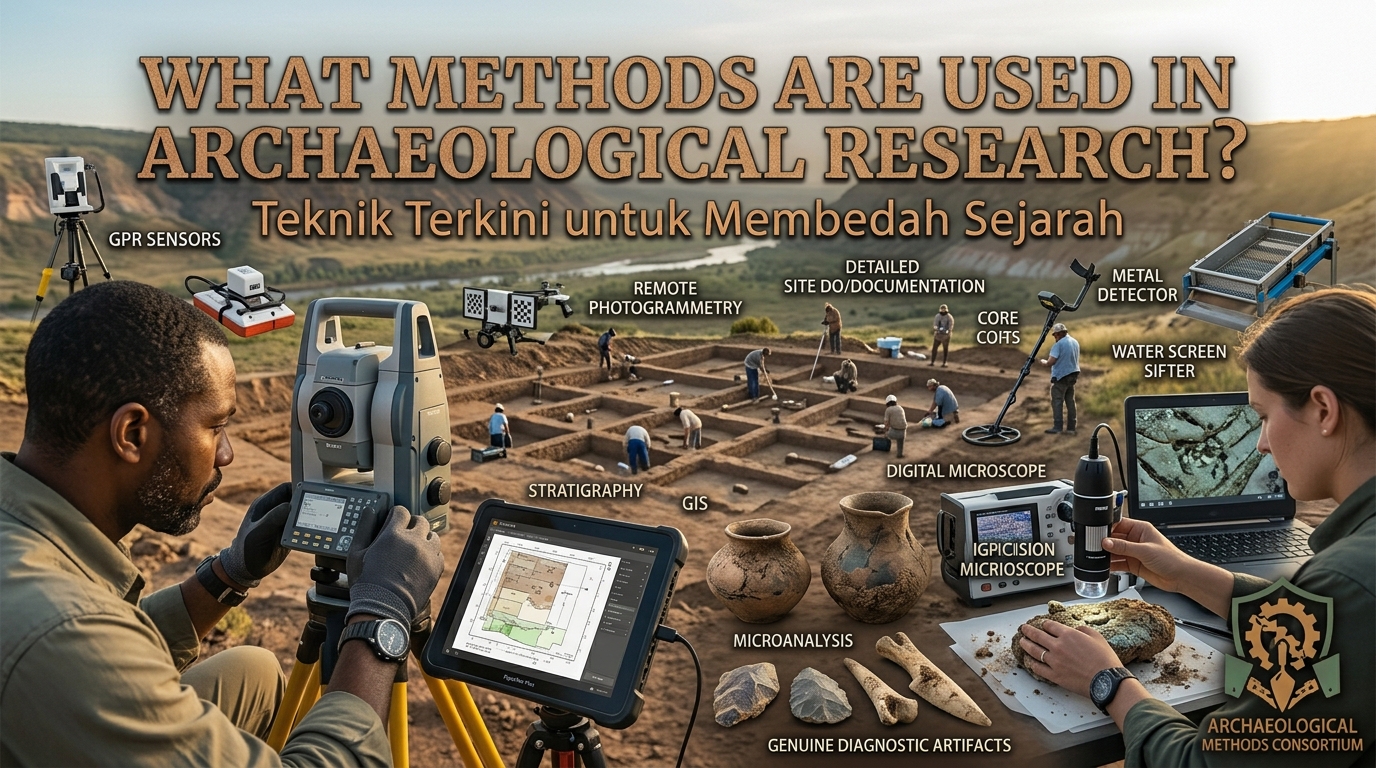
Archaeological research uses a range of scientific methods to investigate past human societies through physical evidence. Archaeologists study artifacts, ancient buildings, human remains, and traces of settlements to understand how people lived, worked, traded, and adapted to their environments. Their research combines fieldwork, laboratory analysis, historical records, and modern technology. Each method provides different information, helping researchers develop a more complete picture of the past. By combining several research methods, archaeologists can produce reliable interpretations while protecting valuable historical evidence.
ARCHAEOLOGICAL SURVEYS
An archaeological survey is often one of the first steps in investigating a potential historical site. Researchers examine landscapes to identify signs of past human activity, such as pottery fragments, stone tools, building remains, or unusual ground patterns. They may walk systematically across an area, record visible discoveries, and map their locations. This information helps archaeologists estimate the size and importance of a site before deciding whether further investigation is necessary.
Surveys can also involve aerial photographs, satellite images, and digital mapping systems. These tools help researchers identify possible settlements, ancient roads, and landscape changes that are difficult to recognize from the ground. Field surveys help archaeologists locate and document sites without immediately disturbing the soil. They also provide a foundation for planning future excavations and conservation work.
ARCHAEOLOGICAL EXCAVATION
Excavation is a method used to uncover archaeological remains buried beneath the ground. Archaeologists remove soil carefully, layer by layer, while recording the location, depth, and relationships of significant objects. These details are essential because the position of an artifact can reveal how it was used and when it entered the ground. Excavation may uncover houses, temples, tools, pottery, burial sites, and other evidence of past communities.
Excavation is a destructive process in the sense that the original arrangement of soil layers cannot be restored after removal. For this reason, researchers must document their work thoroughly through photographs, drawings, maps, and written records. Samples of soil, charcoal, seeds, or animal bones may also be collected for laboratory analysis. Careful excavation and detailed documentation help preserve as much information as possible for future research.
REMOTE SENSING AND GEOPHYSICAL SURVEYS
Remote sensing allows archaeologists to investigate landscapes using information collected from a distance. Satellite imagery, aerial photography, and LiDAR can reveal patterns associated with ancient settlements, roads, agricultural systems, or structures hidden beneath vegetation. LiDAR uses laser pulses to measure distances and can produce detailed terrain models that reveal features obscured by forests. These technologies are especially useful when researchers need to examine large or difficult-to-access areas.
Geophysical methods can also detect certain features beneath the ground without excavation. Ground-penetrating radar uses radar signals to identify subsurface changes, while magnetometry measures variations in magnetic properties that may indicate buried structures or past human activity. However, the results depend on soil conditions, site characteristics, and the type of feature being investigated. Non-invasive survey techniques help archaeologists target excavation areas more precisely and reduce unnecessary disturbance.
ARTIFACT ANALYSIS
Artifact analysis involves examining objects made, modified, or used by humans in the past. Archaeologists study materials, shapes, manufacturing techniques, wear patterns, and decorative features to understand an object's possible function and cultural significance. Pottery may reveal cooking practices or trade connections, while stone tools can provide clues about technological skills. Coins, jewelry, and metal objects may also help researchers investigate economic activities and social relationships.
Researchers often compare artifacts with similar objects from other sites to identify changes in style, technology, and cultural interaction. Laboratory techniques can reveal the chemical composition of materials or help determine where certain raw materials originated. However, an artifact's meaning cannot always be established from its appearance alone. The context in which an object was found is equally important for developing a reliable interpretation.
SCIENTIFIC DATING METHODS
Dating methods help archaeologists establish when objects, structures, and archaeological deposits were formed or used. One important technique is radiocarbon dating, which estimates the age of suitable organic materials such as charcoal, seeds, and bone containing preserved organic carbon. The results are usually expressed as a range of possible dates and may require calibration to account for changes in atmospheric carbon levels. This method is particularly useful for investigating events from the relatively recent geological past, generally within the last tens of thousands of years.
Another approach is stratigraphy, which examines the sequence of soil and archaeological layers. In undisturbed deposits, lower layers are generally older than those above them, although later disturbances can complicate this pattern. Other methods, including dendrochronology using tree rings and luminescence dating of suitable materials, can answer different chronological questions. Choosing the correct dating technique depends on the material, its condition, and the research question.
ANALYSIS OF HUMAN, ANIMAL, AND PLANT REMAINS
Biological remains provide valuable information about the everyday lives of ancient communities. Human bones and teeth can help researchers investigate diet, health, physical activity, and population movement, although interpretations depend on preservation and available evidence. Animal bones may reveal which species people hunted, raised, or consumed. Seeds, pollen, charcoal, and other plant remains can provide evidence of farming, food preparation, vegetation, and environmental change.
Scientists may use microscopic examination, chemical analysis, and other laboratory techniques to study these materials. For example, stable isotope analysis can provide clues about diet and mobility, while ancient DNA may help investigate biological relationships when suitable material survives and ethical requirements are met. These methods must be applied carefully because biological evidence does not always provide a complete picture of past behavior. Environmental and biological analysis helps connect archaeological discoveries with the people, animals, and landscapes of earlier periods.
HISTORICAL AND EPIGRAPHIC RESEARCH
Archaeologists often examine written records alongside physical evidence. Historical documents, maps, travel accounts, and archival records may identify locations, describe historical events, or provide information about past communities. These sources can guide fieldwork and help researchers develop questions about a site. However, written accounts may be incomplete or reflect the views of particular individuals or institutions.
Epigraphy, the study of inscriptions, is especially useful when investigating civilizations that used writing on stone, metal, pottery, or other materials. Inscriptions may contain names, dates, religious messages, political statements, or records of trade and administration. Researchers compare these texts with artifacts and archaeological contexts to evaluate their meaning. Combining documentary evidence with material discoveries creates a stronger basis for interpreting the past than relying on either source alone.
DIGITAL TECHNOLOGY AND THREE-DIMENSIONAL DOCUMENTATION
Digital tools have become increasingly important in modern archaeological research. Geographic information systems, commonly known as GIS, allow researchers to map sites and analyze relationships between archaeological features and their surroundings. Photogrammetry uses overlapping photographs to create detailed three-dimensional models of objects, buildings, and excavation areas. These models help researchers document fragile structures, compare changes over time, and share findings with other specialists.
Digital databases also make it easier to organize large collections of measurements, photographs, and excavation records. Researchers can use computer-based analysis to compare patterns across multiple sites and identify relationships that might otherwise be difficult to recognize. Nevertheless, digital models depend on the quality of the original data and must be interpreted carefully. Digital documentation supports research and preservation, but it does not replace direct observation or sound scientific judgment.
CONCLUSION
Archaeological research uses several methods, including surveys, excavation, remote sensing, artifact analysis, scientific dating, biological analysis, and historical research. Each method answers different questions about the age, function, environment, and cultural significance of archaeological remains. Modern digital technology further improves documentation and helps researchers identify sites while reducing unnecessary disturbance. Combining scientific methods with careful interpretation allows archaeologists to develop a more accurate understanding of past societies. These approaches also support the protection of archaeological sites and the preservation of cultural heritage for future generations.
Recent Posts

Bagaimana Sistem SKS pada Program Kuliah... 22.11.2026/49 View

How Does Technology Make Daily Evaluation... 21.11.2026/79 View

Apa Strategi Menghadapi Kesenjangan antara Kompetensi... 21.11.2026/79 View

Mengapa Inventaris Aset Penting bagi Kelancaran... 21.11.2026/75 View

When Should Musicians Join a Record... 21.11.2026/80 View
