

What Mistakes Should Students Avoid When Creating a Mind Map?
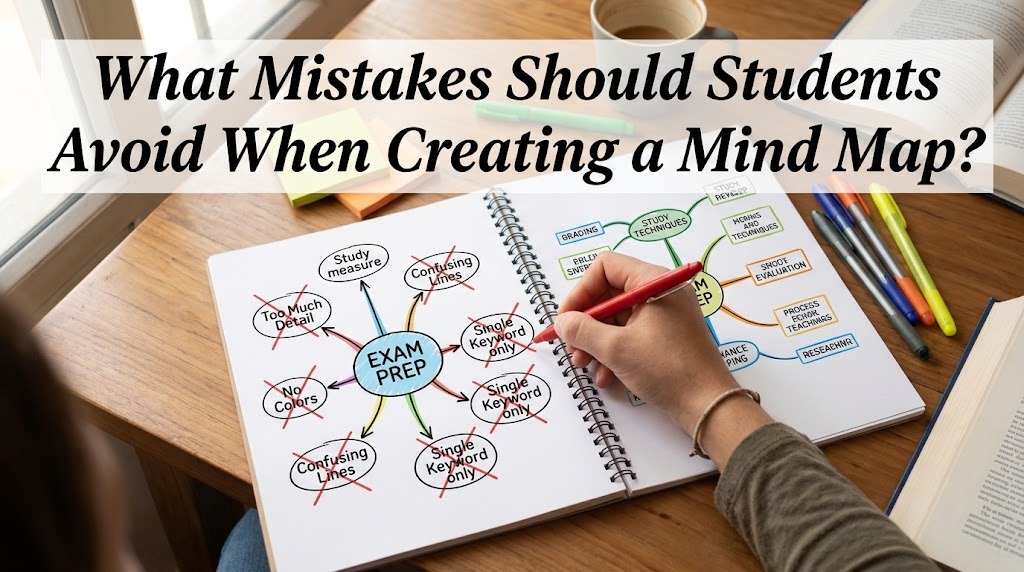
Mind mapping can help students organize information in a visual and structured way. However, a mind map may become difficult to understand if it contains too much information or lacks a clear organization. Students sometimes focus heavily on appearance while forgetting the main purpose of understanding and organizing learning materials. Avoiding common mistakes can make a mind map more useful for studying and reviewing lessons. A good mind map should be clear, relevant, organized, and easy to review.
USING TOO MUCH INFORMATION
One common mistake is putting too much information into a single mind map. Students may try to copy almost everything from a textbook or lecture notes. This can make the branches crowded and difficult to read. A mind map should summarize the most important concepts rather than reproduce an entire chapter.
Students can avoid this problem by selecting keywords and essential details. Information that does not directly support the main topic can be placed in separate notes or another mind map. Students should ask whether each piece of information helps explain the central topic. Keeping the content focused can make the mind map more useful during review.
USING LONG SENTENCES INSTEAD OF KEYWORDS
Another mistake is writing long sentences on every branch. Long sentences can make a mind map look more like traditional notes than a visual learning tool. They also make it harder for students to quickly identify important concepts. Using concise keywords or short phrases can make the structure easier to scan.
However, students should not shorten information so much that its meaning becomes unclear. The goal is to find specific and meaningful keywords that can remind students of the larger concept. For example, instead of writing a complete explanation, students can use a key term and explain the details when reviewing the map. This approach keeps the map concise while preserving its main meaning.
CREATING AN UNCLEAR STRUCTURE
A mind map should have a clear central topic and logical branches. Students may make the map confusing by placing ideas randomly or connecting concepts that have little relationship. When branches do not follow a clear structure, it becomes difficult to understand the information. A logical hierarchy can help students recognize which ideas are main concepts and which are supporting details.
Students should begin with the main topic and gradually develop related branches. Similar concepts can be grouped together, while supporting details can be placed under the appropriate main idea. Using a consistent structure can make the map easier to follow. Students should also avoid unnecessary lines or connections that could confuse the relationship between ideas.
FOCUSING TOO MUCH ON DECORATION
Using colors, symbols, and drawings can make a mind map more attractive, but too much decoration can become a problem. Students may spend more time choosing colors and adding designs than understanding the learning material. Excessive visual elements can also make important information harder to identify. Decoration should support the information rather than distract from it.
Students can use simple visual elements to highlight important concepts or show relationships. For example, a symbol can represent a category, while an arrow can indicate a process or connection. The most important goal is readability and clarity. A simple mind map with meaningful visuals can be more useful than a highly decorated map with poor organization.
FAILING TO CHECK INFORMATION ACCURACY
A visually organized mind map can still be ineffective if it contains incorrect information. Students may accidentally misunderstand a concept, write an inaccurate definition, or create an incorrect connection between ideas. This is especially important when creating maps for technical or academic subjects. Students should check important information against reliable learning materials.
After completing a mind map, students can compare it with their textbooks, lecture notes, or trusted educational sources. They should correct information that is incomplete or inaccurate. This step helps ensure that the map becomes a reliable study reference. Accuracy should always be more important than appearance when creating learning notes.
NOT REVIEWING OR UPDATING THE MIND MAP
Creating a mind map once and never using it again is another common mistake. The main purpose of a study map is to support learning and review, not simply to create a finished page. Students should return to the map and use it to recall important concepts. They can also add new information when their understanding develops.
Students can improve the map after completing assignments, discussions, or additional reading. They can remove unnecessary details and add information that was previously missing. Reviewing the map regularly can also help students identify topics that require further study. This makes the mind map a flexible learning resource rather than a one-time assignment.
CONCLUSION
Students should avoid several common mistakes when creating a mind map, including using too much information, writing long sentences, creating unclear branches, adding excessive decoration, and failing to check accuracy. A good mind map should focus on meaningful keywords and logical connections between ideas. Students should also review and update their maps when necessary. The effectiveness of a mind map depends more on its clarity and usefulness than on its visual appearance. By avoiding these mistakes, students can create a practical study tool that supports better organization and understanding.
Recent Posts

Bagaimana Sistem SKS pada Program Kuliah... 22.11.2026/28 View

How Does Technology Make Daily Evaluation... 21.11.2026/65 View

Apa Strategi Menghadapi Kesenjangan antara Kompetensi... 21.11.2026/65 View

Mengapa Inventaris Aset Penting bagi Kelancaran... 21.11.2026/62 View

When Should Musicians Join a Record... 21.11.2026/63 View
