

What Mistakes Should You Avoid in Essay Competitions?
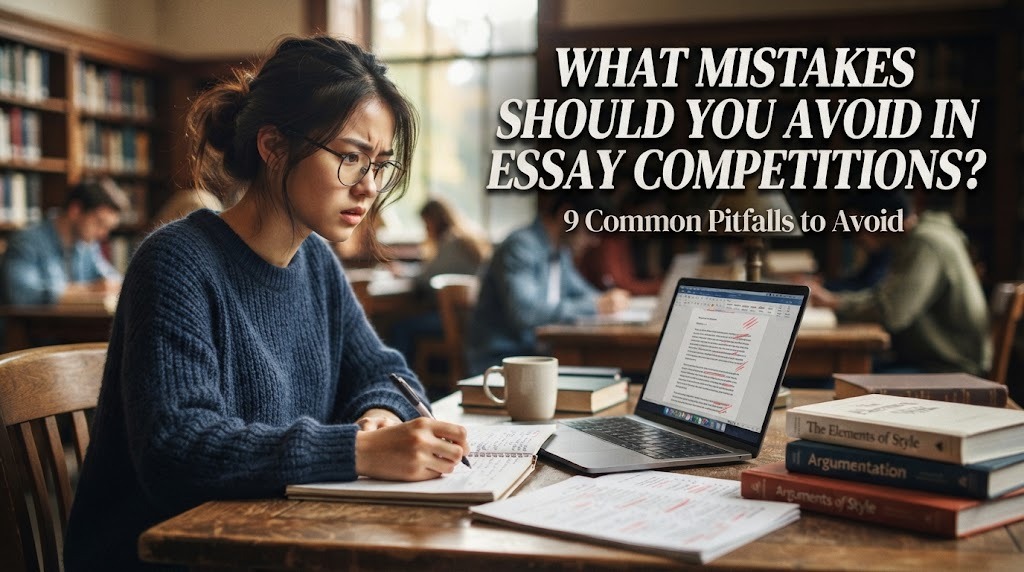
Essay competitions give students an opportunity to demonstrate their writing, research, and critical thinking skills. However, a strong idea does not always guarantee a good result if the essay contains avoidable mistakes. Participants need to pay attention to the competition theme, structure, language, evidence, and submission rules. Small errors can affect the clarity and credibility of an essay, while serious violations may lead to disqualification. Understanding common mistakes can help participants prepare stronger and more competitive essays.
IGNORING THE COMPETITION THEME
One of the most common mistakes is writing an essay that does not properly address the competition theme. Some participants may focus too much on a related issue without answering the main topic. An essay can contain good information but still lose its effectiveness if it is not relevant to the theme. Before writing, participants should identify the main question or issue behind the theme. Staying focused throughout the essay helps judges see that the writer understands the competition requirements.
CHOOSING A TOPIC THAT IS TOO BROAD
A topic that is too broad can make an essay difficult to develop within a limited word count. Participants may try to discuss too many issues and end up providing only superficial explanations. A more specific topic allows writers to analyze an issue in greater depth. Narrowing the topic also makes it easier to create a clear main argument. Before writing, participants should make sure the chosen topic can be discussed thoroughly within the required length.
USING WEAK OR UNSUPPORTED ARGUMENTS
An essay should contain clear arguments rather than only personal opinions. Unsupported claims can make the discussion less convincing and may cause judges to question the writer's reasoning. Each major argument should be explained and supported with relevant evidence or examples when necessary. Participants should also make sure that the evidence actually supports the claim being made. Strong reasoning helps demonstrate critical thinking and a deeper understanding of the topic.
RELYING ON UNRELIABLE SOURCES
Using unreliable information can weaken the credibility of an essay. Random websites, unverified social media posts, or sources without clear authorship may contain inaccurate information. Participants should prioritize credible sources such as academic journals, books, official institutions, research organizations, and reliable reports. They should also check whether the information is current and relevant to the topic. Reliable sources make arguments stronger and demonstrate good research habits.
COPYING OTHER PEOPLE'S WORK
Plagiarism is a serious mistake in essay competitions. Copying sentences, ideas, or entire sections without proper acknowledgment can violate competition rules. Participants should express information in their own words and provide citations when using ideas or evidence from other sources. They should also review the competition's rules regarding originality and permitted use of external materials. Submitting original work protects the writer's credibility and demonstrates genuine ability.
WRITING A WEAK INTRODUCTION
The introduction creates the first impression of an essay. A weak opening may make the discussion seem unclear or uninteresting from the beginning. Participants should introduce the topic clearly and provide enough context for readers to understand the issue. The introduction should also establish the main direction or argument of the essay. A focused and engaging opening can encourage judges to continue reading.
ORGANIZING IDEAS POORLY
Poor organization can make even good ideas difficult to understand. Arguments should be arranged in a logical order, with each paragraph having a clear purpose. Participants should use transitions to connect related ideas and create a smooth flow. Avoid jumping between unrelated points or repeating the same argument in different paragraphs. A well-organized essay makes it easier for judges to follow the writer's reasoning.
USING TOO MANY COMPLICATED WORDS
Some participants believe that difficult vocabulary makes an essay sound more intelligent. In reality, overly complicated language can make ideas harder to understand. Writers should choose words that accurately communicate their meaning while remaining clear to the reader. Technical terms should only be used when they are relevant and necessary. Simple and precise language is often more effective than complicated wording.
IGNORING GRAMMAR AND SPELLING
Grammar and spelling mistakes can reduce the professionalism of an essay. Frequent errors may distract judges from the writer's arguments and make some sentences difficult to understand. Participants should carefully proofread their essays after completing the first draft. Reading the essay several times can help identify incorrect grammar, spelling, punctuation, and awkward sentences. If possible, asking another person to review the essay can provide additional feedback.
WRITING A WEAK CONCLUSION
A conclusion should bring the main discussion together rather than simply stopping the essay. Some participants introduce completely new ideas in the final paragraph, which can make the essay feel incomplete. The conclusion should reflect the main arguments and reinforce the central message. It can also provide a recommendation, solution, or final reflection when appropriate. A strong ending can leave judges with a clear and meaningful impression.
IGNORING THE COMPETITION RULES
Every competition has specific rules that participants must follow. These rules may include word count, formatting, eligibility, file type, submission method, deadline, and originality requirements. Ignoring these instructions can result in rejection even when the essay itself is well written. Participants should read the official guidelines carefully before starting their essay. A final checklist can help ensure that all requirements have been met before submission.
SUBMITTING AT THE LAST MINUTE
Waiting until the final minutes to submit an essay can create unnecessary risks. Technical problems, internet issues, incorrect file formats, or incomplete uploads can prevent successful submission. Participants should finish and review their essays before the deadline whenever possible. Preparing the file and submission details in advance provides time to solve unexpected problems. Good time management also reflects responsibility and preparation.
CONCLUSION
Participants should avoid mistakes such as ignoring the competition theme, choosing overly broad topics, using weak arguments, relying on unreliable sources, and copying other people's work. They should also pay attention to essay structure, language, grammar, conclusion quality, and competition rules. Careful proofreading and early submission can prevent many avoidable problems. By identifying these mistakes before submitting an essay, students can improve the quality and credibility of their work. Good preparation can help them present their ideas more clearly and confidently in an essay competition.
Recent Posts

Bagaimana Sistem SKS pada Program Kuliah... 22.11.2026/37 View

How Does Technology Make Daily Evaluation... 21.11.2026/70 View

Apa Strategi Menghadapi Kesenjangan antara Kompetensi... 21.11.2026/73 View

Mengapa Inventaris Aset Penting bagi Kelancaran... 21.11.2026/68 View

When Should Musicians Join a Record... 21.11.2026/71 View
