

What Role Did Climate Change Play in Human Evolution?
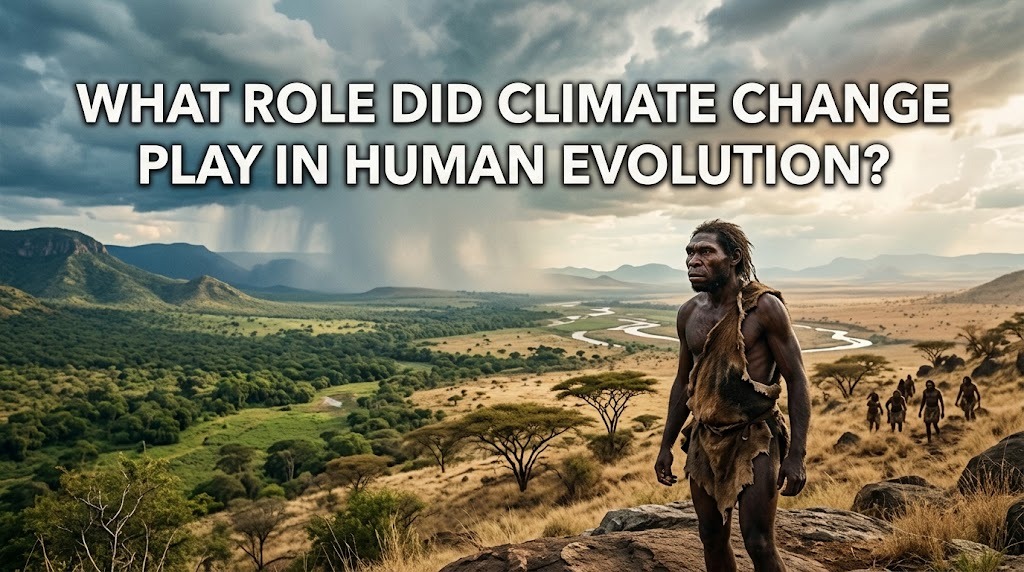
Climate change played an important role in human evolution by changing the environments in which early human ancestors lived. Over millions of years, shifts in temperature, rainfall, and vegetation influenced the availability of food, water, and shelter. These environmental changes created new challenges that affected how early humans moved, found food, and survived. Some populations developed adaptations that helped them live in changing habitats, while others faced greater difficulties. Although climate change did not determine human evolution on its own, it interacted with biological evolution, migration, and behavior to shape the development of our species.
HOW CLIMATE CHANGE AFFECTED EARLY HUMAN HABITATS
Throughout human evolutionary history, the Earth's climate changed repeatedly. Some periods were warmer and wetter, while others were colder and drier. In Africa, where the earliest human ancestors evolved, changes in rainfall influenced the distribution of forests, woodlands, and grasslands. These shifting habitats affected the plants and animals available for food and changed the conditions in which early hominins lived.
When forests became less extensive in some regions, more open landscapes provided different opportunities and challenges. Some early human relatives may have benefited from moving between woodland and grassland environments to find food and water. However, scientists do not believe that one particular climate event caused all major evolutionary changes. Instead, different populations experienced different environmental pressures over long periods, contributing to the diverse pathways of human evolution.
CLIMATE CHANGE AND THE DEVELOPMENT OF BIPEDALISM
Walking on two legs, known as bipedalism, was one of the major developments in human evolution. Fossil evidence shows that some early hominins walked upright millions of years ago, long before modern humans appeared. Scientists have proposed several explanations for this adaptation, including changes in habitat, movement between feeding areas, and the benefits of carrying food or infants. Climate and vegetation changes may have influenced these conditions, although the exact reasons for the development of bipedalism remain debated.
In environments with a mixture of trees and open areas, upright walking may have helped some early hominins travel efficiently between resources. It also freed the hands for carrying objects and other activities. However, bipedalism did not emerge simply because forests disappeared or grasslands expanded. Fossils suggest that early human relatives continued to use trees even after developing the ability to walk upright. This evidence indicates that several ecological and biological factors probably contributed to the evolution of human movement.
FOOD AVAILABILITY AND HUMAN ADAPTATION
Climate change influenced the types and quantities of food available to early human populations. Changes in rainfall and temperature affected plant growth, fruit production, and the distribution of animals. When familiar food sources became less available, early humans may have needed to explore new areas or adjust their diets. These challenges favored flexibility in feeding behavior and helped shape the relationship between humans and their environments.
Over time, different human species developed varied strategies for obtaining food. Some relied on plant resources, while others increasingly used tools to process animal products and other foods. A more flexible diet could help populations survive when environmental conditions changed. Access to different food sources also influenced movement patterns and social behavior. Nevertheless, dietary adaptations varied among populations, and climate was only one factor affecting what early humans ate.
THE INFLUENCE OF CLIMATE ON BRAIN DEVELOPMENT
The relationship between climate change and brain development is an important area of scientific research. Some researchers suggest that environmental instability may have favored behavioral flexibility, problem-solving, and the ability to learn new survival strategies. When food and water became unpredictable, early humans may have benefited from remembering resource locations, cooperating with others, and developing new techniques. These abilities could improve survival under changing conditions.
However, scientists have not established that climate change directly caused the growth of the human brain. Brain evolution involved multiple influences, including genetics, diet, social relationships, and the demands of different environments. The development of larger brains also required substantial energy, making reliable access to nutritious food important. Climate variability may have contributed to the challenges that encouraged adaptation, but it should not be treated as the sole explanation for increasing brain size or intelligence.
CLIMATE CHANGE AND HUMAN MIGRATION
Changing environmental conditions influenced where early humans could live and how they moved between regions. Periods of increased rainfall sometimes created greener landscapes and expanded access to water and food. In contrast, prolonged dry periods could make certain areas difficult to inhabit. These changes affected the availability of routes, natural resources, and suitable habitats, encouraging some populations to move elsewhere.
Climate also influenced human migration beyond Africa. During parts of the Ice Age, lower sea levels exposed land bridges and changed the geography of coastal regions. Although cold conditions created challenges in some locations, human groups developed cultural and technological strategies to survive in a variety of climates. Clothing, shelters, controlled use of fire, and specialized tools helped people adapt to colder environments. Human migration therefore reflected both environmental opportunities and the ability to respond to new conditions.
THE ROLE OF ICE AGES IN HUMAN EVOLUTION
Ice Ages were long periods during which global temperatures decreased and large ice sheets expanded across parts of the Earth. The most recent major glacial period lasted until approximately 11,700 years ago, when the current geological epoch, the Holocene, began. During glacial periods, colder temperatures and changes in rainfall transformed landscapes and affected the distribution of plants and animals. These environmental shifts influenced the habitats available to human populations.
Human groups responded to these conditions in different ways. Some moved toward regions with more favorable resources, while others adapted to colder environments through changes in technology, clothing, and shelter. Lower sea levels also changed coastlines and exposed areas that are now underwater. These geographical changes affected migration routes and access to new territories. The Ice Ages did not produce a single uniform evolutionary response, but they formed an important part of the environmental history in which humans developed.
HOW SCIENTISTS STUDY CLIMATE AND HUMAN EVOLUTION
Scientists combine several types of evidence to understand how climate influenced human evolution. Fossils reveal changes in anatomy and help researchers identify which species lived in particular periods. Archaeological discoveries, including stone tools and animal remains, provide information about human behavior and the use of resources. Researchers compare these findings with evidence of past environmental conditions to investigate possible connections between climate and adaptation.
Scientists also examine natural records such as lake sediments, ocean sediments, fossil pollen, and ice cores. These records can reveal past temperatures, rainfall patterns, vegetation changes, and atmospheric conditions. By comparing climate records with fossil dates and archaeological evidence, researchers can investigate whether environmental changes occurred alongside important evolutionary developments. However, a close relationship in time does not automatically prove that climate caused a particular adaptation. Scientists therefore use multiple sources of evidence to evaluate explanations and distinguish strong conclusions from possibilities that require further research.
CONCLUSION
Climate change played an important role in human evolution by transforming habitats, influencing food availability, and affecting migration patterns. These changes created environmental challenges that may have encouraged early humans to develop flexible diets, new technologies, and different survival strategies. Climate variability may also have influenced the conditions surrounding bipedalism and brain development, although these processes had multiple causes.
Scientific evidence shows that human evolution was not a simple response to a single climate event. Instead, it resulted from interactions between environmental conditions, genetic variation, natural selection, and human behavior over millions of years. By studying fossils, archaeological discoveries, and records of ancient climates, scientists continue to improve our understanding of how environmental change shaped the history of humanity.
Recent Posts

Bagaimana Sistem SKS pada Program Kuliah... 22.11.2026/51 View

How Does Technology Make Daily Evaluation... 21.11.2026/81 View

Apa Strategi Menghadapi Kesenjangan antara Kompetensi... 21.11.2026/81 View

Mengapa Inventaris Aset Penting bagi Kelancaran... 21.11.2026/77 View

When Should Musicians Join a Record... 21.11.2026/82 View
